Air freight and sea freight are not simply fast versus cheap. For an ecommerce business, the right mode depends on how transport time affects inventory, cash flow, stockout risk and the cost of holding too much stock.
The useful question is: which transport mode gives this SKU the best total replenishment outcome?
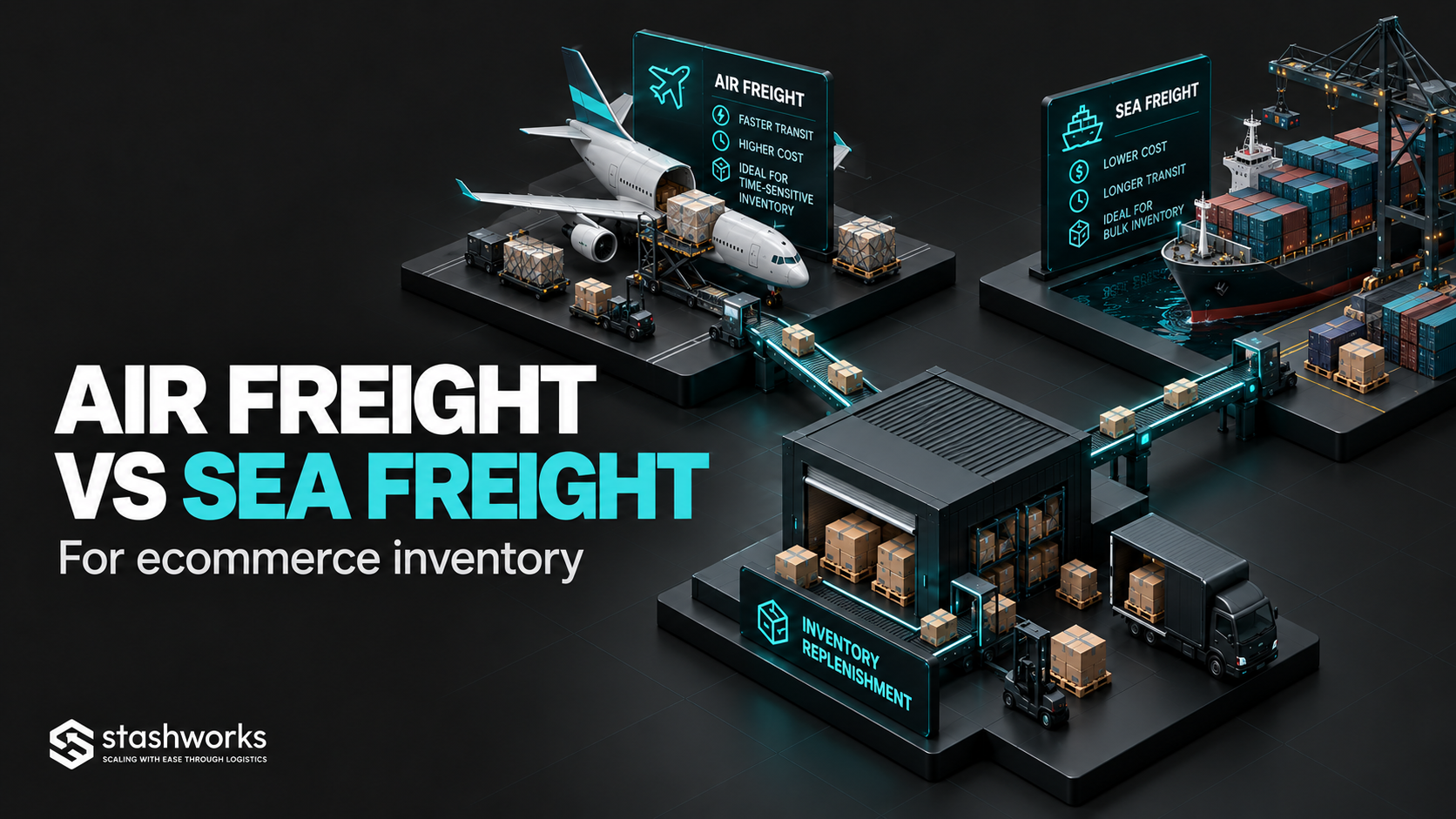
Air freight usually prioritises speed
Air freight can shorten the international transport leg and is often considered for urgent replenishment, product launches, stockout recovery and smaller higher-value shipments.
The premium is transport cost. A business that relies on air for every replenishment may reduce inventory lead time but spend substantially more per unit moved.
Sea freight usually prioritises capacity and unit economics
Sea freight is commonly used for larger or heavier cargo and less time-sensitive replenishment. Containerised movement can make transport economics more attractive when the business can plan inventory far enough ahead.
The trade-off is longer and more variable total lead time. More inventory may need to be ordered earlier and held while the next shipment is still moving.
Do not use one universal transit-time number
Actual transit depends on origin, destination, routing, service, schedule, port or airport handling, customs processes and final delivery. Compare current quotes for the real lane rather than using a generic number from a blog post.
The operational comparison should use total door-to-warehouse lead time, not only the time the aircraft or vessel is moving.
Shipment size and density change the economics
Air freight pricing is sensitive to actual and volumetric weight. Sea freight can be structured as less-than-container-load or full-container-load depending on cargo volume and the service.
A small dense shipment, a bulky low-value product and a full container of replenishment stock should not be evaluated with the same assumptions.
Product value matters because inventory spends time in transit
Longer transport ties up inventory capital for longer. For high-value goods, the cost of capital and the commercial risk of having stock unavailable in transit can materially affect the comparison.
For low-value bulky products, paying a large air-freight premium can quickly exceed the economic benefit of faster arrival.
Stockout cost can justify a faster mode
If an important SKU will run out before a sea shipment arrives, the business can compare the air-freight premium with the expected cost of stockout: lost sales, campaign disruption, marketplace availability problems and customer-service work.
This is why freight choice should be connected to reorder points and inventory visibility rather than made by the logistics team in isolation.
Consider a hybrid replenishment strategy
Many businesses do not need to choose one mode permanently. A planned sea shipment can cover baseline demand while a smaller air shipment protects a launch, catches up after a supplier delay or bridges an unexpected demand spike.
The hybrid approach can preserve lower average transport cost without forcing the business to wait for the slowest replenishment path when stock is at risk.
Product restrictions and handling requirements matter
Dangerous goods, batteries, liquids, temperature-sensitive products, oversized cargo and controlled goods can have mode-specific requirements or restrictions.
Confirm acceptance, packaging and documentation with the forwarder and carrier before making a cost comparison. A theoretically faster service is irrelevant if the commodity cannot move under that service as packed.
Compare landed cost, not only the freight quote
Add insurance, origin charges, destination handling, customs-related costs, import GST or duty where applicable and final local delivery. Then allocate those costs to the units or SKUs in the shipment.
The calculation framework is covered in How to Calculate Landed Cost When Importing into Singapore.
Use a simple decision matrix
Connect the freight decision to the warehouse
The winning mode is the one that gets saleable inventory into the operation at the right time and total cost. Coordinate expected arrival with receiving capacity, product data and the warehouse inbound notice.
Stashworks' freight forwarding service supports import and export coordination and connects cargo movement to warehousing and fulfilment. For a quote, provide the real shipment dimensions, weight, origin, destination, commodity and required timing so air and sea options can be compared on the actual lane.
Sources: DHL, Choosing Between Ocean and Air Freight; DHL Global Forwarding, Ocean Freight; Stashworks, Freight Forwarding.