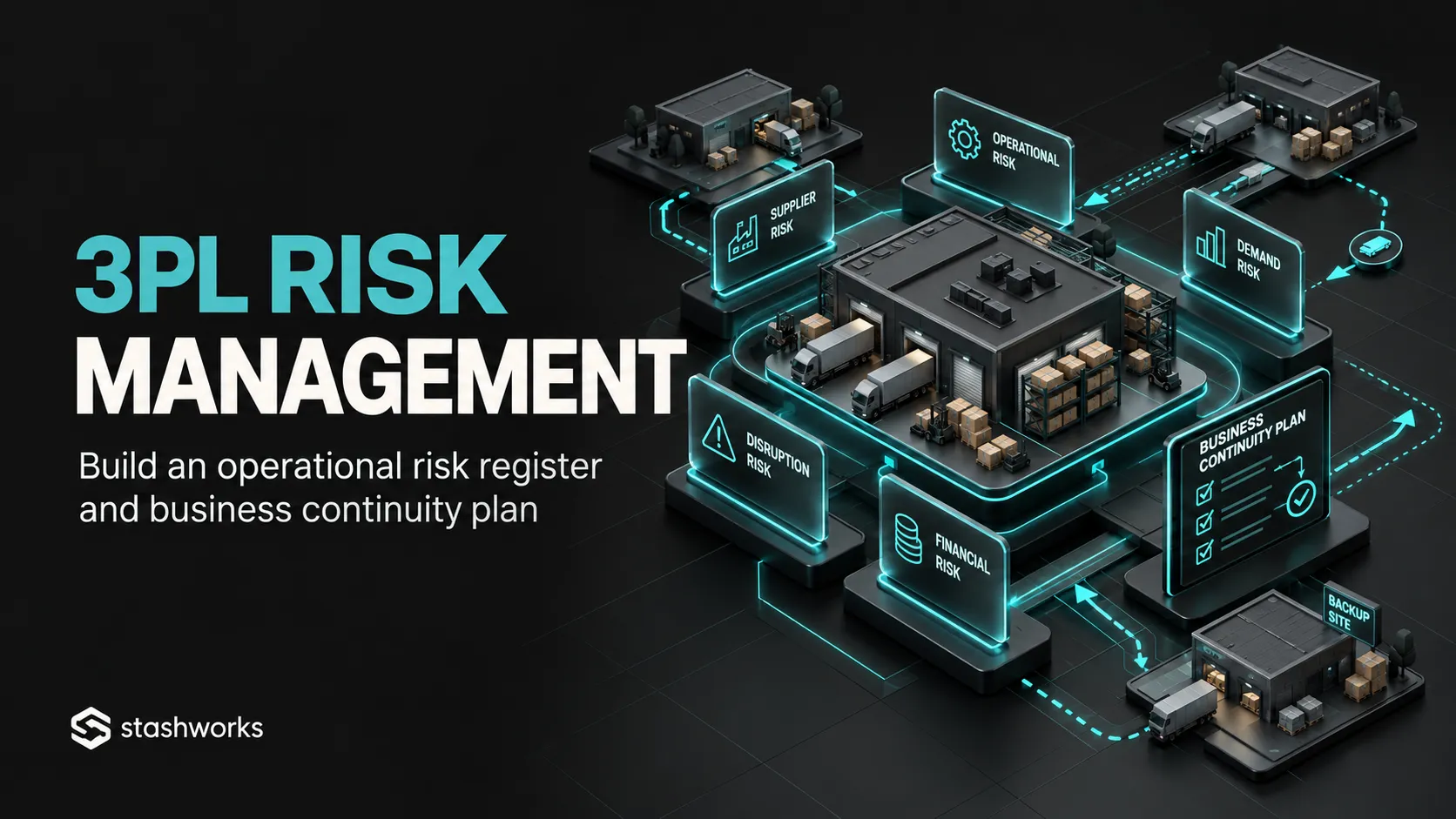
Outsourcing logistics transfers operational execution, but it does not transfer the brand's responsibility to understand business risk. A 3PL risk register makes disruption scenarios visible before they become emergencies, while a business continuity plan defines how critical fulfilment activity should be recovered.
The objective is not to predict every incident. It is to identify the failures that matter most and prepare proportionate responses.
Start with the critical customer promise
Define the activities the business cannot lose for long: receiving, inventory access, order ingestion, picking, packing, dispatch, returns, customer-service information and reporting.
These become the prioritised activities used in the business-impact analysis.
Build the risk register by operational layer
Separate facility, people, technology, inventory, carrier, supplier, cyber, data and commercial risks. A single line called “warehouse disruption” is too broad to manage.
Score likelihood and impact separately
Use a simple risk scale and define what each score means. Impact can include revenue, customer orders, inventory loss, regulatory exposure, data exposure and reputational damage.
A low-frequency risk can still be high priority if the consequence would stop the operation completely.
Map dependencies
Every fulfilment process depends on something else: electricity, internet, WMS access, marketplace integrations, carrier capacity, packaging supplies, warehouse labour and key product data.
Business continuity becomes more realistic when these dependencies are visible.
Set recovery priorities
Singapore's Ministry of Manpower describes business continuity planning around risk assessment, business impact analysis, continuity strategies, the plan itself and exercises. It also highlights prioritised activities, recovery time objectives, dependencies and resources.
Use that logic to decide which 3PL processes need to recover first rather than trying to restore everything simultaneously.
Define manual fallback workflows
For technology failure, determine which orders can be processed manually, how inventory changes are recorded, how duplicate fulfilment is prevented and how records will be reconciled after systems return.
A fallback that creates uncontrolled spreadsheets can make recovery harder than the outage itself.
Plan for integration failure separately from warehouse failure
The warehouse may remain operational while one marketplace or API connection fails. Define how orders are identified, whether selling should be restricted, how inventory buffers are handled and how missed events are replayed after recovery.
Protect inventory during disruption
Inventory controls should cover fire, water, access restrictions, theft, damage, temperature issues where relevant and prolonged system unavailability. Define who can quarantine stock and who can authorise write-offs or movement.
Identify carrier alternatives
If last-mile delivery is critical, document the primary courier routes and any alternative network available for priority orders. The business does not need a duplicate carrier for every service, but it should understand where single points of failure exist.
Review packaging and supplier dependencies
A warehouse can have inventory and labour but still stop dispatch if labels, cartons, inserts or specialised packaging are unavailable. Include critical consumables in the risk register.
Include data and privacy risk
A 3PL can process customer names, addresses, order details and tracking information. The PDPC's guidance on managing data intermediaries highlights governance, risk assessment, service management and exit management when processing is outsourced.
Define access, permitted processing, incident notification, retention and deletion responsibilities in the agreement.
Write an escalation tree
List operational, technology, executive, carrier and customer-service contacts with decision rights. During disruption, teams should know who can pause fulfilment, reroute orders, approve emergency cost or communicate with customers.
Build communication templates
Prepare internal and customer-facing templates for major delay, system outage, inventory issue and delivery disruption. The message should reflect verified facts and avoid promising recovery times before they are known.
Exercise the plan
Enterprise Singapore and MOM both emphasise testing business-continuity plans. Run tabletop exercises using realistic scenarios such as WMS outage, facility inaccessibility or carrier disruption.
The purpose is to discover missing information while there is no real customer impact.
Track actions after every exercise or incident
Record what failed, who owns the corrective action, due date and verification method. A risk register that never changes after real incidents is not functioning as a management tool.
Ask the 3PL how its continuity model connects to yours
Do not assume the provider's internal BCP automatically covers your priorities. Discuss critical SKUs, sales channels, reporting needs, recovery sequencing and what information the brand receives during an incident.
Stashworks' current site describes connected inventory, order and warehouse visibility but does not publish a universal business-continuity commitment. Any recovery arrangement should therefore be confirmed for the specific account.
Sources: Ministry of Manpower, Business Continuity Planning; Enterprise Singapore, Business Continuity Planning; PDPC, Guide to Managing Data Intermediaries; Stashworks, 3PL Singapore.