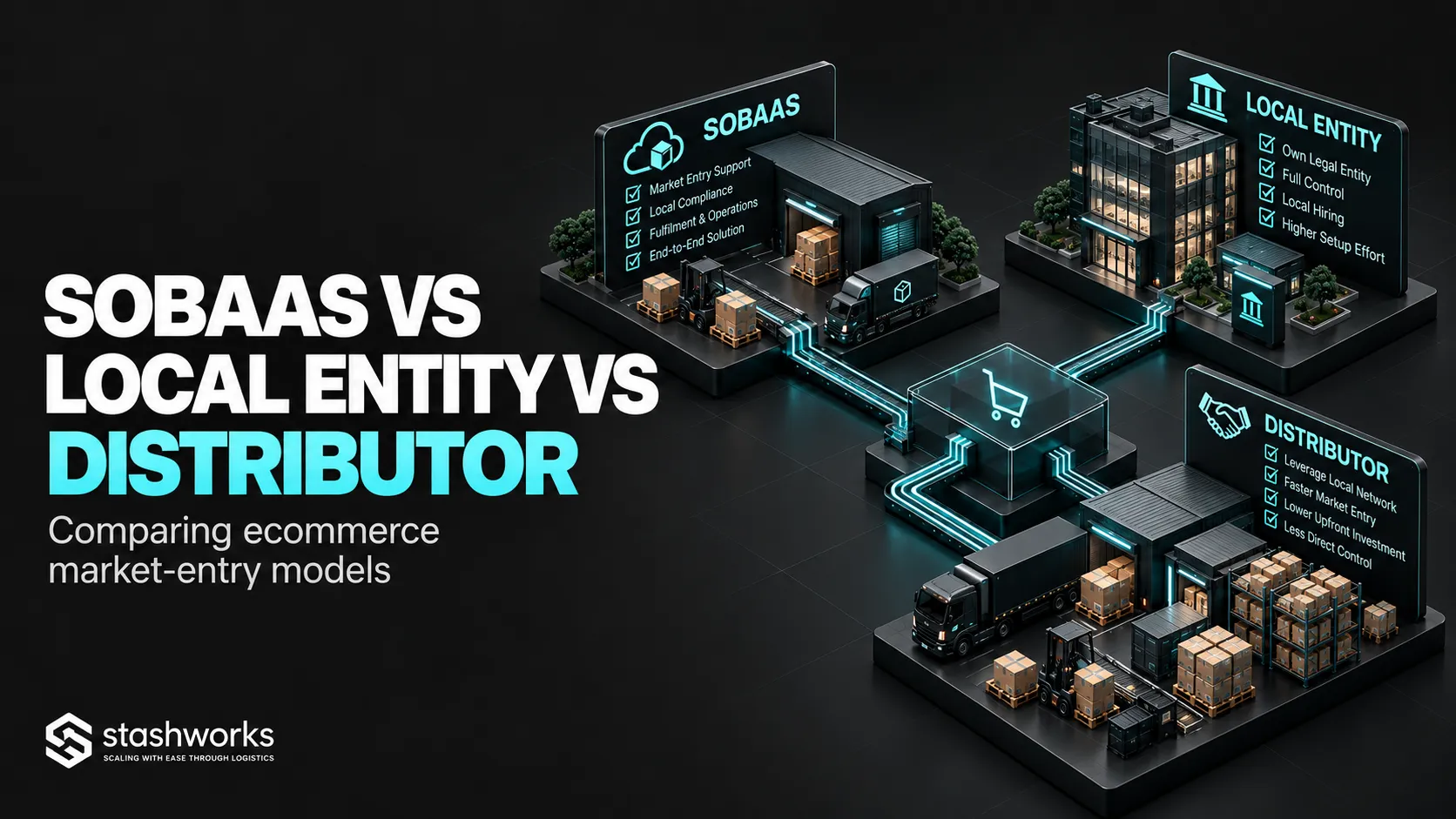
There is no single “correct” ecommerce market-entry structure. A brand can build its own local entity, appoint a distributor, or use a sell-on-behalf operating model. Each route changes who controls the customer relationship, who carries inventory, who manages local operations and which legal or compliance responsibilities sit with each party.
The right comparison starts with the commercial and operating model, not the label.
Three models solve different problems
A local entity gives the brand direct local presence and control. A distributor gives another business commercial responsibility to distribute the product under agreed terms. A sell-on-behalf model aims to help the brand enter through a coordinated local ecommerce and logistics arrangement without necessarily building the entire operating structure itself.
Stashworks' SOBAAS sits in the third category and is currently available for Singapore, Malaysia and Thailand, subject to market, product and scope suitability.
A local entity maximises direct control but creates direct obligations
Operating through your own local entity can give the brand direct control over marketplace accounts, contracts, employees, banking, inventory, customer relationships and local commercial decisions.
That control comes with setup and ongoing responsibilities. In Singapore, ACRA currently distinguishes routes such as a local subsidiary and a foreign-company branch, with different legal status and filing requirements. Additional permits or licences can also apply depending on the business activity and product.
A distributor changes the commercial relationship
A distributor generally operates under a commercial agreement to market and resell products in a territory or channel. The exact structure can vary substantially: some distributors purchase inventory, some have exclusivity, some manage marketing, and some handle only selected accounts.
Because these terms are contractual, brands should not assume that a distributor automatically controls every marketplace or that it automatically takes every regulatory responsibility. The agreement should state territory, channels, pricing rights, stock ownership, marketing obligations, returns, compliance responsibilities and termination.
A sell-on-behalf model is built around coordinated execution
Stashworks describes SOBAAS as a market-entry solution that can combine market-entry setup, marketplace operations, local inventory and fulfilment, delivery, returns and agreed customer support.
The value proposition is reduced operating complexity at launch. The brand does not have to independently coordinate as many separate functions before testing the market. However, the exact selling and compliance arrangement still needs to be confirmed for the proposed market and product category.
Compare the models by control and commitment
The table below is a decision framework rather than legal advice. Actual rights depend on the contract and local law.
Who should own the marketplace account?
This is one of the most important questions. Account ownership affects data access, reviews, advertising history, customer communication, catalogue control and the ability to switch operating partners later.
If the account is not owned by the brand, document what happens to listings, ratings, content, customer data, advertising assets and access when the relationship ends. Platform terms and local selling eligibility also need to be respected.
Who is the seller in the customer transaction?
The commercial structure needs to identify which party makes the sale to the customer. That decision can affect invoicing, tax, consumer obligations, marketplace onboarding and who bears refunds or chargebacks.
Do not infer the seller-of-record position from the service name. Confirm it explicitly for the market and channel, then obtain legal and tax advice where needed.
Who imports the goods?
Local inventory requires an import process. In Singapore, Singapore Customs defines the importer as the party bringing goods into Singapore, and import permit applications require the appropriate UEN and activated Customs account.
The operating agreement should state who acts as importer, who prepares product and shipment documents, who pays import GST or duty where applicable, and who handles category-specific licences or permits.
Who owns inventory after it arrives?
A distributor may buy inventory and carry stock risk, while a local entity or sell-on-behalf arrangement may leave ownership with the brand or allocate it differently. There is no safe generic assumption.
Document title transfer, damage risk, shrinkage, obsolete stock, return ownership and what happens to remaining inventory if the relationship ends.
Product compliance can change the feasibility of each model
Some products need local notifications, registrations, licences or approved importers. Singapore examples include cosmetic notification through HSA, food-import licensing or registration through SFA, and registration requirements for controlled household goods under the Consumer Protection (Safety Requirements) Regulations.
Those obligations can determine which party must hold a local registration or whether a proposed structure is workable at all.
Tax cannot be reduced to “do I have a local company?”
GST and other tax obligations depend on the transaction, supply chain and registration rules. IRAS has specific rules for overseas entities importing goods for local supply as well as overseas vendors supplying low-value goods to Singapore consumers.
That means an overseas business may have Singapore GST obligations even when it has not incorporated a standard local subsidiary. Obtain tax advice for the actual flow of goods and sales.
Choose based on the stage of market entry
A distributor can be attractive when the brand wants a commercial partner with established local channels and is comfortable delegating more control. A local entity can make sense when demand is proven and direct control justifies the ongoing structure. A sell-on-behalf model can be useful when the brand wants to test or expand into a supported market through a coordinated operating arrangement before building the full local organisation.
The correct choice can also change over time.
Use a weighted decision matrix
Score each model against control, setup time, upfront cost, ongoing cost, regulatory fit, marketplace ownership, customer data, inventory risk, scalability and exit flexibility. Weight the factors according to the brand's strategy.
A company focused on rapid validation may weight speed and low commitment heavily. A company with a long-term regional strategy may put more weight on direct ownership and control.
Do not choose before defining the exit
Ask what happens if the test fails or the market-entry model changes. Can inventory be transferred? Who owns listings and content? What happens to customer-service records? How quickly can marketplace access be removed? Are there minimum commitments or termination costs?
The exit scenario often reveals risks that are hidden during an optimistic launch discussion.
General information only: Market-entry structures create legal, tax and regulatory consequences that vary by country and contract. This article is not legal or tax advice.
Sources: Stashworks, SOBAAS; ACRA, Ways to set up foreign businesses in Singapore; Singapore Customs, Import Procedures Overview; IRAS, GST registration for overseas entities.