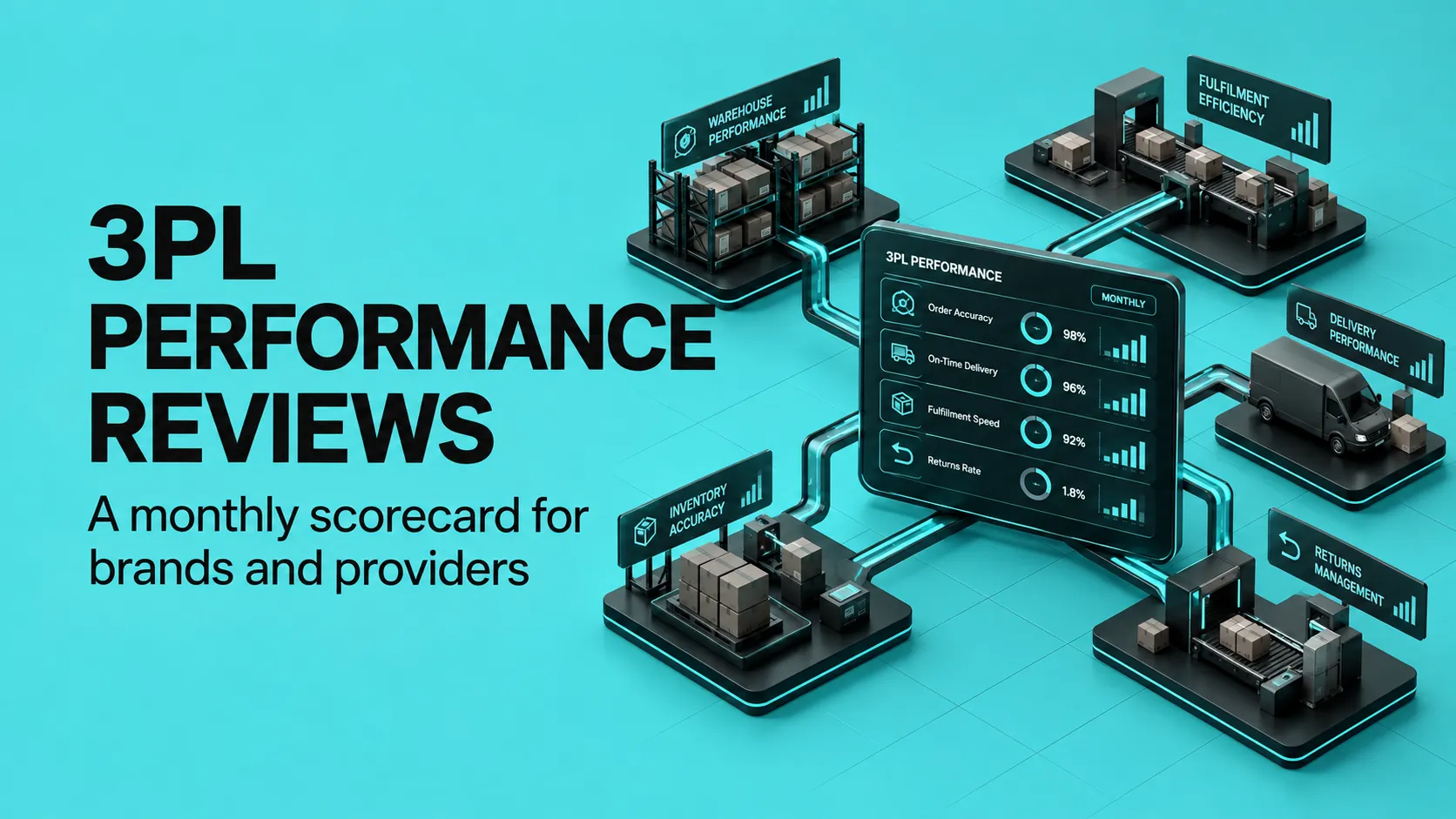
A monthly 3PL review should do more than present a dashboard. Its purpose is to explain what changed, identify risks early and assign corrective actions before operational issues become customer problems.
The strongest scorecard combines outcome metrics with context, exceptions and open actions.
Start with the agreed scope
Only measure services the provider actually owns. If the 3PL manages warehousing and fulfilment but not paid advertising or purchasing, those outcomes do not belong on its operational scorecard.
Map the scorecard to the statement of work and SLA definitions.
Review inbound performance
Track planned versus received shipments, receiving discrepancies, unexpected deliveries and ageing of unresolved inbound exceptions.
A late putaway metric is only useful if the starting point and required inbound information are defined.
Review inventory accuracy
Include cycle-count results, unexplained variances, quarantined inventory and long-running discrepancies. Separate resolved errors from open investigations.
For high-value or high-velocity SKUs, consider showing material exceptions individually rather than hiding them inside one average.
Review fulfilment accuracy
Track incorrect SKU, quantity, bundle or packing errors according to the agreed definition. Pair the number with root cause and corrective action where a pattern exists.
Review order processing and dispatch
Measure qualifying orders against the agreed processing or handover standard. Separate warehouse delays from courier delivery failures.
If marketplaces have their own dispatch rules, keep those metrics visible because late handover can affect channel performance.
Review exception queues
Show ageing for unmatched orders, failed integrations, inventory discrepancies, address holds, returns awaiting disposition and other operational exceptions.
A small but old exception queue can be more serious than a larger same-day queue.
Review returns
Track return volume, processing status, disposition, restock rate where relevant and recurring reasons. Identify whether the root cause sits in product, fulfilment, delivery or customer expectation.
Review technology incidents
Record integration outages, delayed syncs, WMS issues and manual fallback events. For each incident, note impact, duration, recovery and whether follow-up work remains open.
Stashworks' current technology page describes connected order flow, inventory visibility, WMS workflows and tracking information; actual account-level reporting should be confirmed during setup.
Review last-mile outcomes separately
If delivery forms part of the service scope, track carrier handover, delivery exceptions, failed attempts, return-to-sender and claim status by carrier or service where useful.
This helps distinguish warehouse performance from downstream transport performance.
Review capacity and upcoming demand
Use the meeting to look forward. Discuss promotions, product launches, expected inbound shipments, peak periods, new channels and major catalogue changes.
A review that only explains last month can still allow next month's problem to arrive unplanned.
Review cost against the operating drivers
Compare invoice categories with order volume, storage, returns, project work and delivery mix. Investigate material variance rather than asking the provider to explain every small movement.
If cost is rising because the order profile changed, record that separately from an unexplained billing issue.
Track project and onboarding work
New integrations, packaging changes, warehouse moves and catalogue cleanup need their own milestones and owners. Do not bury projects inside the monthly operational metrics.
Use red, amber and green carefully
Status colours can help focus attention, but define the thresholds. A metric should not be “green” because the provider feels comfortable with it.
Use the underlying number and trend beside the colour.
Maintain one corrective-action log
Every material issue should have an owner, action, due date and verification step. Keep actions open until the fix has been tested, not merely discussed.
This creates continuity between monthly meetings.
Separate SLA misses from improvement opportunities
Some issues breach a contractual service level; others are process improvements that sit outside the SLA. Label them differently so governance remains fair.
Review trend, not only current-month performance
Show three- or six-month trends for key metrics. A small recurring decline can be more important than one unusually bad month.
End with decisions
The review should finish with decisions about staffing, process change, integration work, inventory action, carrier changes or commercial scope. A scorecard without decisions becomes reporting theatre.
Where Stashworks fits
Stashworks' live site emphasises visibility across inventory, orders, fulfilment activity and delivery status within a connected 3PL operation. It does not publish a universal monthly scorecard, so the final review format should be agreed for the specific operation.
Use 3PL Service-Level Agreements to define the measures before building the monthly review.
Sources: Stashworks, 3PL Singapore; Stashworks, Technology.