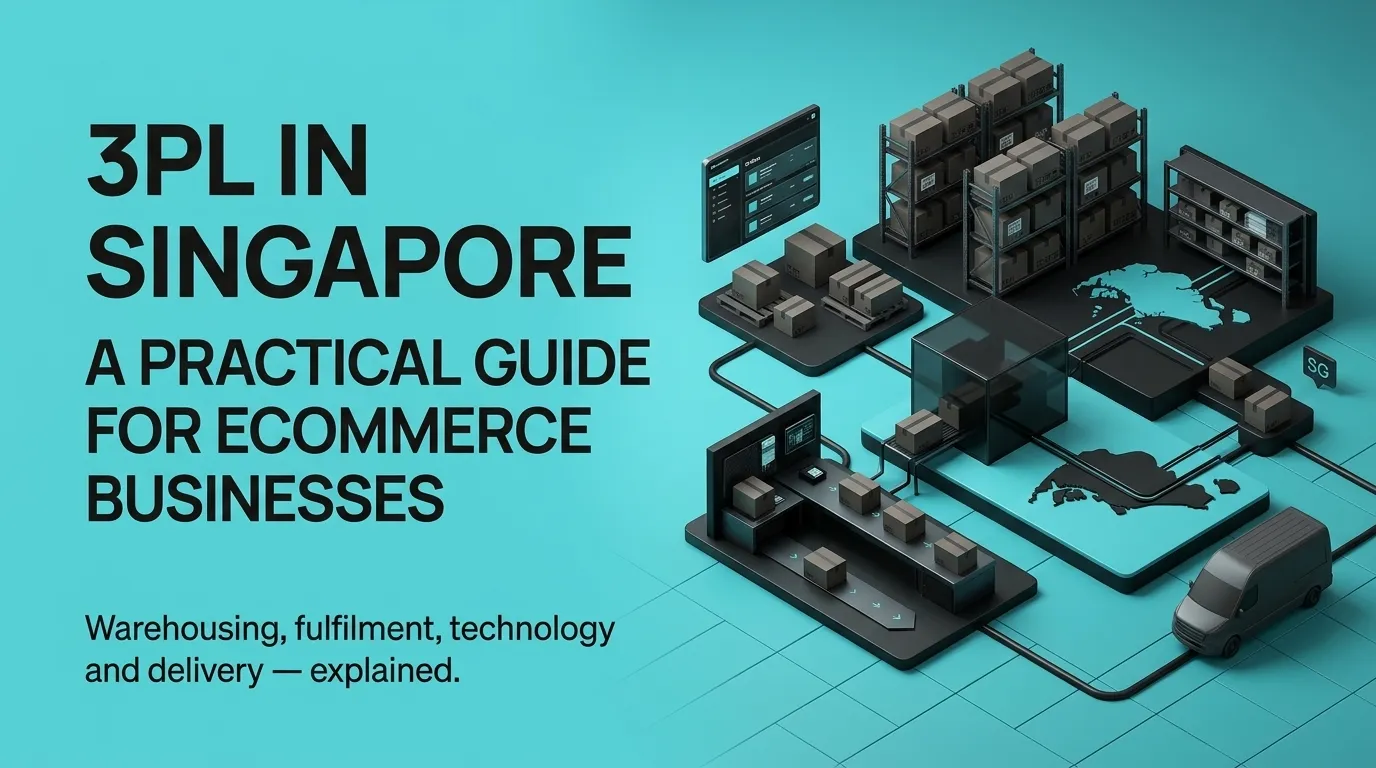
For an ecommerce business, “using a 3PL” can sound like a simple decision to outsource packing. In practice, it changes how stock enters the business, how orders move between sales channels and the warehouse, and how customer promises are turned into daily operating instructions.
The model matters in Singapore because online retail is no longer a niche channel. SingStat estimated that online sales represented 14.8% of total retail sales in December 2025, and 17.0% when motor vehicles were excluded. That does not mean every seller needs an outsourced warehouse. It does mean fulfilment needs to be treated as an operating system rather than an afterthought.
This guide explains what a third-party logistics provider actually does, where its responsibilities begin and end, and what a Singapore ecommerce business should understand before requesting a quotation.
What a 3PL does—and what it does not
A third-party logistics provider performs logistics activities on behalf of another business. For ecommerce, the usual scope begins when inventory arrives at the warehouse and continues through storage, order processing, picking, packing and handover to a delivery carrier. Some providers also coordinate freight, returns, kitting, relabelling or marketplace operations.
A 3PL is therefore broader than a courier and more operational than a storage-only warehouse. A courier transports a parcel that is already ready to move. A storage facility may hold pallets without touching individual customer orders. A fulfilment-focused 3PL connects stock, order data, warehouse work and delivery handover.
Provider typePrimary jobWhat the client still managesStorage warehouseHolds cartons, pallets or unitsOrder processing, packing and carrier coordinationCourierCollects and transports parcelsInventory, picking, packing and shipment preparation3PL fulfilment providerCoordinates warehouse and order-fulfilment activitiesDemand planning, product decisions, channel strategy and agreed exceptions
The distinction is important when comparing prices. A delivery rate cannot be compared with a fulfilment fee unless both cover the same work.
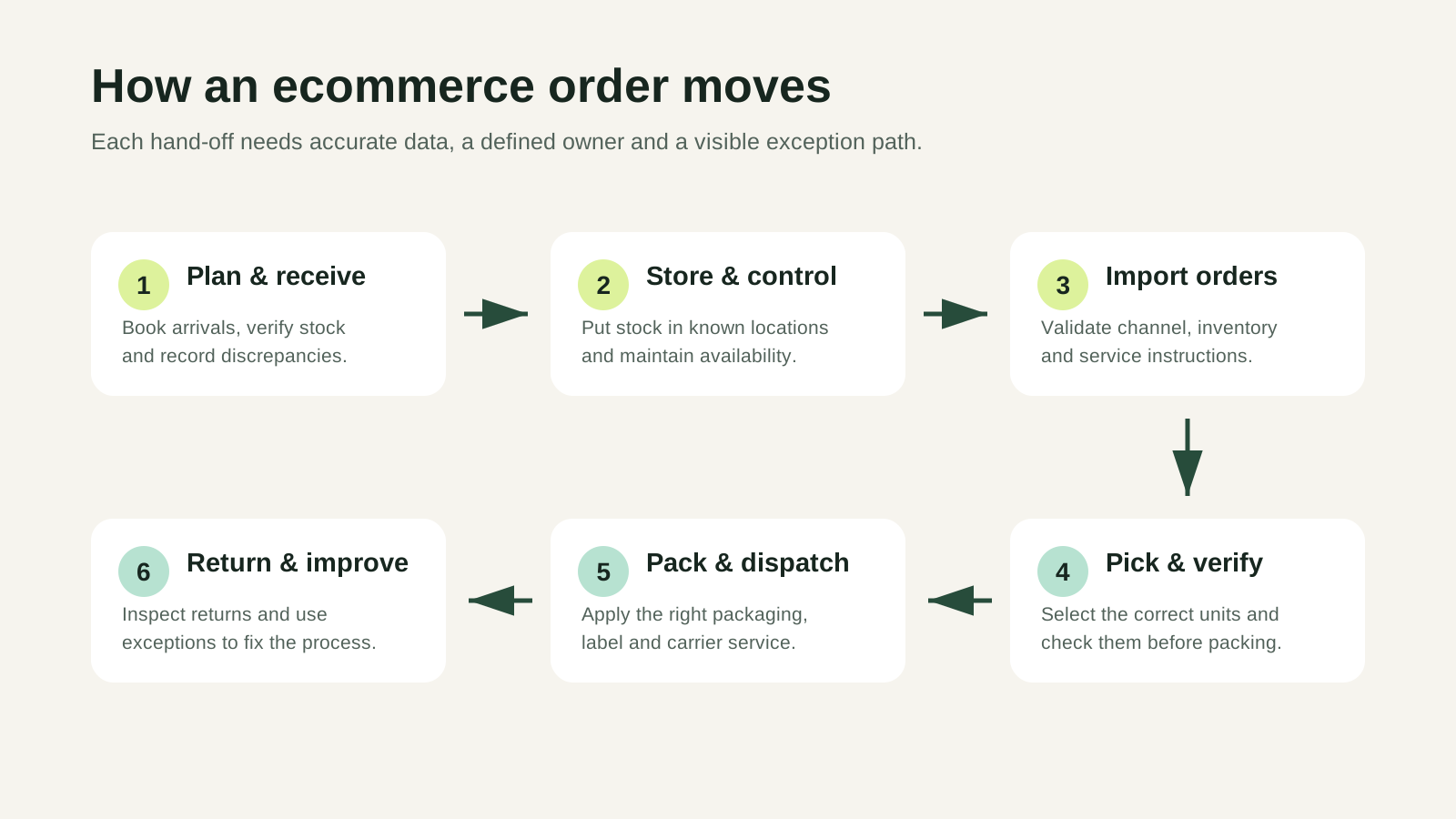
How the ecommerce fulfilment workflow operates
The customer sees a checkout page and a delivery notification. Behind that simple experience is a series of handovers that must agree with one another. The quality of a 3PL relationship depends less on any single step than on whether the whole chain remains accurate.
Inventory is prepared before it arrives
The process begins with product data, not the truck at the warehouse door. The provider needs a clean SKU list, barcode information, product dimensions, handling instructions and an inbound packing list. If cartons arrive without labels or contain unexpected mixed stock, receiving becomes slower and discrepancies become harder to resolve.
Once goods arrive, the warehouse checks them against the submitted information. The agreed scope may include counting cartons, counting individual units, inspecting visible damage or performing more detailed quality checks. These are not interchangeable activities, so the receiving standard should be documented.
Stock becomes available in the inventory system
After receiving and putaway, units are assigned to warehouse locations and recorded in the inventory system. The ecommerce business should be able to understand what is available, reserved, damaged, returned or awaiting investigation. A single “stock on hand” number is not enough if the states behind it are unclear.
Stashworks describes a web-based inventory system that lets clients view orders, monitor stock across its fulfilment centres, receive low-stock notifications and use reports and analytics. Its published workflow also describes QR-assisted picking and a second verification during packing. The current details are available in the Stashworks WMS overview.
Orders move from the sales channel to the warehouse
Orders may enter through a direct ecommerce integration, marketplace connection, open API or agreed file-based process. The important questions are what information moves, how frequently it moves and how changes are handled. A connection that imports new orders but not cancellations, address changes or bundles may still leave substantial manual work.
Stashworks states that its WMS pulls marketplace orders every 30 minutes after integration. Businesses with time-sensitive dispatch promises should confirm how that published interval works for their specific platform and what happens when an order changes after it has entered the warehouse queue.
The warehouse picks, verifies and packs
A picking list tells the warehouse which SKU and quantity to retrieve. Scan-based checks can reduce the risk of selecting a visually similar item, but the process still depends on accurate barcodes and locations. During packing, the items can be verified again, protected for transport and prepared according to the brand’s instructions.
Packaging rules should cover more than box size. They may need to define branded materials, inserts, fragile protection, bundle presentation, gift messages and what to do when a preferred material is unavailable. The goal is repeatability: a clear rule should produce the same result regardless of who is working at the packing station.
The parcel is released to a carrier
The 3PL prepares the shipment label and documents, then hands the parcel to the selected carrier. From that point, the warehouse and courier responsibilities meet. A useful operating agreement explains collection cut-offs, tracking updates, failed deliveries, damaged parcels and the escalation route when the carrier does not perform as expected.
Which activities can Stashworks support?
Stashworks’ live website lists freight forwarding, warehousing, fulfilment, last-mile delivery, consolidation, order management, live commerce, ecommerce management, kitting and custom solutions. Its fulfilment description specifically includes picking and packing, while its warehousing description includes storage and quality checks on receipt.
Those published capabilities provide a starting point, not a substitute for scoping. A business should still confirm product restrictions, service levels, integration behaviour, packaging rules, returns processes and pricing for its own operating profile. Review the current Stashworks service list before a discovery call.
When the 3PL model tends to make sense
There is no universal order-volume threshold. A seller with a few straightforward SKUs may handle hundreds of orders efficiently, while a multi-channel business with bundles, fragile products and frequent campaigns may struggle at a lower volume.
The model becomes relevant when logistics creates a persistent constraint. Typical signals include unreliable stock records, staff repeatedly diverted into packing, insufficient storage, campaign backlogs, increasing error rates or the need to enter Singapore without building a local warehouse operation.
Outsourcing is not automatically cheaper. It changes the cost structure by replacing some rent, equipment, staffing and software commitments with service charges linked to storage and activity. The right comparison includes the total internal operation, not only warehouse wages.
What information a 3PL needs from you
A useful proposal can only be built from a realistic operating profile. Giving every provider the same information also makes quotations easier to compare.
Prepare the following before requesting a quote:
- Monthly order volume and expected campaign peaks
- Total active SKUs and planned product launches
- Average order lines and units per order
- Product dimensions, weights and handling requirements
- Average and peak storage footprint
- Sales channels, integrations and destination markets
- Packaging, kitting, returns and quality-control requirements
Amazon Singapore’s official 3PL selection guidance similarly recommends assembling monthly volume, basket size, SKU count, product measurements, common combinations and ecommerce software before approaching providers.
How to judge whether the operation is under control
Visibility should extend beyond a dashboard. Ask how receiving differences are recorded, how the system prevents or detects picking mistakes, when stock changes become visible, how failed integrations are identified and who owns an exception until it is resolved.
Agree on a small set of operating measures that match the customer promise. These might include inventory discrepancy rate, order accuracy, orders released within the agreed window, return-processing time and the age of unresolved exceptions. The exact targets must come from the contract; they should never be assumed from a marketing page.
Next step: scope the operation before discussing price
A 3PL is not simply warehouse space rented by the month. It is a connected process that must translate orders into accurate physical movement. The best starting point is to document the current workflow, identify where it fails and define what success should look like after outsourcing.
If you are evaluating a Singapore fulfilment partner, share your SKU data, monthly and peak orders, storage needs, sales channels and special handling with Stashworks. That creates the basis for a scoped discussion rather than a misleading headline-price comparison.
For the governance layer behind a 3PL relationship, continue with 3PL Service-Level Agreements and One Integrated 3PL vs Multiple Logistics Providers.
Sources: Singapore Department of Statistics, Retail Sales December 2025; Amazon Singapore, Best Practices for Choosing a 3PL.