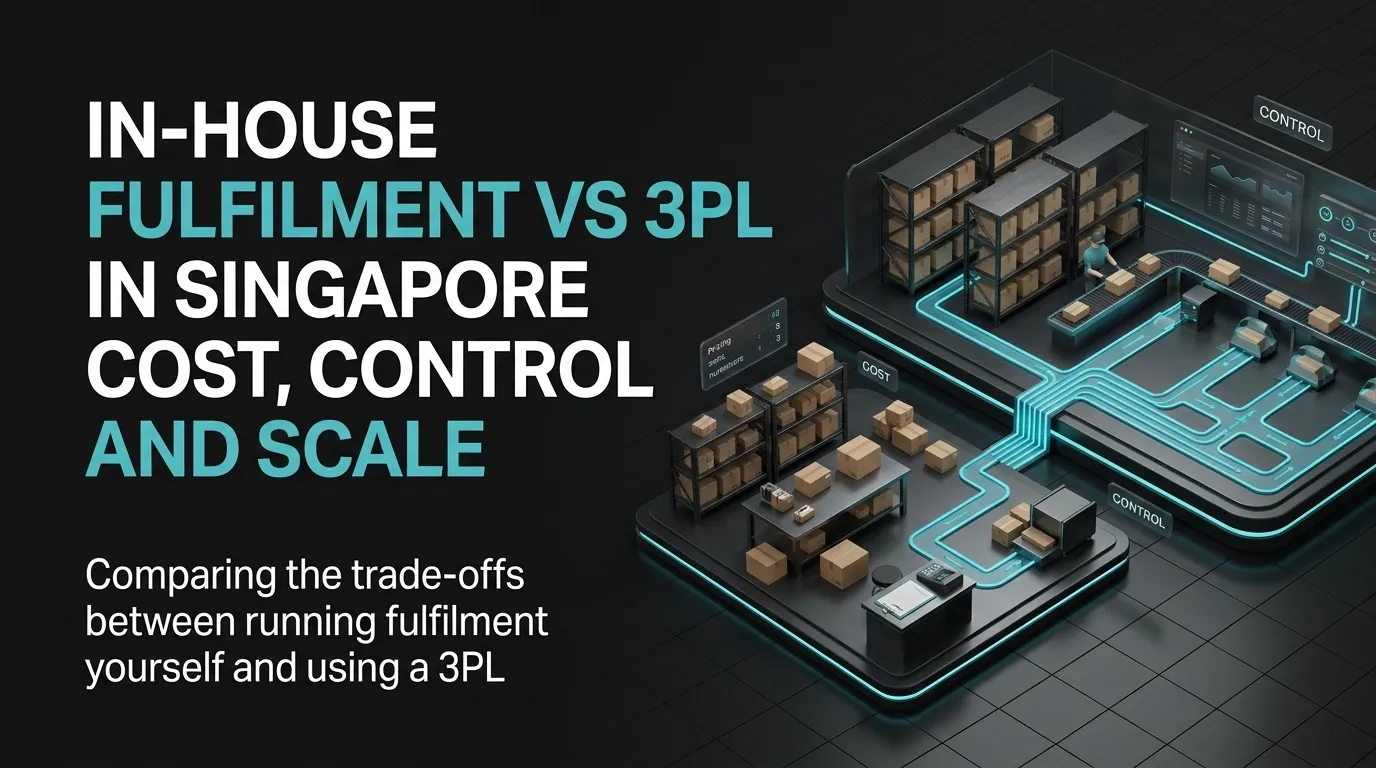
Choosing between in-house fulfilment and a third-party logistics provider is not a contest between “control” and “convenience”. Both models can provide excellent service, and both can fail. The meaningful question is which operating system gives the business enough control, capacity and information at a sustainable total cost.
For a Singapore ecommerce brand, the decision often becomes urgent when inventory outgrows informal space or campaign volumes expose the limits of a small packing team. At that point, comparing a 3PL pick-and-pack rate with one employee’s hourly wage produces the wrong answer. The two models include different infrastructure, risk and management responsibilities.
This guide compares the models across cost, control, technology, people, service risk and scalability, then provides a framework for deciding between in-house, outsourced and hybrid fulfilment.
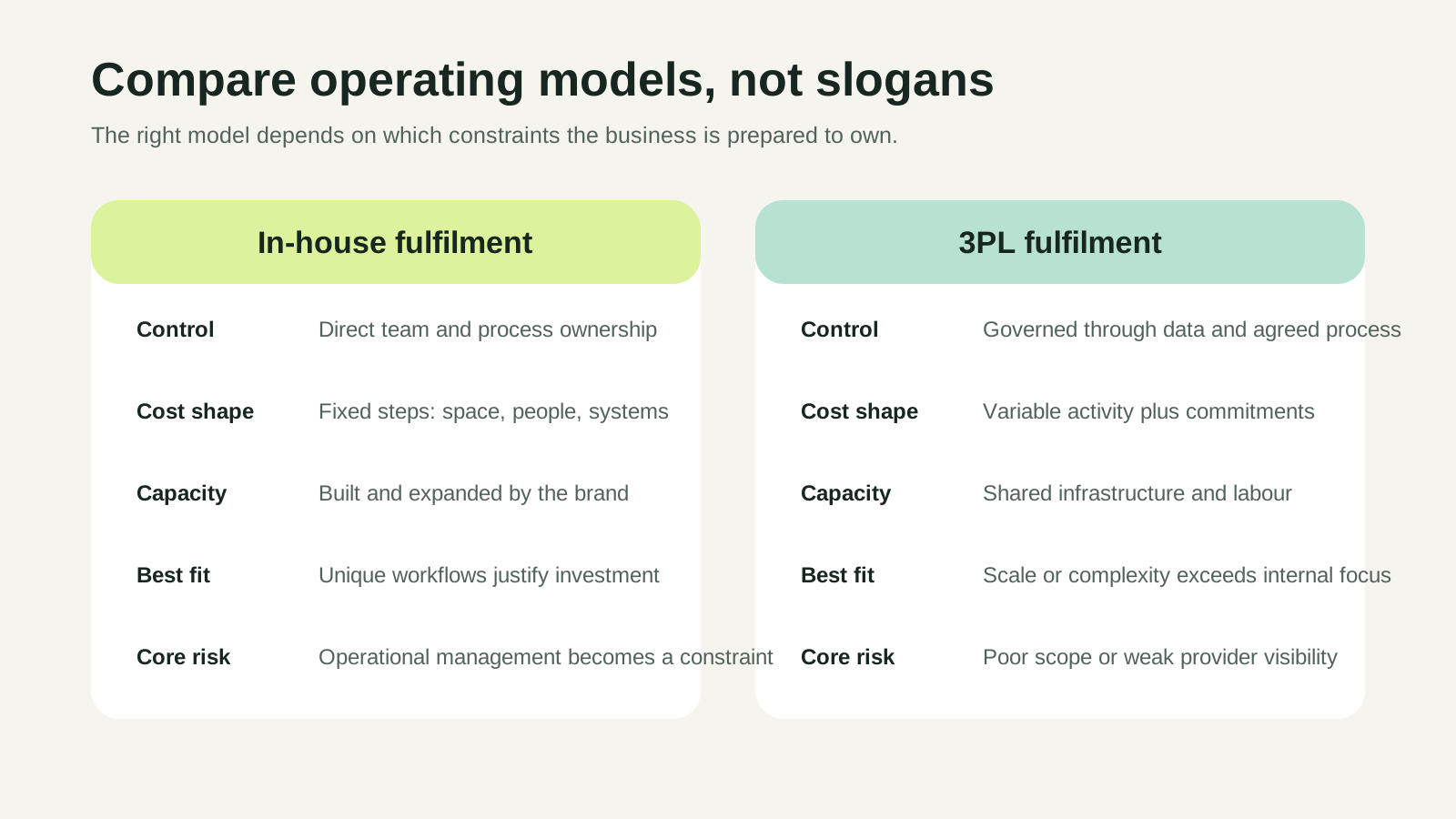
The fundamental difference is who owns the capacity
In-house fulfilment means the ecommerce business builds or leases the capability required to receive, store, pick and pack its own stock. The business owns the process, employs or manages the people and decides how much capacity to maintain.
With a 3PL, the business buys access to infrastructure and operating expertise shared across clients. It still owns the customer promise and inventory decisions, but the provider performs the agreed warehouse activities. Control moves from direct supervision towards documented processes, system visibility and service governance.
Compare the complete cost architecture
In-house operations can appear inexpensive because many costs are hidden inside existing departments. A spare room is treated as free space. A founder’s packing time is not costed. Customer service absorbs error recovery. Software administration sits with an employee whose role is not labelled “warehouse”.
A credible comparison gives both models the same volume, product profile, service promise and time horizon.
What belongs in the in-house model
The internal calculation should include the space and people required in a normal month and at peak. It should also recognise that capacity is purchased in steps: the next warehouse, employee or packing line may create more capacity than the business immediately needs.
Relevant costs include:
- Rent, deposits, utilities, service charges and insurance
- Warehouse staff, supervisors, payroll costs, leave and temporary peak labour
- Racking, trolleys, scanners, printers, workstations and maintenance
- Inventory, order-management, shipping and reporting software
- Packaging materials and storage for those materials
- Management time, training, safety processes and error recovery
What belongs in the 3PL model
A 3PL quotation usually separates activities that are bundled internally. Receiving, storage, picking, additional items, packaging, delivery, returns and project work may each have a different charging unit. Minimum monthly charges or onboarding costs may apply.
Use a representative order file and inventory profile rather than relying on headline rates. Model a normal month and a campaign month, then test what happens if order volume, units per order, parcel size or storage changes.
Control is not the same as physical proximity
Keeping inventory in the next room feels like control because problems can be seen and corrected immediately. That works when the operation is small and the people making decisions are close to the work. As volume grows, informal control can become dependence on a few individuals.
A well-governed 3PL relationship replaces proximity with explicit rules. Packaging standards, order cut-offs, return outcomes, stock adjustments and escalation responsibilities are documented. The client should be able to see inventory and orders without calling the warehouse for every update.
Stashworks states that its web-based system provides order and stock visibility, reports, low-stock notifications and ecommerce integrations. Its published WMS workflow describes QR-assisted picking, packing verification and client monitoring. A prospective client should still test how the dashboard, integrations and exception reports work for its own channels.
Customisation can favour either model
Highly variable personalisation, made-to-order work or frequent last-minute changes often favour an internal or hybrid process. The people making the product decision can speak directly to the person packing it.
Standardised brand presentation can work well with a 3PL when the rules are clear. Branded boxes, inserts, bundles, relabelling and quality checks can be repeatable warehouse instructions. Stashworks lists kitting, repacking and relabelling among its current services, but the exact method and charge need to be scoped.
The test is whether the requirement can be specified. If two employees would interpret the same instruction differently, an outsourced team will face the same ambiguity.
People and peak capacity often decide the result
An internal warehouse gives the business a dedicated team and deeper daily product familiarity. It also makes the business responsible for recruitment, training, scheduling, absenteeism, turnover and temporary campaign labour.
A 3PL can spread infrastructure and labour planning across clients. That can provide more flexibility, but capacity is not infinite. Ask how forecasts are collected, how campaign cut-offs are agreed, when extra packaging must arrive and what happens if actual demand materially exceeds the forecast.
Technology changes the nature of the relationship
In-house fulfilment allows the business to choose its own inventory, order and shipping tools. That freedom is valuable when the company has unusual workflows or an internal technology team. It also creates implementation, integration and support responsibility.
Outsourcing means connecting the commercial stack to the provider’s operating system. Confirm which data moves in each direction, how often it synchronises, how cancellations and bundles behave, who monitors failures and how historical data can be exported if the relationship ends.
A marketplace logo is not proof that the complete workflow works. Request a demonstration using realistic orders and exceptions.
Use three operating scenarios, not one average
Averages hide the exact circumstances that make fulfilment difficult. Model the business in three states:
- Normal trading: typical orders, items per order, storage and returns.
- Campaign peak: highest credible daily volume, promotional bundles and carrier constraints.
- Growth case: expected channels, SKUs, markets and volume in 12–24 months.
For each state, estimate cost, staffing, space, service risk and management attention. A model that wins in the normal month may be less attractive once the campaign or growth case is included.
When each model is usually strongest
The choice should follow the operating characteristics rather than a general belief that outsourcing or internal control is always superior.
In-house tends to be stronger when
Fulfilment is a genuine competitive differentiator, requirements change constantly, production and packing are inseparable, or the business has enough stable volume to use dedicated infrastructure efficiently.
A 3PL tends to be stronger when
Warehouse work is constraining the commercial team, demand fluctuates, professional systems are needed without a large upfront build, or the business needs a Singapore operating base without establishing its own facility.
A hybrid tends to be stronger when
Most orders are standard but a meaningful minority need personalisation, wholesale handling or launch-day control. The split must be visible to systems and customers; otherwise two fulfilment locations can create overselling and routing confusion.
Make the decision with an evidence pack
Prepare twelve months of order and inventory data, a campaign forecast, the full internal cost model and a written service requirement. Ask shortlisted providers to quote the same scenario and explain every assumption.
If the outsourced model remains stronger after that comparison, review Stashworks’ current fulfilment, warehousing and related services. A discussion based on real data will reveal far more than comparing isolated per-order rates.
Once outsourcing appears viable, convert the comparison into a decision paper with How to Build a 3PL Business Case for Management Approval.