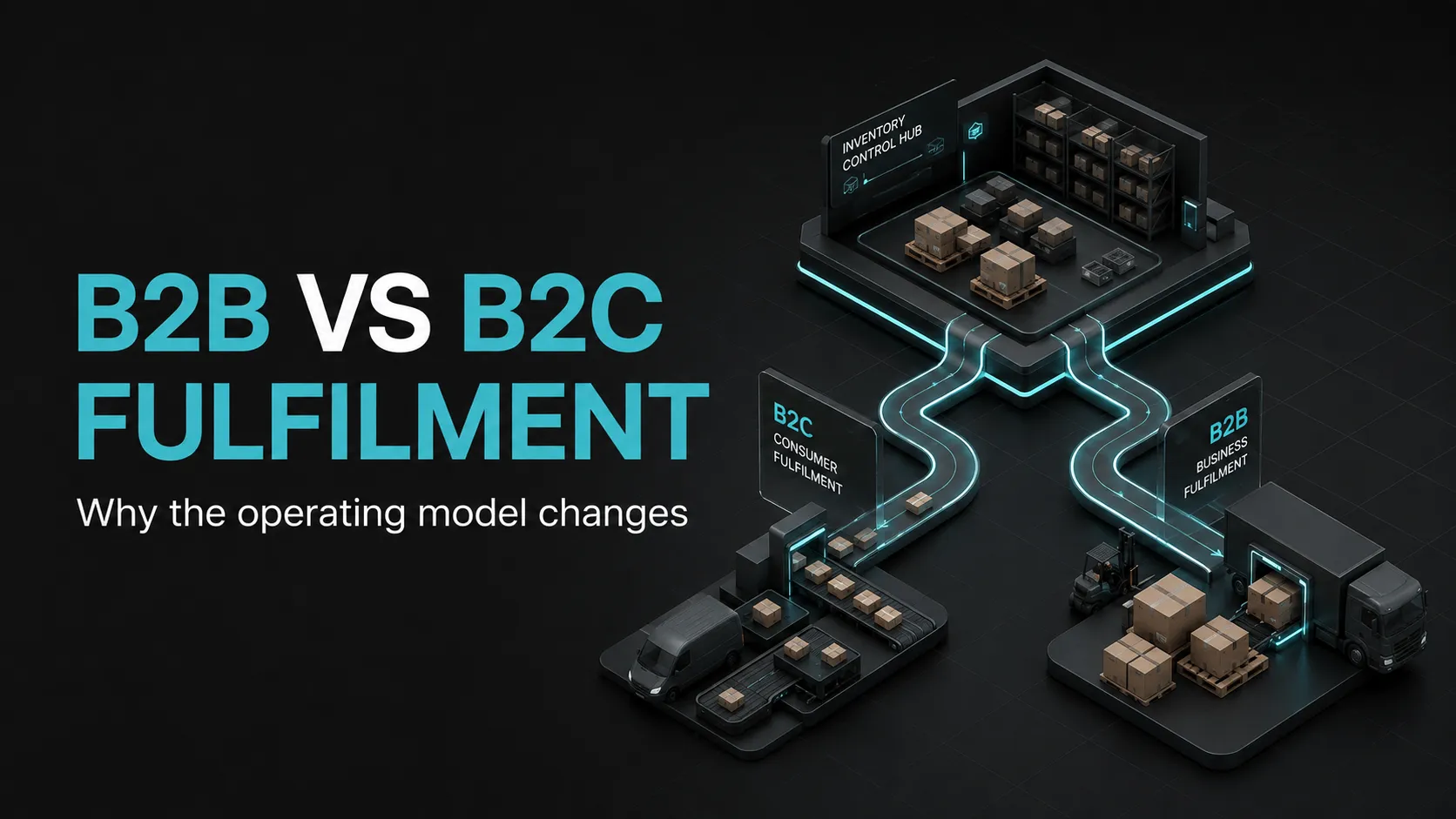
The same product can require two different fulfilment operations depending on who is buying it. A consumer might order one unit for home delivery. A retailer might order twelve cartons, require an advance shipping notice, specify a receiving window and reject the shipment if labels or paperwork are wrong.
That is why B2B and B2C fulfilment are not simply different order volumes. The receiver changes the rules of the warehouse. Brands that sell through both channels need one inventory view but often need separate workflows for order release, picking, packing, documentation and delivery.
B2C fulfilment optimises for many small customer orders
Business-to-consumer ecommerce usually involves frequent parcel-sized orders shipped to individual addresses. Orders tend to move quickly after purchase, packaging is designed for parcel networks, and the customer expects tracking and clear delivery communication.
The warehouse therefore focuses on unit-level picking, fast order processing, parcel labelling and consistent presentation across many individual shipments.
B2B fulfilment often handles fewer, larger and more specific orders
Business-to-business orders can involve cartons, cases, pallets or large quantities of individual units. The delivery may go to a retailer, distributor, office, warehouse or another commercial receiving point.
The physical shipment can be larger, but the operational complexity often comes from the receiver’s requirements: purchase-order references, carton labels, packing lists, delivery appointments, pallet configuration or specific documentation.
The picking method may need to change
A warehouse designed around single-unit ecommerce picks can become inefficient when a wholesale customer orders full cases. Conversely, an operation optimised for pallet movement may struggle with thousands of individual DTC orders.
Mixed-channel brands should define when the warehouse picks individual units, inner packs, cases or pallets. Product master data should support the relevant units of measure so that one “quantity” does not mean something different to sales and operations.
Packaging serves a different receiver
B2C packaging often has to balance protection, parcel size and brand presentation. B2B packaging may prioritise transport stability, efficient receiving and buyer-specific labels.
A retailer may want cartons configured by SKU and quantity for easier receiving. A consumer wants one complete order that looks intentional when opened. Using the same pack rule for both can create unnecessary work or non-compliant deliveries.
Delivery speed is only one part of the B2B promise
Consumer ecommerce frequently emphasises rapid delivery. B2B customers may care more about arriving complete, on the agreed day, within a receiving window and with the correct documents.
Shopify’s B2B fulfilment guidance makes this distinction: larger business orders often have more complex logistics and compliance requirements than consumer parcels.
Order release can follow different commercial rules
A B2C order may be released immediately after payment clears. A B2B order can depend on credit terms, purchase-order validation, account-specific pricing or a scheduled dispatch date.
The fulfilment system should know when the order is genuinely ready for warehouse work. If commercial approval and warehouse release are mixed together manually, large orders can be picked before the customer or finance team has completed the necessary checks.
Inventory allocation needs channel rules
When B2B and B2C customers draw from the same physical inventory, one large wholesale order can consume stock that was expected to support several days of consumer demand.
The business may need safety buffers, reserved stock, allocation rules or forecast visibility by channel. The correct approach depends on the commercial strategy; the warehouse should execute the rule rather than invent it.
Returns also differ
A consumer return often arrives as an individual parcel and follows a customer-facing return policy. B2B returns may involve bulk quantities, commercial claims, delivery discrepancies or agreed return authorisations.
Define the physical and financial workflow separately for each channel so that returned wholesale stock does not disappear into the consumer returns queue.
Technology should preserve one inventory truth while allowing different workflows
A mixed-channel operation benefits from consolidated visibility, but “one system” does not mean “one process”. Orders can share inventory data while using different rules for allocation, picking, documents, packaging and shipment.
This is where the connection between WMS / inventory technology and fulfilment operations matters. The system should make the order type visible before warehouse work begins.
Build requirements around the receiving party
When a brand adds a wholesale or retail-distribution channel, do not simply ask whether the 3PL “does B2B”. Give the provider sample orders and the buyer’s actual delivery specification.
Confirm units of measure, carton or pallet rules, labels, documents, delivery booking, claims and returns. Then test whether the warehouse can process B2B and B2C work without corrupting one shared inventory record.
A hybrid brand needs two service promises
The operational model should reflect the promise made to each customer type. B2C buyers expect a reliable parcel experience. B2B buyers expect the shipment to fit their receiving operation. Neither is inherently more demanding; the rules are simply different.
For a Singapore operation handling both, share representative B2B and B2C order files with Stashworks so the fulfilment scope, storage and delivery requirements can be designed around the actual mix.
Sources: Shopify, B2B Fulfillment; Shopify, B2B vs B2C Ecommerce.