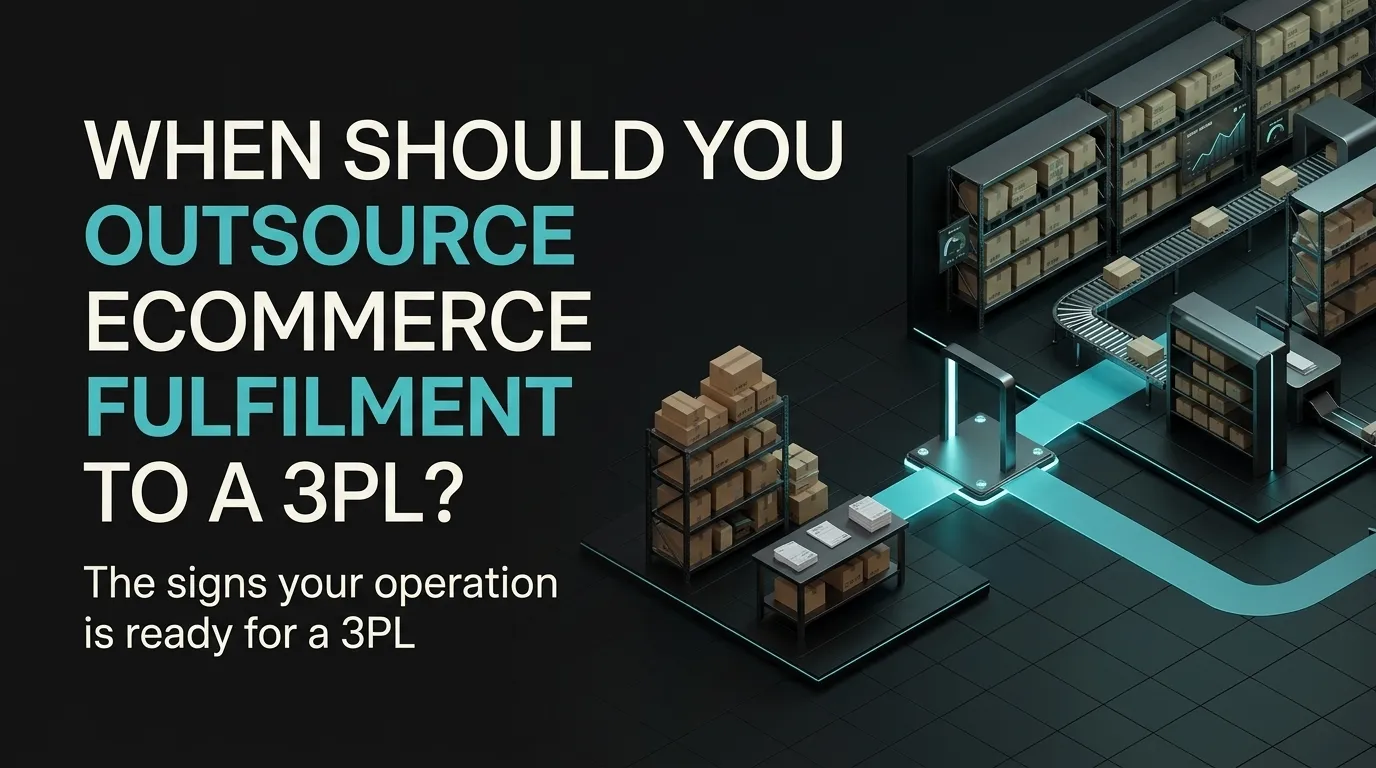
Most ecommerce businesses do not wake up one morning and discover that fulfilment has suddenly become unmanageable. The change is gradual. An extra sales channel adds another order feed. A campaign creates a temporary packing backlog. More stock arrives, but no one is certain which spreadsheet shows the correct quantity. Founders spend a growing part of the week solving delivery exceptions.
The right time to outsource is therefore not defined by a single order-volume threshold. It arrives when the current operation consumes more value, space or management capacity than the business should continue carrying—and when an external provider can take over the work without weakening the customer experience.
This guide provides a practical readiness test for Singapore ecommerce businesses, including the signs to watch, the numbers to calculate and the situations in which outsourcing may still be premature.
Start with the constraint, not the sales pitch
Outsourcing works best when it solves a defined operating problem. “We are growing” is not specific enough. The problem might be that orders miss carrier collection, inventory records are unreliable, the office has become a stockroom or key staff spend every afternoon packing instead of selling.
Write the constraint in measurable terms. For example: “During campaign weeks, 18% of orders remain unprocessed at the end of the next business day,” or “Two people spend a combined 55 hours each week on receiving, packing and courier coordination.” That statement becomes the basis for comparing an improved in-house process with a 3PL proposal.
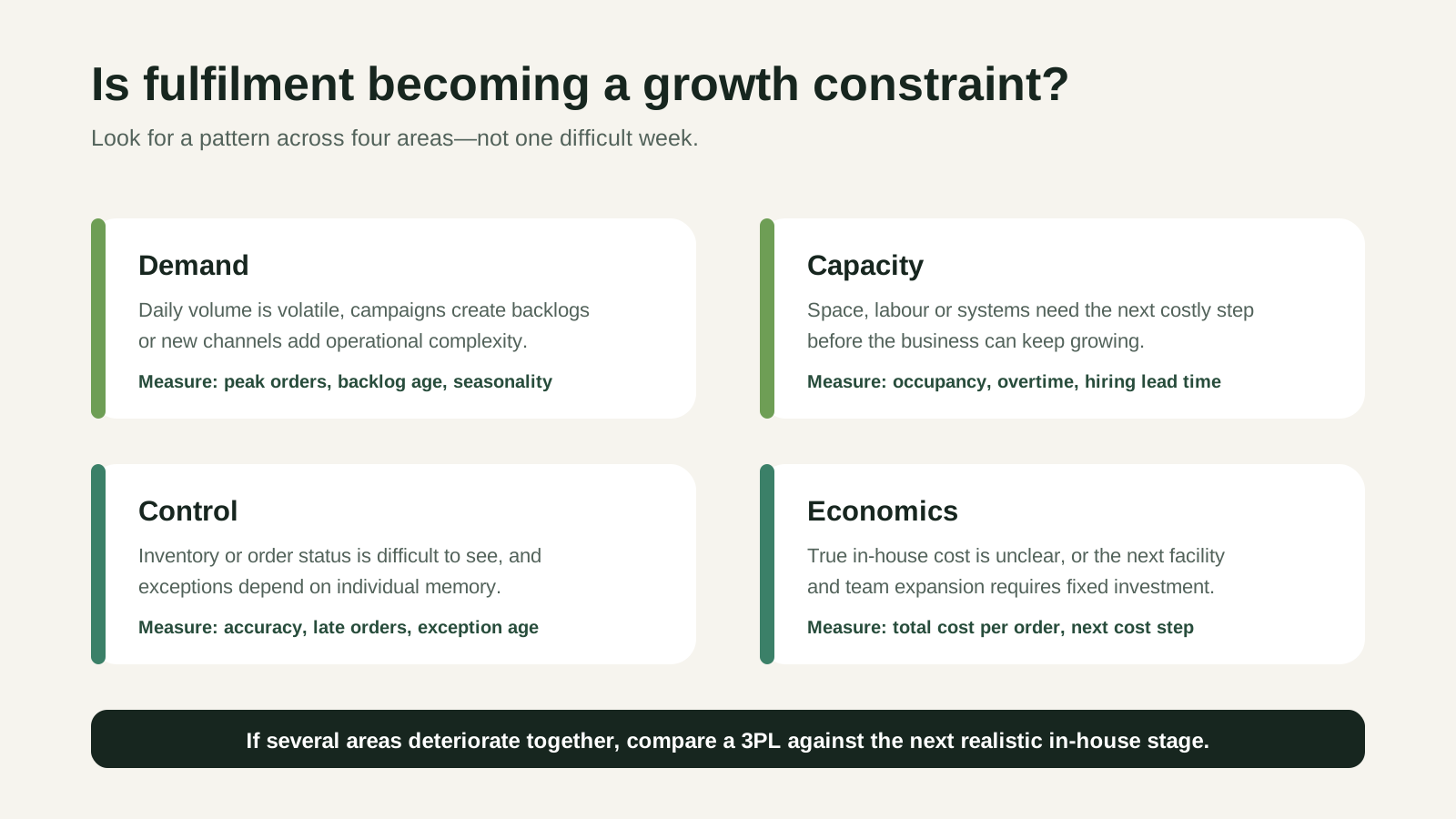
Seven signals that fulfilment is limiting the business
No single signal proves that a 3PL is the answer. Several occurring together, repeatedly, indicate that the current model deserves a formal review.
1. High-value staff are doing low-leverage warehouse work
Founder involvement is normal at an early stage. It becomes expensive when sales, marketing, product or customer-service work is regularly paused to receive cartons, print labels or chase collections. The wage cost understates the impact because it ignores the work those people are no longer doing.
Track the hours by task for four weeks. Separate routine fulfilment from genuine exceptions. If experienced staff are repeatedly needed because the process depends on unwritten knowledge, outsourcing alone will not fix it; the operating rules must be documented first.
2. Space is influencing purchasing and sales decisions
When inventory fills an office, retail unit or home, stock becomes slower to count and easier to damage or misplace. The business may begin delaying replenishment, restricting product launches or ordering uneconomically small quantities because there is nowhere to put the next shipment.
The alternative is not simply “rent a warehouse”. A dedicated facility brings deposits, utilities, shelving, packing stations, equipment, insurance, safety procedures, software and staffing. Compare that full commitment with outsourced storage and handling.
3. Campaign peaks create a service hangover
A successful promotion should not leave the business apologising for a week. Persistent backlogs, missed cut-offs, temporary labour chaos and a sharp increase in “Where is my order?” messages show that demand is exceeding operating capacity.
Measure the peak separately from the average month. A provider needs to understand the highest daily orders, the shape of the spike, expected notice and whether campaign orders contain more items or special packaging.
4. Inventory cannot be trusted
Overselling, unexplained stock differences and late replenishment decisions are symptoms of weak inventory control. More warehouse space will not resolve them. The business needs clear receiving, location, adjustment, return and stock-count processes supported by reliable system records.
Stashworks describes a web-based system with stock visibility, order monitoring, reports and low-stock notifications. Its published workflow uses QR scanning during picking and another verification at packing. Review the WMS overview, then confirm how the controls would apply to your products and channels.
5. Error recovery is absorbing customer-service time
A picking error costs more than the replacement shipment. It can generate customer contact, reverse logistics, repacking, inventory adjustments and reputational damage. If the business cannot explain where errors originate, it also cannot tell whether a proposed solution will reduce them.
Record mistakes by cause: wrong SKU, wrong quantity, missed instruction, damaged packaging, incorrect address or carrier exception. This evidence helps a prospective provider demonstrate the relevant controls.
6. Fixed costs are arriving before reliable demand
Hiring warehouse staff and signing a lease require capacity to be purchased in advance. If demand is seasonal or uncertain, the business carries that unused capacity during slower months. A 3PL usually turns a larger share of the operation into charges linked to storage and activity, although minimum commitments may still apply.
That flexibility has a price. It should be evaluated against the avoided fixed cost and risk, not presented as automatically cheaper.
7. Expansion requires an operating base you do not have
An overseas brand entering Singapore may need local receiving, storage, order processing and delivery without immediately forming an internal warehouse team. A local 3PL can provide that operating layer, but the brand remains responsible for product compliance, demand planning, channel management and clear fulfilment instructions.
Calculate the real in-house cost
Many outsourcing comparisons fail because the internal model includes only rent and packing wages. The 3PL proposal, by contrast, itemises almost every activity. Put both models on the same scope and time horizon.
Run the comparison for a normal month and a campaign month. A model that looks efficient at average volume may fail when labour or space reaches its practical limit.
When outsourcing may be premature
A 3PL cannot compensate for a business that has not defined its products and rules. Moving disorder into another warehouse often makes the disorder harder to see and more expensive to correct.
Outsourcing may be premature when:
- Order volume is very low and the process remains simple
- SKU and barcode data are incomplete or duplicated
- Products require production work that cannot be separated from fulfilment
- Packaging and returns decisions change from order to order
- The business cannot forecast even a broad normal and peak range
- A provider’s minimum commitment outweighs the value being created
A hybrid model can be appropriate. Standard ecommerce orders might move to a 3PL while highly personalised, wholesale or launch orders remain in-house until the workflow is stable.
A four-week outsourcing readiness test
Use a short measurement period to replace impressions with evidence. Avoid choosing a campaign-only period unless peaks are the main reason for the review.
- Track demand. Record orders, order lines, units, cancellations and returns by channel.
- Track effort. Measure receiving, putaway, picking, packing, administration and exception hours.
- Track service. Record order-processing time, errors, missed collections and customer contacts.
- Track capacity. Measure occupied space, labour bottlenecks and the highest sustainable daily volume.
- Track full cost. Allocate space, people, equipment, systems, packaging, delivery and failure costs.
Amazon Singapore’s official guidance makes the same central point: there are no hard-and-fast rules for when to outsource. It recommends assessing errors, processing backlogs, storage pressure, shipping expense and fulfilment labour before approaching providers.
What to ask a 3PL once you are ready
Share the evidence collected during the readiness test. Ask the provider to explain how its proposed workflow addresses the specific constraint, what information it needs, what assumptions shape the quote and how performance will be measured.
Stashworks lists warehousing, fulfilment, order management, last-mile delivery, freight forwarding, consolidation, ecommerce management and kitting among its current services. Use the service overview to identify the required scope before requesting a proposal.
Make the decision around value, not frustration
The worst time to select a 3PL is during an uncontrolled backlog, when the business is tempted to accept the fastest available solution. Measure the operation before the next crisis, define what must improve and compare the full cost of each viable model.
If fulfilment is persistently restricting growth, customer service or management capacity, contact Stashworks with your operating profile. A useful first discussion should test fit and assumptions—not force the business into a generic package.
If your main bottleneck is not physical fulfilment but seller-centre administration, listings, campaigns or customer support, compare the warehouse decision with Ecommerce Enablement Explained and When Should You Outsource Marketplace Operations?.
If management needs a formal approval case rather than an operational trigger list, use How to Build a 3PL Business Case. For businesses comparing one broader partner with several specialists, see One Integrated 3PL vs Multiple Logistics Providers.
Source: Amazon Singapore, Best Practices for Choosing a 3PL.