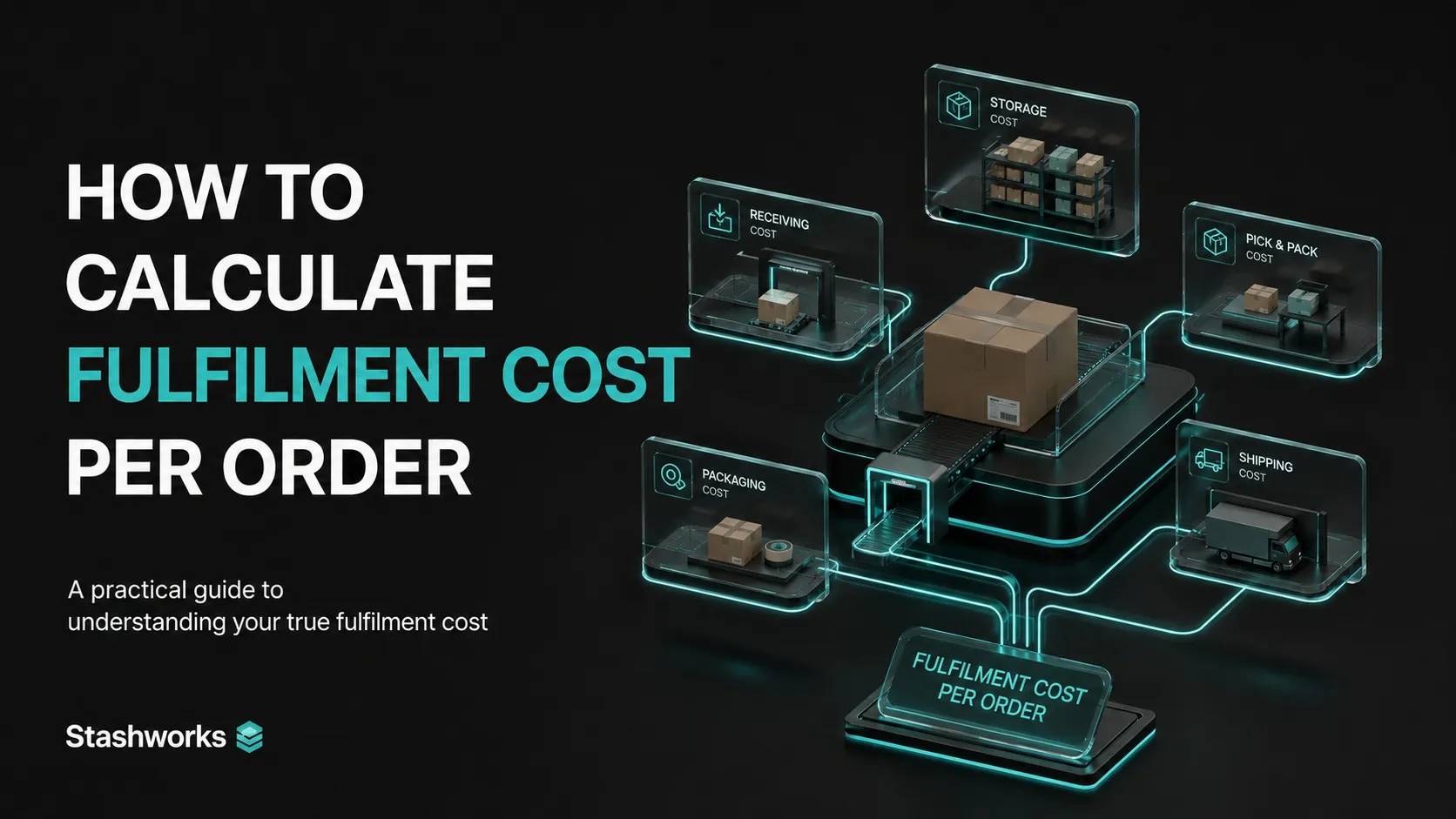
Fulfilment cost per order looks like a simple division problem. The usefulness of the result depends entirely on what is included. A business that counts packing wages but ignores warehouse space, receiving, systems and returns will produce a low number that cannot be compared fairly with a 3PL proposal.
The purpose of the metric is not only to report cost. It should help the business understand which activities drive margin, how campaign orders behave and whether an internal or outsourced model is improving.
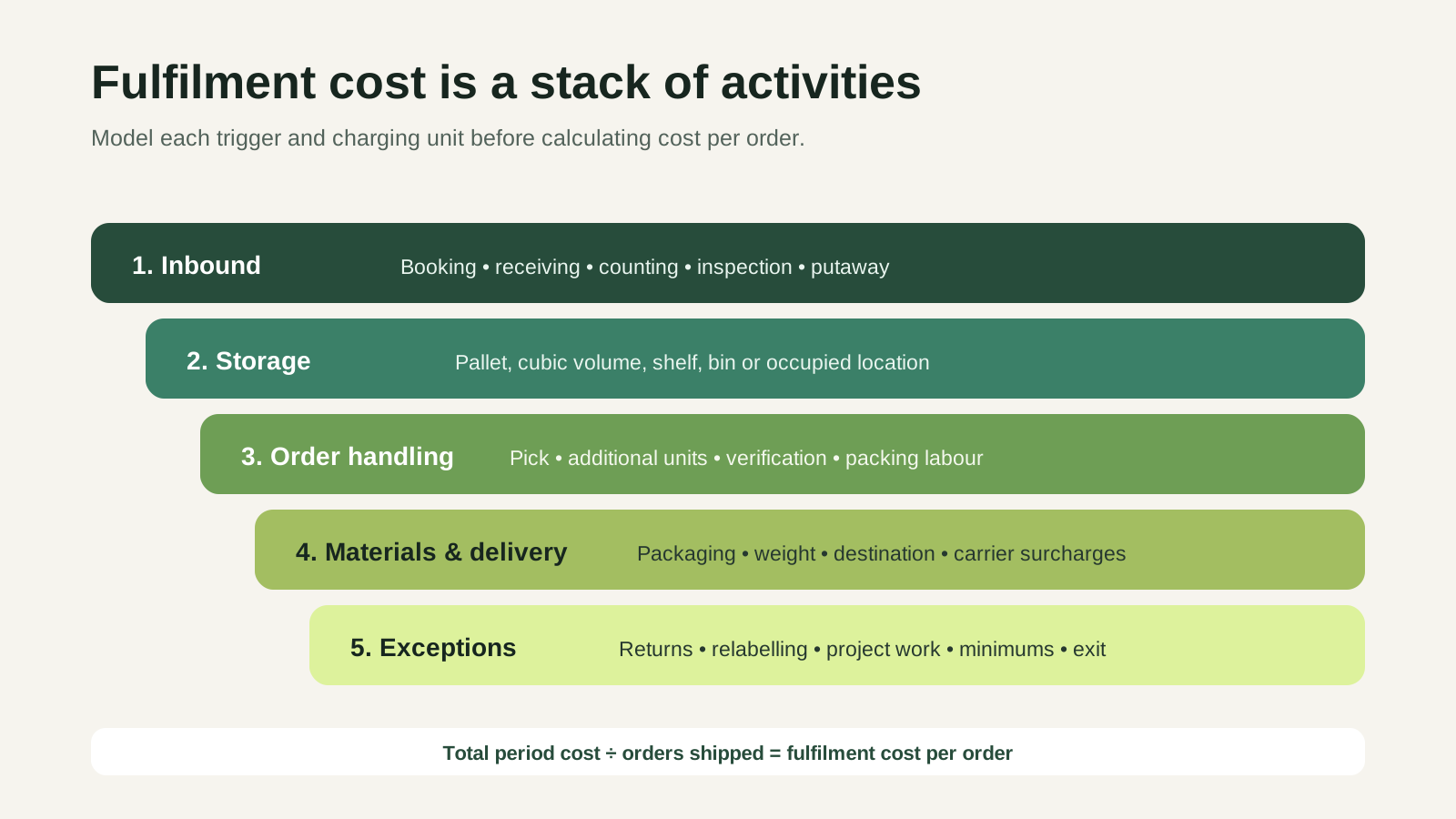
The core formula
Fulfilment cost per order = total fulfilment-related cost for the period ÷ orders shipped in the period.
Use orders actually shipped, not orders placed, unless the business deliberately wants to include cancellations in a different operating metric. Keep the definition consistent from month to month.
Build the numerator in three layers
A strong calculation separates costs that attach directly to an order from costs shared across inventory or the operation.
Direct order costs
These costs occur because a particular order is processed. Include base picking, additional lines or units, packing materials, shipment preparation, delivery and any customer-specific work.
If the customer pays delivery separately, calculate two versions: warehouse fulfilment cost excluding delivery and delivered fulfilment cost including it. The first helps compare warehouse efficiency; the second shows the logistics impact on order margin.
Receiving and putaway
Inbound inventory supports future orders, so receiving cost needs a consistent allocation rule. A simple monthly model divides the period’s inbound expense by shipped orders. A more detailed model assigns receiving cost to units and recognises it when those units are sold.
The second method can be more accurate when inbound activity is irregular, but it requires reliable unit-level data. Choose the method the business can maintain consistently.
Storage
Include warehouse occupancy for an internal operation or the billed storage charge for a 3PL. Storage per order will rise when inventory grows faster than sales, which is useful information rather than a flaw in the metric.
Track inventory turnover or days on hand alongside cost per order. Otherwise, the business may respond to higher storage cost without recognising that the underlying issue is excess stock.
People, equipment and systems
For in-house fulfilment, include warehouse staff, supervision, payroll costs, leave coverage, temporary labour, scanners, printers, packing stations, software, utilities, insurance and an appropriate share of management time.
For a 3PL, account-management, integration, reporting or project fees may sit outside the pick-and-pack invoice lines. Include them if they support the fulfilment operation during the period.
Returns, errors and exception cost
Returns processing, reshipments, replacement packaging, write-offs, carrier claims and customer-service work can materially change the economics of certain channels or products.
Track a separate cost per return as well as allocating total reverse-logistics cost across orders. This prevents a changing return rate from disappearing inside the headline metric.
A worked example using variables
Stashworks has not supplied approved rates, so this example uses variables rather than invented prices.
Assume a business ships 1,000 orders in one month:
- A = pick, pack, packaging and delivery
- B = receiving and storage
- C = people, systems and other fulfilment overhead
- D = returns, reshipments and fulfilment-related failure cost
The complete calculation is (A + B + C + D) ÷ 1,000.
Suppose the next month also has 1,000 orders but more promotional bundles and larger parcels. Order count is unchanged, yet A may rise because there are more picks, packaging materials and delivery weight. Cost per order must be interpreted alongside order complexity.
Segment the metric before making decisions
A single average can hide expensive channels or product groups. Calculate cost per order by dimensions that change warehouse or delivery work.
Useful segments include:
- Sales channel
- Single-item versus multi-item order
- Standard versus oversized parcel
- Domestic versus international delivery
- Normal trading versus campaign period
- Product category or storage type
Avoid creating more segments than the data can support. The purpose is to expose meaningful differences, not produce a dashboard no one uses.
Use normal, peak and growth scenarios
Monthly reporting describes what happened. Scenario modelling helps the business decide what to do next.
Build a normal case from typical volume, a peak case from the highest credible daily demand and a growth case from the expected order, SKU and storage profile in 12–24 months. Apply the relevant internal cost steps or 3PL rate tiers to each one.
Compare in-house and 3PL on the same boundary
If a 3PL quote includes receiving, storage, fulfilment and account charges, the internal calculation needs those same categories. If delivery is excluded from one model, exclude it from both.
Also recognise cost behaviour. In-house costs may remain flat until another employee or facility is required, then increase sharply. Outsourced charges may move more continuously with orders and storage but include minimum commitments.
What the metric cannot tell you
Cost per order should not be used alone. A lower number may come with slower processing, more errors or insufficient campaign capacity. Review it with order accuracy, processing time, inventory discrepancy and exception age.
The correct question is not “Which model has the lowest cost?” It is “Which model delivers the required service and control at the lowest sustainable total cost?”
Build a calculation the team can update
Document the data source and allocation method for every component. Recalculate monthly, investigate the largest movements and keep the normal and peak views separate.
DHL Singapore’s official calculator groups fulfilment pricing into warehouse handling, storage and delivery and allows more detailed operating inputs. It can provide external context, but its estimates are not a substitute for your actual costs or a tailored proposal.
Review Stashworks’ fulfilment services and provide your real order profile for a comparable scope.