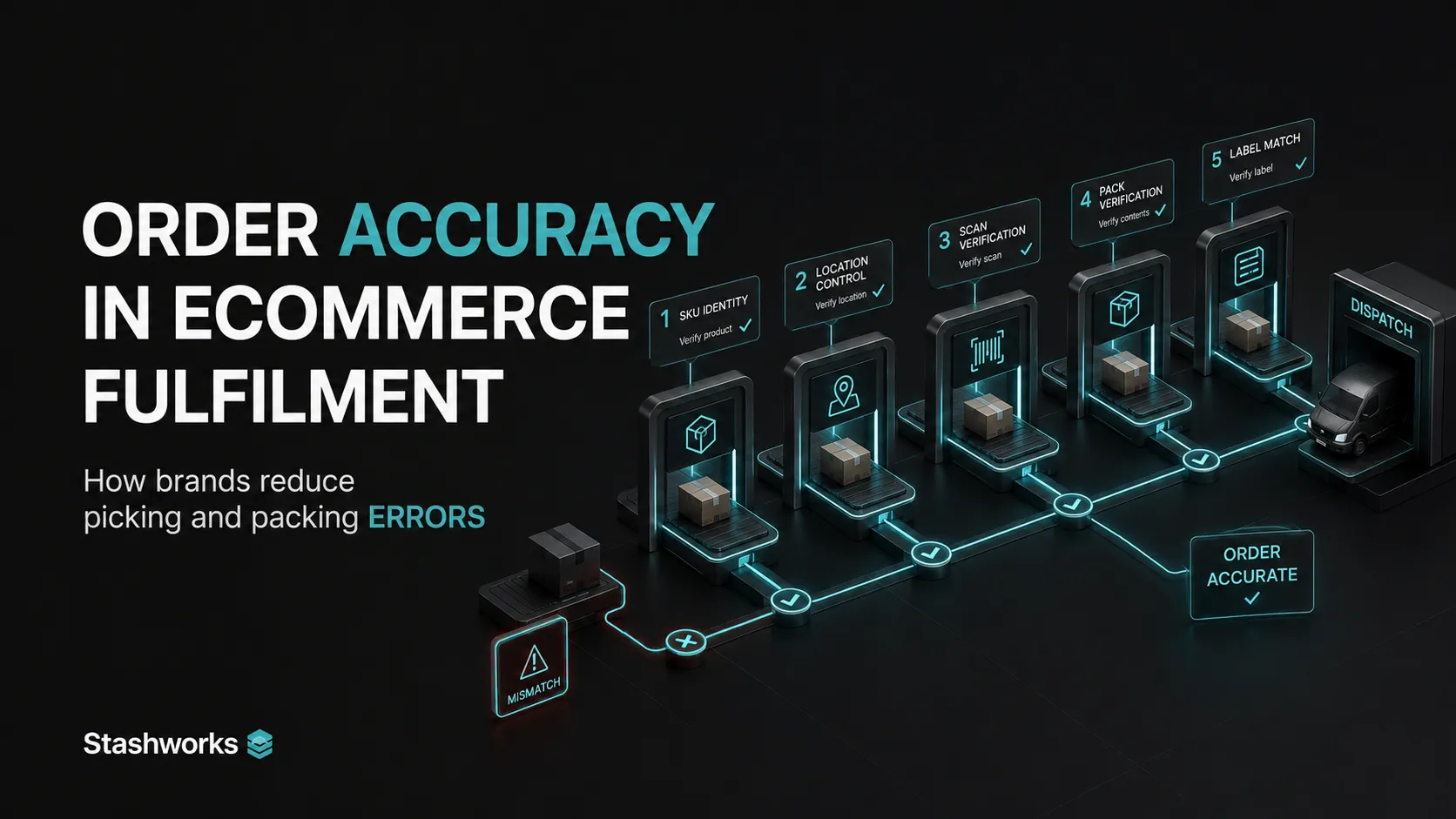
An order error is rarely caused by one careless moment. The wrong parcel that reaches a customer can begin with a duplicated SKU, a receiving discrepancy, stock placed in the wrong location, an ambiguous picking instruction, a missed quantity check or a label applied to the wrong box.
That matters because the fix depends on where the error enters the system. Adding another final inspection may catch some mistakes, but it will not repair weak product data or unreliable inventory locations. The most effective accuracy programme works upstream: identify the failure point, put a control beside it and make exceptions visible enough to investigate.
Start by defining what counts as an order error
“Order accuracy” can hide several different problems. Track them separately so that a reduction in one category does not disguise another.
Useful categories include wrong SKU, wrong variant, wrong quantity, missing line, extra item, damaged item packed, incorrect bundle, missing insert and shipping-label mismatch. Returns caused by customer preference should not be mixed with returns caused by fulfilment error.
Product master data is the first accuracy control
The warehouse can only pick what the system tells it exists. Every sellable variant should have one unambiguous SKU and, where possible, a unique scannable identifier. Product names should help distinguish similar items rather than relying on internal shorthand only one employee understands.
Bundles need component rules that match the sales channel. If the storefront sells one bundle but the warehouse system receives only the parent name with no component logic, the picking team is being asked to infer the order.
Receiving errors become picking errors later
Suppose ten units are received into the wrong location or counted against the wrong SKU. The customer-facing error may not appear until days later, when the system directs a picker to stock that is not physically there.
Receiving therefore needs clear checks for expected SKU, quantity, condition and location. Unresolved differences should move into an exception status rather than being forced into the available balance simply to complete the inbound task.
Location discipline removes guesswork
A picker should be directed to a defined location and should find the expected product there. Informal “everyone knows where it is” systems can work at very small scale but become fragile as SKU count, staff and replenishment activity grow.
Location labels, replenishment rules and scan-based confirmation make the physical warehouse easier to audit. GS1 traceability guidance uses the same principle: product identifiers and location or logistic-unit identifiers are recorded as goods move through receiving, storage and outbound processes.
Scanning works best as a decision control, not a ritual
Scanning is valuable when the system knows what should happen next. A scan should confirm the expected SKU or location and trigger a clear response when it does not match.
If employees routinely override alerts because the master data is wrong, the scan becomes theatre. Review override frequency, failed scans and manual substitutions. High exception volume usually points to a data or process issue that deserves correction.
Packing should verify the final customer order
The packing station is the last controlled warehouse point before carrier handover. Verification here should focus on the completed order: correct items, correct quantity, acceptable condition, required inserts or bundle components and the correct shipment label.
The purpose is not to repeat every earlier warehouse step. It is to catch the failures that can still be corrected before the parcel leaves.
Separate normal work from exceptions
Accuracy falls when unusual orders are forced through a workflow designed for standard orders. Gift messages, pre-orders, replacements, address changes, urgent orders, missing barcodes and damaged inventory need defined exception paths.
A good exception path identifies who can make the decision, what data must change and how the order returns to the normal flow. Without that ownership, staff improvise under time pressure.
Measure the cost of recovery, not only the error count
A wrong item can create a replacement shipment, return label, extra customer-service contact, inventory adjustment and possible write-off. That recovery cost can be more useful than the original picking labour when deciding which accuracy improvements deserve investment.
Track the error rate alongside reshipment cost, support time and root cause. A rare error with a high commercial impact may deserve stronger controls than a more common low-cost exception.
Peak periods reveal whether controls are robust
Processes that depend on experienced employees remembering unwritten rules often look reliable during a normal week. Campaign volume, temporary staff and compressed dispatch windows expose that dependence.
Before a major peak, test the same product identification, replenishment, scan and packing controls at the expected order mix. Accuracy should not rely on the warehouse being quiet.
Use an accuracy review loop
Each meaningful error should produce an operational question: where did it enter, why was it not detected earlier, and what control would prevent recurrence without creating unnecessary work?
Review patterns rather than blaming individuals. If three pickers make the same variant error, the stronger hypothesis is that the product data, labels or location design are weak.
Technology helps when the physical process is disciplined
A WMS can direct work, record scan events, show inventory status and make exceptions easier to trace. It cannot compensate for unlabelled products, inconsistent receiving or undefined operating rules.
Stashworks connects its WMS and inventory technology with ecommerce fulfilment. When evaluating the workflow, ask to see how the system handles the normal order and the failure case: wrong scan, missing stock, bundle exception, cancellation and final verification.
When listing or master-data errors are feeding warehouse mistakes, the Marketplace Product Data Template guide provides the upstream catalogue controls that should be fixed before adding more packing checks.
Two upstream controls can reduce downstream picking errors: Barcode Strategy for Ecommerce Warehousing for scan identity and Warehouse Slotting for Ecommerce for physical placement. Repeated failures should enter the Warehouse Exception Management process rather than remain informal fixes.
When the issue appears after carrier handover rather than inside the warehouse, use Delivery Claims for Lost or Damaged Parcels. For products that need stronger protective controls, see Fragile-Product Fulfilment.
Sources: GS1 Global Traceability Standard; GS1, Logistic Label Benefits.