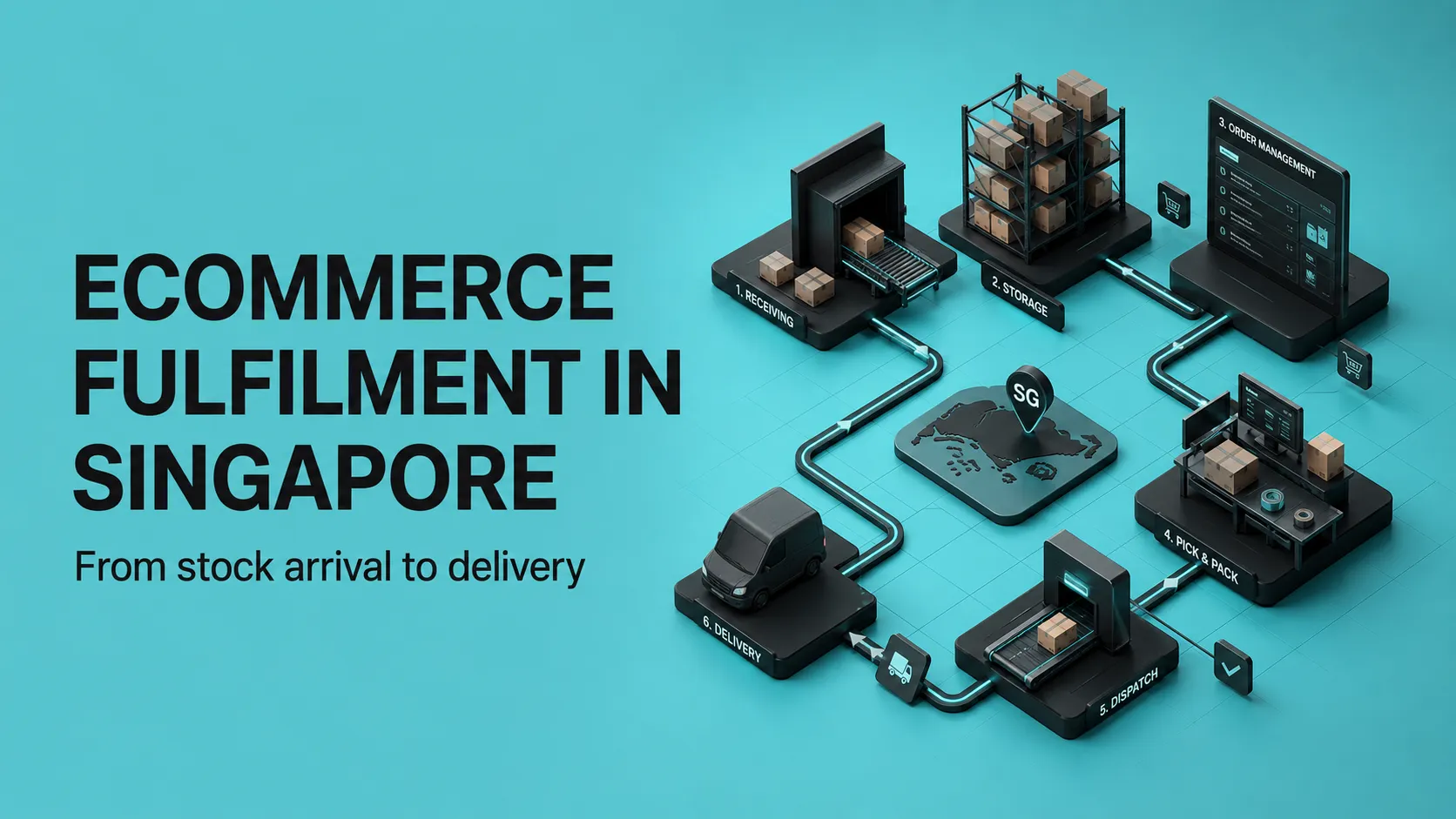
Ecommerce fulfilment starts before the first customer order reaches a warehouse. Product data has to be clean, inbound stock has to be received against an expected quantity, locations have to be assigned, and the systems that connect sales channels to physical inventory have to agree. If those foundations are weak, the visible problem may appear much later as an oversold SKU, a missed dispatch or a return that cannot be reconciled.
That is why fulfilment is better understood as an operating system than as a packing task. The work connects inventory, order data, warehouse decisions, packaging, carrier handover and reverse logistics. For a Singapore ecommerce business selling through one or several channels, the useful question is not simply “Who can ship our parcels?” It is “How does one customer order move through the whole operation without losing accuracy or ownership?”
Before stock arrives, the warehouse needs a usable product record
Receiving begins with information. Each sellable item should have a unique SKU, a scannable identifier where possible, dimensions, weight and handling instructions. Bundles need component rules. Products with expiry, batch, serial or special-storage requirements need those fields defined before the first inbound delivery.
The warehouse also needs an inbound notice: what is arriving, when, in which cartons or pallets, and in what expected quantities. Without that reference, a receiving team can count physical stock but cannot confidently say whether the delivery is complete.
Receiving turns delivered cartons into accountable inventory
A supplier delivery is not automatically available stock. The warehouse first checks what arrived against the inbound information, records shortages or overages, identifies visible damage and applies the agreed receiving standard.
The important distinction is between different levels of checking. A carton count, unit count, barcode verification and detailed quality inspection are separate activities. Brands should define which of those they need, especially for mixed-SKU cartons, fragile goods, date-sensitive products or items that arrive without usable labels.
Once receiving is complete, accepted stock can move into putaway. Any damaged, quarantined or unresolved units should remain in a separate status rather than being mixed into saleable inventory.
Storage is about location control, not simply available space
A warehouse may have enough square metres and still perform poorly if inventory is difficult to identify or retrieve. Every item needs a location strategy that reflects its size, velocity, handling needs and relationship with other products.
Fast-moving SKUs might be positioned closer to picking areas. Bulky stock may need pallet locations. Small items may sit in bins or shelving. The exact design varies, but the system record and physical location must agree. That agreement is what allows a picker to trust the instruction on the screen instead of searching the warehouse from memory.
Stashworks positions its technology and WMS around inventory and order visibility. For any fulfilment partner, the practical test is whether the business can distinguish stock that is available, reserved, damaged, returned or under investigation.
Order fulfilment begins when sales-channel data becomes warehouse work
After a customer places an order, the relevant order data must reach the fulfilment operation accurately. That may happen through a direct ecommerce integration, marketplace connector, API or another agreed workflow.
The basic order is only the start. A robust setup also defines what happens to cancellations, address changes, bundles, pre-orders, split shipments and duplicate orders. If those exceptions require manual intervention, the business should know who sees the problem, who owns the fix and how the stock record is corrected afterward.
Picking converts an order into physical movement
Picking is the act of locating and retrieving the correct SKU and quantity. The quality of that step depends on the product master, location accuracy, picking method and verification controls.
For a simple one-item order, the process may look straightforward. Complexity increases with multiple lines, visually similar variants, bundles, expiry requirements or channel-specific rules. Scan-based checks can reduce reliance on memory, but only when labels and system mappings are reliable.
Packing is where accuracy, protection and brand requirements meet
The packing station should confirm that the order is complete before it is sealed. The packer may also need to select the correct box or mailer, add protection, apply an insert, assemble a bundle, follow a channel-specific labelling rule or use branded materials.
Packaging has several jobs at once: protect the product, avoid unnecessary parcel size, support efficient handling and preserve the intended customer experience. Those trade-offs are important enough to deserve their own operating rules rather than being left to individual judgement at the packing bench.
Dispatch is the handover between fulfilment and delivery
Once the parcel is complete, shipment data is created and the order is released to the selected carrier. At this point two operating systems meet: the warehouse has finished preparing the parcel, while the delivery network becomes responsible for moving it toward the customer.
Businesses should understand carrier cut-offs, tracking flow, failed-delivery handling and the escalation path for damaged or delayed parcels. A 3PL can coordinate the handover, but no warehouse can eliminate every carrier exception. The useful question is how quickly an exception becomes visible and who owns the response.
Stashworks connects fulfilment with last-mile delivery, which can simplify that handover when the service scope is agreed clearly.
Returns complete the fulfilment loop
Fulfilment does not necessarily end at successful delivery. When an item comes back, the operation needs to identify the order, inspect the product, decide whether it is saleable and update inventory accordingly.
A returned unit might go back to stock, move to quarantine, require repacking, be sent back to the brand or be written off. Those are inventory decisions as much as customer-service decisions. A returns process that records only “received” without the final disposition leaves the business with an unreliable stock position.
The most useful fulfilment metrics follow the handovers
Rather than measuring warehouse activity in isolation, monitor the points where errors can move from one stage to the next. Useful measures can include receiving discrepancies, order accuracy, orders processed within the agreed window, inventory adjustments, return-processing age and unresolved exceptions.
Targets should come from the operating agreement, not from a generic industry benchmark. A fragile-product business and a simple apparel operation may need different controls even when their order volumes are similar.
Map the complete workflow before comparing providers
A good fulfilment proposal starts with the real operation: SKUs, inbound pattern, storage, sales channels, order complexity, packaging, delivery profile, returns and peak demand. Give every shortlisted provider the same operating picture and ask how each stage will work.
Shopify describes ecommerce fulfilment as the end-to-end process covering receiving, warehousing, inventory, picking, packing, shipping and returns. Amazon similarly treats fulfilment as a connected process rather than a single warehouse task. Those definitions are useful because they prevent businesses from comparing a courier rate with a full fulfilment service.
If the current operation is becoming difficult to coordinate, review Stashworks’ ecommerce fulfilment service and share the actual SKU, order, storage and channel profile before discussing price.
Sources: Shopify, Ecommerce Fulfillment Guide; Amazon Supply Chain Services, Ecommerce Fulfillment Guide.