Warehouse decisions are often reduced to two questions: how much space is available, and what does it cost per month? For an ecommerce business, those questions are incomplete. Two facilities with the same floor area can create very different operating models depending on who receives the stock, who controls inventory, whether individual customer orders are processed, and what happens when the business hits a campaign peak.
In Singapore there is another distinction that matters: a commercial warehouse model and a Customs storage scheme are not the same thing. A 3PL, a dedicated warehouse and a fulfilment centre describe how the operation is run. A Free Trade Zone, Licensed Warehouse or Zero-GST Warehouse describes a regulatory treatment for qualifying goods. Choosing well starts by separating those two decisions.
First decide how much of the warehouse operation you want to own
The most useful comparison begins with operating responsibility. Do you only need somewhere to place cartons, or do you need a team and system to receive stock, control locations, process ecommerce orders and handle returns?
That distinction determines the people, software and management effort that remain with your business after the storage contract is signed.
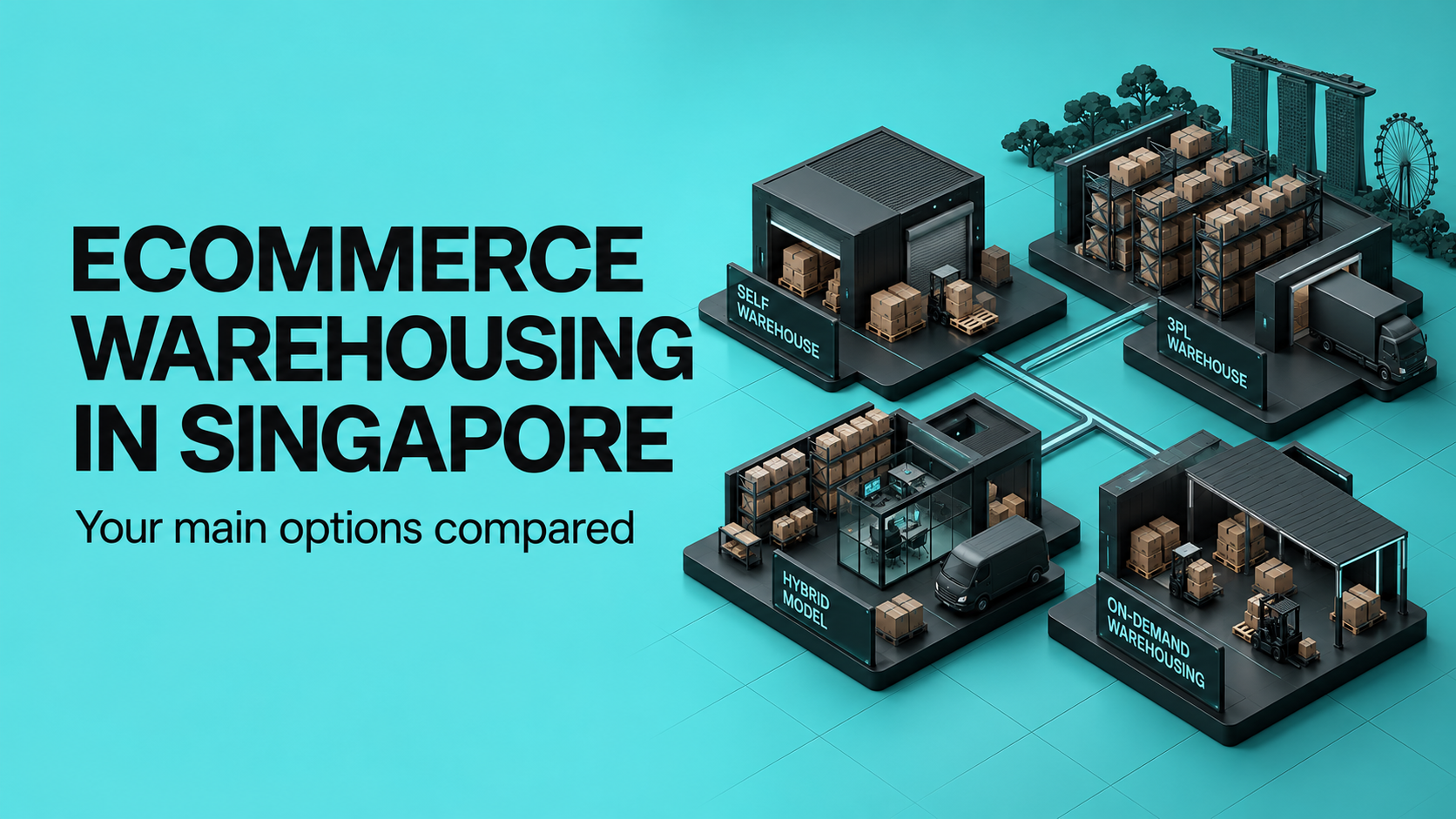
Self-managed storage can work while the operation remains simple
A small stockroom, self-storage arrangement or other basic space can be practical when the catalogue is limited and the same small team receives, stores and ships the goods. The business keeps direct access to inventory and avoids introducing a provider relationship too early.
The limitation is that the space itself does not create a warehouse process. The brand still needs product identification, receiving records, locations, stock counts, packing space, security and order control. As SKUs and channels grow, informal storage can become expensive through lost time and inventory uncertainty even if the monthly rent still looks low.
A dedicated warehouse buys control and dedicated capacity
Leasing and operating a warehouse gives the business control over layout, staffing, systems and operating rules. That can be valuable when fulfilment is highly specialised, tightly connected to production, or large and stable enough to use dedicated infrastructure efficiently.
The trade-off is commitment. Rent is only one part of the operating cost. Racking, equipment, scanners, packing benches, utilities, insurance, software, supervision, recruitment, leave coverage and peak labour all sit behind the facility. Capacity is also bought in steps: the next unit of space or the next shift may be needed before demand consistently fills it.
This is why the decision should be compared with outsourced warehousing on a complete cost and responsibility basis, not rent per square foot alone.
Shared 3PL warehousing changes capacity from an asset into a service
In a shared third-party logistics model, the provider operates the warehouse processes for several clients using agreed rules and systems. The client still owns the inventory and commercial decisions, while the provider performs activities such as receiving, putaway, storage, stock control and approved inventory movements.
This model can reduce the need to build warehouse capability internally. It also makes governance more important. The brand should understand what the provider counts at receiving, how locations and adjustments are controlled, which stock states are visible, how discrepancies are investigated and what reporting is available.
Stashworks’ warehousing service is positioned around managed inventory and storage rather than bare space. The exact product, handling and service requirements should still be scoped before inventory is moved.
An ecommerce fulfilment centre is more than a storage location
When stock is stored in the same operation that processes customer orders, warehousing and fulfilment become one connected workflow. Inventory received today may be allocated to an order, picked, packed and released to a carrier soon afterward.
That creates efficiencies, but it also means integrations, product data and exception rules matter more. A storage-only warehouse can tolerate a manual spreadsheet for longer than a multichannel fulfilment operation can.
If the requirement includes individual ecommerce orders, compare fulfilment capability as well as storage. Ask how orders enter the system, what happens to cancellations, how packing rules are represented and how returns change available stock.
Customs-regulated storage is a separate decision
Businesses importing goods into Singapore may encounter Free Trade Zones and Customs-licensed warehouse schemes. These are not simply premium versions of an ordinary warehouse.
Singapore Customs states that goods stored in a Free Trade Zone can have duty and GST suspended while they remain under the relevant conditions. It also operates Licensed Warehouse schemes for dutiable goods and Zero-GST Warehouse schemes for imported non-dutiable goods, where duty and/or GST can remain suspended until goods are removed for local use or consumption.
That treatment can matter for businesses holding imported goods before re-export or local release, but eligibility and procedures depend on the goods and movement. Do not assume a general ecommerce warehouse has the necessary Customs licence. Verify the scheme, licensed premises and permit responsibilities separately with Singapore Customs and the proposed operator.
Special product requirements can eliminate otherwise attractive options
Temperature-sensitive, dangerous, controlled, high-value or unusually large products may require storage conditions that a general ecommerce warehouse is not designed to provide. The same applies when batch, serial or expiry control is critical.
Start with the product before touring facilities. Record dimensions, weight, storage condition, handling risk, shelf life, identification method and any regulatory status. An impressive warehouse that cannot support the product correctly is not a viable option.
Warehouse location should follow the physical flow
Being close to the city centre is not automatically valuable. A business receiving containerised imports may care more about inbound transport and warehouse access. A rapid local-delivery model may care about carrier collections and final-mile coverage. A regional operation may need efficient movement between freight, storage and export flows.
Map where stock comes from and where orders go. Then evaluate the warehouse location against those journeys rather than a postcode alone.
Compare capacity in normal, peak and growth states
A warehouse can fit the business today and still be the wrong choice. Model normal inventory, pre-campaign inventory and the expected 12–24 month SKU and storage profile.
For a dedicated facility, identify the next capacity step. For a 3PL, ask how forecast changes are communicated, whether product or storage limits apply and what happens when actual inventory materially exceeds plan. “Scalable” should become a documented process rather than a marketing adjective.
Separate storage price from the total operating model
A low storage rate can be offset by expensive receiving, poor stock visibility or labour your own team still has to provide. A higher storage rate can include operational services that reduce internal work. Compare the complete boundary.
For each option, assign responsibility for receiving, inventory accuracy, stock counts, order processing, packaging, returns, systems, reporting and final dispatch. Then compare cost under the same volume assumptions.
The right option is the one that removes the right constraint
There is no universal best warehouse model for Singapore ecommerce. A small brand may be better keeping a simple operation in-house. A stable high-volume business may justify dedicated infrastructure. A growing multichannel seller may benefit more from shared 3PL warehousing and integrated fulfilment.
Start with the work that has to happen inside the building, not the building itself. If managed receiving, inventory control and storage are the current constraint, review Stashworks warehousing. If stock also needs to flow directly into customer orders, assess the ecommerce fulfilment layer at the same time.
Sources: Shopify, Inventory Storage Options; Singapore Customs, Depositing Goods in Free Trade Zones; Singapore Customs, Licensed and Zero-GST Warehouses.