
TikTok Shop can compress demand into a very short window. A product may move slowly during the morning, appear in a strong piece of content or live session, and then generate a concentrated wave of orders before the warehouse has time to change its staffing or pick-face layout.
The fulfilment challenge is therefore not simply speed. It is being ready for a faster change in order velocity without losing inventory accuracy, platform deadlines or packing control.
Start with a product record the warehouse can identify immediately
Every sellable TikTok Shop variant should map to one stable internal SKU. Product names, variant labels and promotional wording can change, but the warehouse identity should remain consistent.
Record the barcode or scanning identifier, dimensions, weight, unit of measure, bundle components and any special handling requirements before the campaign starts. Fast demand amplifies catalogue errors because the same incorrect mapping can be repeated across hundreds of orders before anyone notices.
Keep TikTok Shop inventory connected to the physical stock
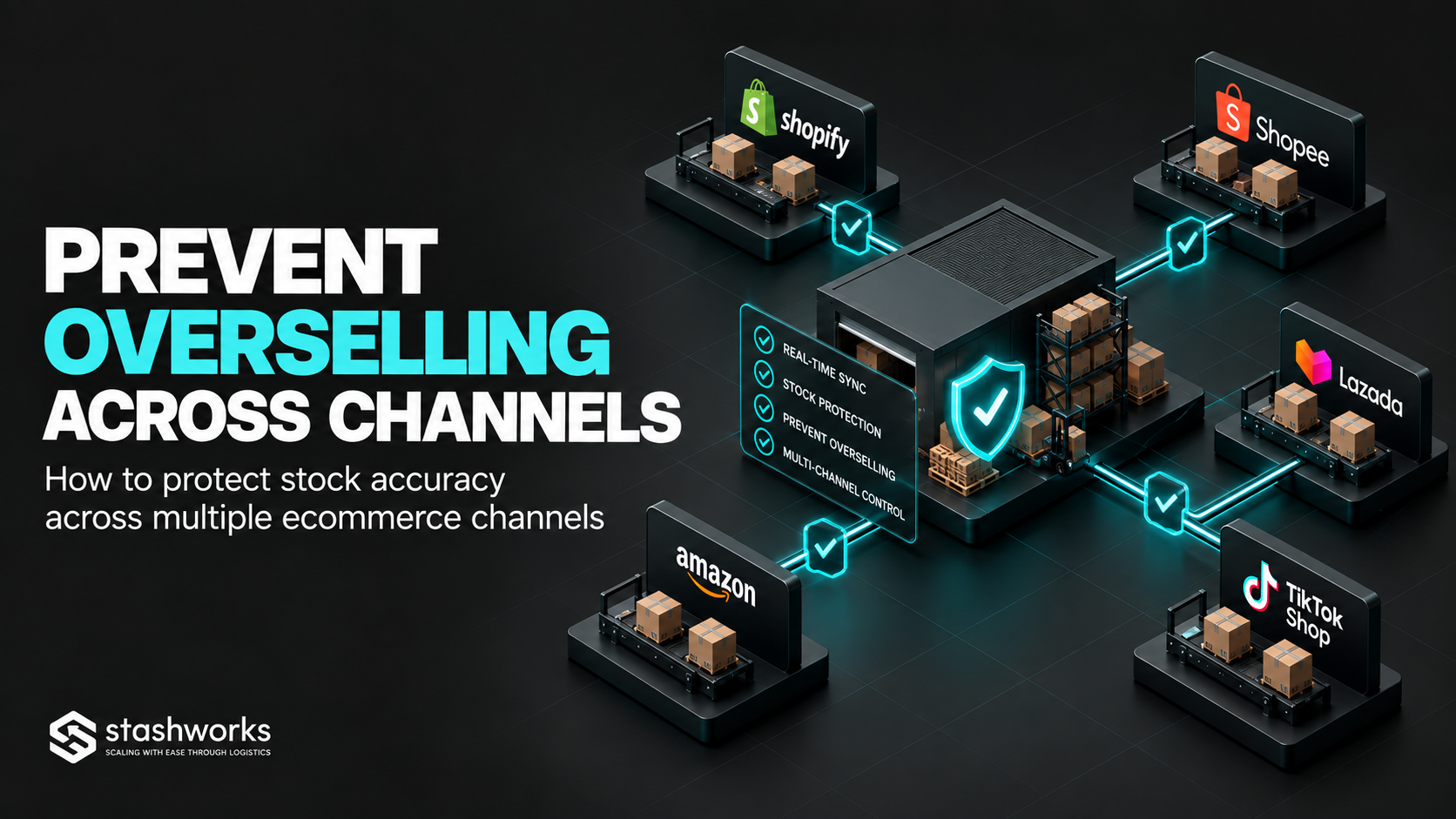
A fast-moving listing is dangerous when the quantity shown to customers is only loosely connected to what the warehouse can actually sell. Available inventory should reflect receiving, reservations, picks, damage, returns and manual adjustments.
If the same SKU is also sold through Shopify, Shopee or Lazada, use one controlled source of truth rather than separate manual quantities. The architecture is covered in How to Manage Inventory Across Shopify, Shopee, Lazada and TikTok Shop.
Distinguish standard orders from longer-lead-time order types
TikTok Shop's Singapore fulfilment guidance distinguishes standard orders from pre-orders, which have different preparation expectations. Sellers should not use a longer-lead-time workflow as a substitute for operational capacity on normal stocked products.
Configure the product correctly before it goes live and make sure the warehouse knows which orders follow the ordinary fulfilment timeline and which follow a separately defined schedule.
Use the current platform deadline, not an old SOP number
TikTok Shop publishes fulfilment timelines for Singapore and links missed timelines to fulfilment metrics such as Late Dispatch Rate and platform auto-cancellation. Because policy details can change, the warehouse should use the current deadline attached to the order or current Seller Center guidance rather than a number copied into a document months earlier.
Build an internal target that finishes packing and handover before the platform deadline. That margin is what absorbs label problems, carrier delays and late order exceptions.
Prioritise orders by operational deadline as well as age
First-in, first-out is useful, but a mixed order queue may contain different deadlines or fulfilment types. The warehouse should be able to identify which orders are closest to a platform deadline and which have an exception preventing release.
Create a queue that surfaces orders waiting on inventory, address problems, payment status, packaging or carrier handover rather than letting them disappear inside the normal workload.
Monitor fulfilment performance as an operating signal
TikTok Shop introduced a dedicated Fulfilment Performance page in Seller Center for Singapore. It consolidates fulfilment timelines and metrics, and the platform states that fulfilment performance affects Account Health Rating and Store Rating.
Use those metrics diagnostically. If late dispatch rises after a campaign, determine whether the cause was insufficient stock, slow picking, packing capacity, carrier collection or orders that remained unresolved in an exception queue.
Set a realistic daily handling capacity before a spike
TikTok Shop's Order Handling Capacity tool is currently a pilot for selected Singapore sellers. For sellers with access, it can provide fulfilment deadline extensions when incoming volume exceeds the declared normal capacity.
That should not be treated as a universal safety net. The tool is not available to every seller, and the underlying lesson applies regardless: estimate how many orders the warehouse can genuinely process per day using people, space, equipment and carrier capacity.
Use that number in campaign planning instead of assuming the warehouse can absorb unlimited demand because the storefront can accept it.
Build campaign stock around sellable units, not cartons received
Inventory arriving at the warehouse is not automatically ready for a TikTok Shop order. It still needs to be received, checked, located and made available.
Set an inbound deadline before major content or live activity. Leave enough time to resolve barcode problems, quantity discrepancies and damaged stock before the campaign begins. A pallet waiting at receiving should not be counted as protection against a stockout.
Use safety buffers where synchronisation risk justifies them
If a product can sell rapidly across several channels, a small controlled buffer can reduce the chance that multiple channels promise the last units at the same time. The buffer should be deliberate and documented rather than hidden manual padding.
Review it after each event. If the buffer is always consumed, the deeper problem may be slow synchronisation, poor forecasting or insufficient inventory rather than the size of the buffer itself.
Prepare the pick and pack flow before the stream starts
Move campaign SKUs into efficient pick locations, confirm bundle components, pre-stage approved packaging where appropriate and make scanning or product verification easy for similar variants.
Do not sacrifice verification simply because volume is high. A fast wrong order creates returns, customer-service work and replacement fulfilment after the campaign has already ended.
Carrier handover is part of fulfilment, not an afterthought
A parcel that is packed but not collected or scanned can still become a late operational event. Confirm the appropriate collection or drop-off workflow for the seller's current TikTok Shop setup and keep evidence of handover where relevant.
During high-volume periods, forecast parcel count to the logistics provider rather than assuming the normal collection will absorb a campaign spike.
Reconcile immediately after the demand event
When the stream or campaign finishes, compare orders, reservations, shipments and physical stock. Investigate failed imports, cancellations, unshipped orders, manual inventory adjustments and returns that have already started arriving.
This prevents a one-night spike from leaving the next week's inventory balance unreliable.
Connect social demand to a warehouse system that can absorb it
Stashworks currently lists TikTok among its supported integrations. Its technology layer connects order and inventory information with warehouse operations, while ecommerce fulfilment covers the physical flow from inventory and pick and pack through dispatch and returns.
Before relying on the setup for a major TikTok Shop event, confirm the exact integration method and test product mapping, order import, cancellations, stock updates, shipping confirmation and tracking. The strongest campaign plan is one that has already proven the normal and failure paths before volume arrives.
Sources: TikTok Shop Singapore, Order Fulfilment Timelines; TikTok Shop Singapore, Fulfilment Performance Page; TikTok Shop Singapore, Order Handling Capacity Tool; Stashworks, Ecommerce Fulfilment.