
Growth does not always expose a fulfilment problem as a dramatic warehouse failure. More often, the symptoms appear elsewhere: marketing limits a campaign because operations cannot absorb it, customer service spends more time chasing parcels, purchasing loses confidence in the stock number, or experienced staff become the only people who know how to fix certain orders.
Those signals do not automatically mean the business needs a 3PL. They mean the fulfilment system is becoming a constraint and deserves diagnosis. The right fix might be better product data, a new WMS, layout changes, more capacity, clearer processes, outsourcing—or a combination.
1. Inventory is treated as an estimate
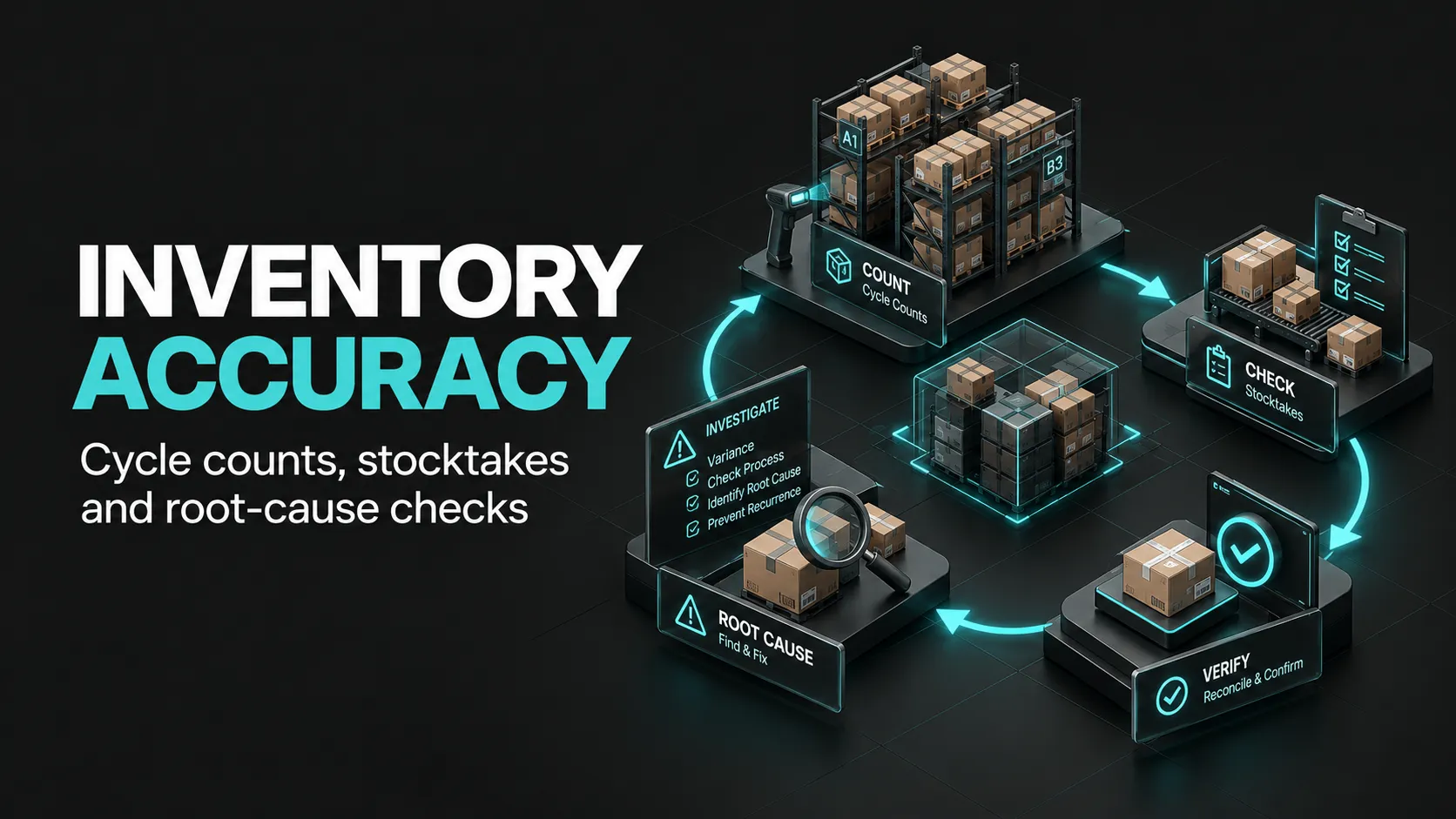
If teams regularly say “the system shows five, but check the shelf first”, growth is being built on an unreliable promise. Stock discrepancies create overselling, delayed replenishment and manual checks before campaigns.
Measure: adjustments by SKU and reason, stock-count variance, oversold orders and time spent investigating missing units.
First fix: trace the discrepancy to receiving, putaway, picking, returns or manual adjustments before adding more safety stock.
2. Orders wait because the workflow depends on one person
A process is not scalable when an experienced employee must interpret every unusual order. Growth increases the number of exceptions until that person becomes the queue.
Measure: orders on hold, exception age and how many require manager intervention.
First fix: convert recurring decisions into written rules and define which exceptions genuinely need approval.
3. Campaign success creates a dispatch hangover
A promotion that generates a week of backlog is exposing a capacity gap. The issue may be labour, packing stations, replenishment, carrier collection, order release or a more complex campaign basket.
Measure: peak orders by hour/day, orders processed inside the target window and days required to return to normal.
First fix: model the campaign order profile separately from the average month.
4. Fast-moving products are difficult to pick
Inventory layout often evolves organically. New products occupy whatever space is available, while old locations remain even after the order pattern changes.
Measure: travel time, pick frequency by location, replenishment interruptions and congestion around high-volume SKUs.
First fix: review slotting based on actual velocity and order combinations.
5. More sales channels create more manual reconciliation
A new marketplace should add demand, not a new spreadsheet ritual. If staff manually copy orders, change stock across channels or reconcile tracking every day, the channel architecture is consuming the growth it creates.
Measure: manual touches per order, missed imports, duplicate orders and channel stock corrections.
First fix: define the source of truth and the event flow for orders, inventory, cancellations and tracking. See the Stashworks technology page for the system side of fulfilment.
6. Packing rules live in people’s memory
Brands often add inserts, special boxes, promotional gifts and bundle rules one campaign at a time. Eventually the packer needs tribal knowledge to know what belongs in the parcel.
Measure: packing exceptions, rework, missing inserts, material substitutions and questions raised at the packing bench.
First fix: standardise pack rules by SKU, channel or campaign and define the fallback when a material is unavailable.
7. Returns accumulate outside normal inventory control
A returns corner full of unprocessed parcels is not just a customer-service issue. It is inventory whose condition and value are unknown.
Measure: returns waiting for inspection, time to disposition, value in quarantine and percentage returned to saleable stock.
First fix: create a return reference, inspection standard and clear disposition options.
8. The operation does not know its real cost per order
If fulfilment cost is described only as wages and courier fees, growth decisions can be misleading. Space, systems, receiving, packing materials, management time, errors and returns also consume resources.
Measure: total fulfilment-related cost divided by shipped orders, then segment by channel or order type where complexity differs.
First fix: use the same cost boundary when comparing internal improvement with outsourcing. The detailed method is covered in How to Calculate Fulfilment Cost per Order.
9. Growth requires capacity to be bought in large steps
An internal operation may be efficient until the next employee, warehouse unit, racking zone or system upgrade is required. The problem is not the investment itself; it is whether the business is forced to buy substantially more capacity before demand is reliable.
Measure: practical daily capacity, storage utilisation, labour utilisation and the next capacity step.
First fix: model normal, peak and 12–24 month demand rather than deciding from the current month alone.
10. Customer-service problems increasingly originate in fulfilment
“Where is my order?”, wrong-item contacts, missing tracking and replacement requests are operational signals. When support volume rises with order volume, the underlying process is not scaling cleanly.
Measure: support contacts by fulfilment cause, replacement shipments, failed-delivery escalations and time spent investigating warehouse status.
First fix: connect customer-service reason codes to warehouse and carrier data so recurring failures can be traced.
Diagnose the bottleneck before choosing the remedy
These signs are useful because they tell the business where to look. They are not a checklist that automatically leads to outsourcing.
Some operations can recover significant capacity by cleaning product data, redesigning locations, standardising packaging or improving order integrations. Others reach a point where the required space, people, systems and peak flexibility are better obtained through an external fulfilment partner.
If the question has become specifically whether outsourcing is the right next step, use the separate guide When Should You Outsource Ecommerce Fulfilment to a 3PL?. That article evaluates the make-or-buy decision; this one is about identifying the operational constraint first.
Turn symptoms into an evidence pack
For four weeks, collect order volume and mix, inventory adjustments, dispatch timing, error causes, returns age, manual intervention, storage pressure and customer-service contacts. Add a campaign or peak view if that is where the operation fails.
That evidence makes the next decision much clearer. It can support an internal improvement plan, a technology project or a properly scoped ecommerce fulfilment discussion with Stashworks.
Growth should increase volume, not operational uncertainty
A scalable fulfilment operation does not need to be perfect. It needs to make normal work repeatable, exceptions visible and capacity understandable. When every increase in sales produces disproportionately more manual work, customer contact or stock uncertainty, the operating model is consuming growth rather than supporting it.
Use the ten signs as a diagnostic, identify the strongest constraint and fix that system before simply adding more volume to it.
Sources: Shopify, Order Fulfillment Guide; Amazon Supply Chain Services, Ecommerce Fulfillment Guide.