Ecommerce importers often reach an awkward middle ground: too much stock for parcel shipping, but not enough cargo to justify using an entire container for every replenishment.
Freight consolidation solves that problem by combining cargo so transport capacity is used more efficiently. The best-known ocean-freight version is less-than-container-load, or LCL.
What is freight consolidation?
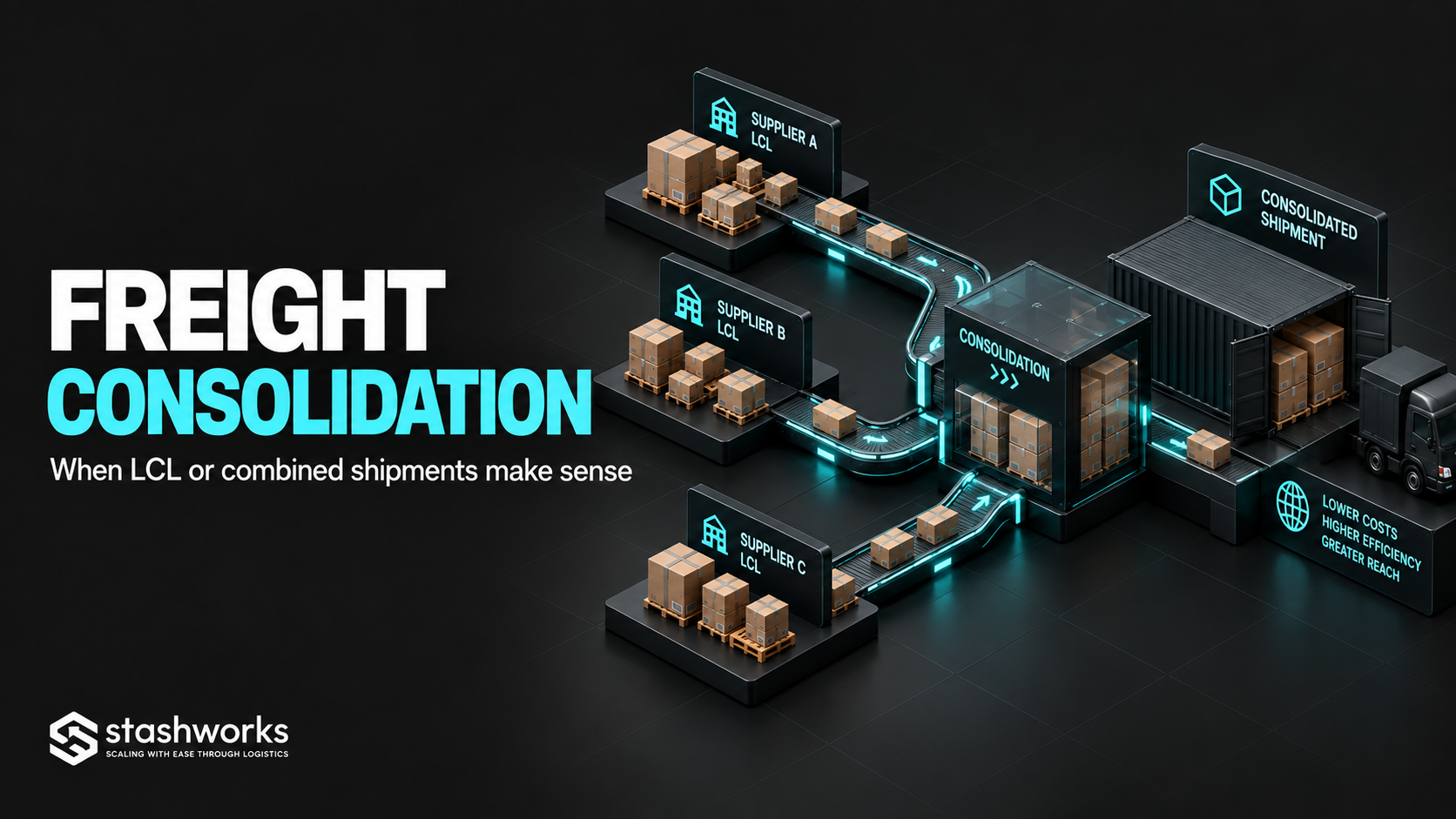
Consolidation combines smaller shipments into a larger transport unit for part of the journey. In ocean freight, cargo from multiple shippers can share a container. At destination, the consolidated shipment is separated so each consignment can continue to its final receiver.
Consolidation can also refer to combining several supplier shipments belonging to the same buyer before international transport.
What is LCL?
LCL is an ocean-freight service for cargo that does not occupy a full container. Multiple consignments share container space, and each shipper pays for the applicable space and services associated with its cargo.
The practical advantage is that a business does not need to wait until it has enough inventory for a full container before replenishing.
When can LCL make sense?
LCL can suit smaller or more frequent replenishment, early-stage import volumes, product launches and businesses that want to reduce the size of each inventory purchase.
It can also help when a full-container order would create too much stock relative to sales velocity or warehouse capacity.
Why there is no single volume threshold
Online guides often quote a fixed cubic-metre threshold for switching from LCL to FCL. Real economics depend on the route, carrier, origin and destination charges, cargo density, minimum charges and current freight market.
Ask for both options when the shipment is approaching full-container economics. Compare total door-to-door cost and operational lead time rather than applying a universal cutoff.
Consolidation creates extra handling steps
LCL cargo normally passes through consolidation and deconsolidation processes. Those steps can add handling, cut-off requirements and time compared with cargo moving in a dedicated full container.
For fragile, highly sensitive or unusually shaped products, the handling profile can be as important as the freight rate.
Buyer consolidation can combine several suppliers
If inventory is purchased from multiple suppliers in the same origin region, a consolidation programme can collect those shipments and combine them before the international leg.
This can reduce the number of separate international movements and simplify the destination receiving schedule, but product and purchase-order references must remain traceable after cargo is combined.
Keep carton-level identification intact
Every carton or pallet should still map to the correct purchase order, SKU set and receiving record. A consolidated shipment should not arrive as one anonymous collection of boxes.
Use consistent supplier references, labels and packing lists so the warehouse can separate the inventory correctly after arrival.
Compare the complete cost structure
LCL can include origin handling, consolidation, ocean freight, destination handling, deconsolidation, documentation and local delivery charges. The cheapest headline freight line is not necessarily the cheapest landed shipment.
Allocate the complete cost across the inventory using a consistent basis. See How to Calculate Landed Cost When Importing into Singapore.
Shipment frequency affects inventory as much as freight
One large shipment may have a lower transport cost per unit but creates more inventory at once. More frequent LCL shipments can reduce inventory peaks while increasing the number of freight and receiving events.
Model both logistics cost and the stock profile. The warehouse may prefer smaller predictable inbounds to one oversized arrival that consumes receiving and storage capacity.
Use consolidation when it improves the whole replenishment system
The decision should consider supplier readiness, shipment size, required arrival date, cargo characteristics, customs documentation, warehouse capacity and total landed cost.
Stashworks' freight forwarding service coordinates import and export cargo and can connect inbound freight with warehousing. For combined or LCL shipments, confirm the origin handling, consolidation points, documentation, expected destination process and receiving references before booking.
Sources: Maersk, Consolidation and Deconsolidation; DHL, LCL Shipping; Stashworks, Freight Forwarding.