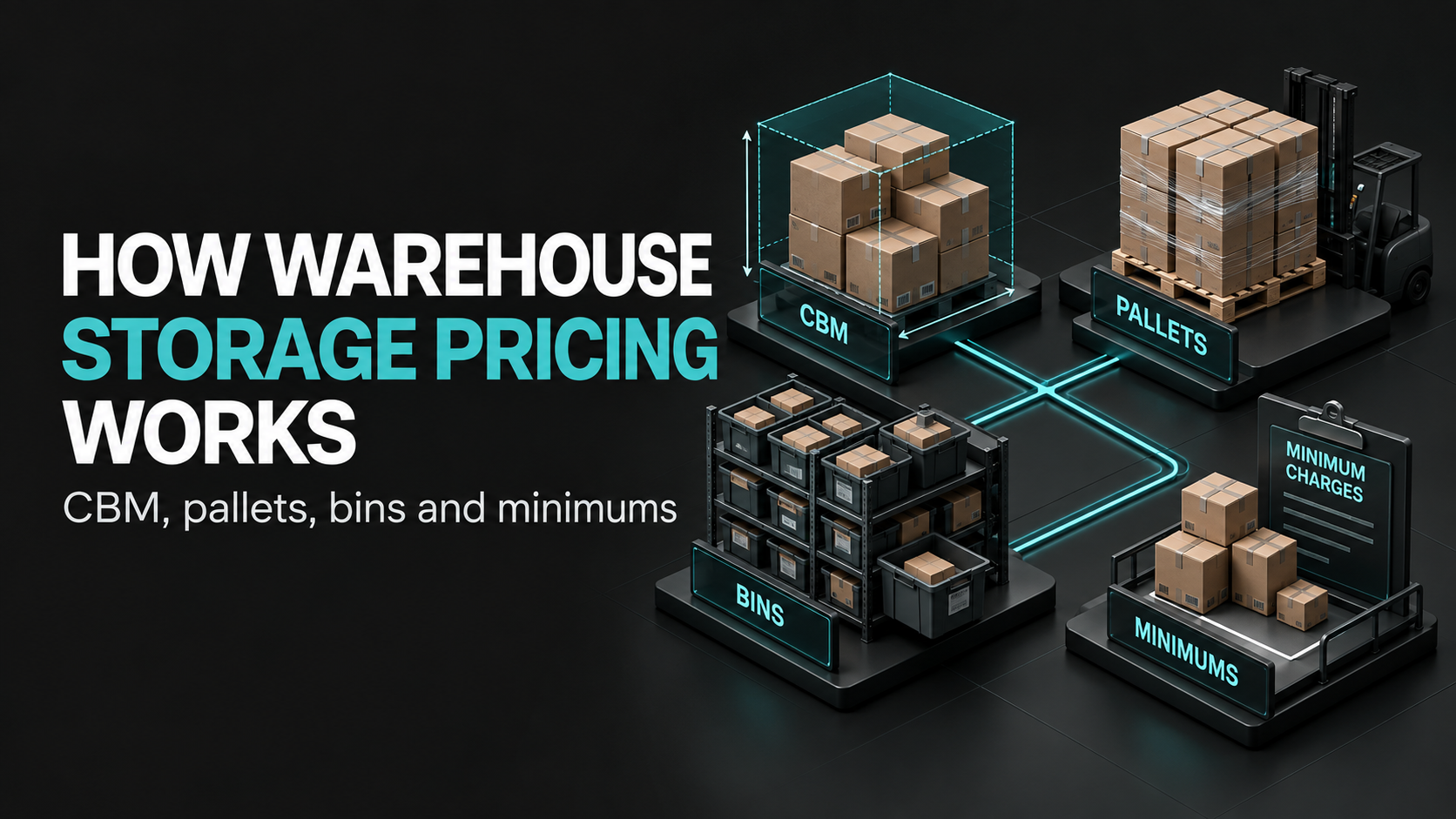
A storage rate is only useful when you know what physical space the unit represents. “Per pallet”, “per CBM” and “per bin” can all describe fair ways to charge for warehouse capacity, but they reward different inventory profiles. A low rate in the wrong unit can cost more than a higher rate that matches the way your products actually occupy the warehouse.
The central question is therefore not “What is your storage price?” It is “How does my inventory become billable space in your operation?” Once the measurement, rounding, billing period and minimums are clear, quotes become much easier to model.
Pallet pricing charges for a location, not necessarily every cubic centimetre
Pallet-based storage is common for cartons that can be stored and moved as palletised units. The commercial unit is usually the pallet position or another defined pallet location.
This can be straightforward when inventory arrives on consistent pallets and turns quickly. It becomes less intuitive when a pallet is partly full, contains mixed SKUs, is oversized or cannot be stacked because of product restrictions.
Ask what dimensions and height qualify as a standard pallet position, whether partial pallets are rounded up, how mixed-SKU pallets are treated and when a pallet changes from receiving or staging status into billable storage.
CBM pricing measures volume, but the measurement rule still matters
CBM means cubic metre. The theoretical volume of a carton is calculated from length × width × height after converting the dimensions into metres. A carton measuring 0.5 m × 0.4 m × 0.3 m occupies 0.06 CBM before any commercial rounding.
That does not automatically mean a warehouse bills every item to three decimal places. Providers may use minimum increments, measured storage volume, allocated volume or another operational rule. The quote should state the method.
CBM-based pricing can suit inventory that varies in size or does not fit neatly into fixed pallet positions. It can also expose inefficient packaging: large inbound cartons with unused space still occupy warehouse capacity.
Bins and shelves suit smaller pick-face inventory
Small ecommerce products may be stored in bins, totes or shelf locations rather than pallets. A provider can therefore charge by occupied bin or shelf.
This model makes location fragmentation important. Ten compact SKUs may physically occupy less total volume than one large carton, yet still require ten separate pick locations if products cannot be mixed safely or efficiently.
ShipBob, for example, publicly describes bin, shelf and pallet storage options alongside cubic-foot pricing for some inventory profiles. That is useful as an example of why modern fulfilment centres may offer several storage units rather than one universal rate; it is not a Stashworks rate card.
Some inventory needs floor, rack or oversized pricing
Bulky goods, long items, non-stackable products and unusual equipment may not fit a standard bin, shelf or pallet location. The warehouse may allocate floor area, oversized positions or special racking.
Do not force an unusual product into the cheapest published unit. Ask the provider to show how a representative item will actually be stored and which billing unit that physical layout creates.
The billing period can change the effective price
A rate may be quoted per day, week, half-month or month. Some providers prorate based on actual occupancy; others measure inventory at defined billing points. The same nominal monthly rate can therefore produce different charges when stock arrives or leaves partway through the period.
Ask which dates create a charge, whether the opening and closing days are both billable, and what happens when inventory moves between storage types during the period.
Minimum storage commitments protect capacity for the provider
A minimum can be expressed as minimum spend, minimum number of pallet positions, minimum cubic volume or another commitment. It does not necessarily mean the provider is expensive; it means the warehouse is reserving operational capacity that has value even when the client uses less of it.
Model the quiet month. If the business uses half the committed space for several months, the effective cost per actual unit of inventory can be substantially higher than the headline storage rate.
Rounding rules deserve a line in the quote
Warehouses cannot always sell space in infinitely small increments. A partly occupied pallet location may still prevent another pallet from using it. A shelf with one SKU may be unavailable for another client. Commercial rounding can therefore reflect physical reality.
The risk is not rounding itself; it is not knowing the rule. Request a sample calculation using your actual carton dimensions and expected SKU quantities.
Quarantine, returns and packaging materials also occupy space
Saleable product is not the only inventory in an ecommerce operation. Returned goods awaiting inspection, damaged stock, branded boxes, inserts, dunnage and stock awaiting disposal can all consume locations.
Clarify whether these categories are included in the main storage unit or measured separately. This is particularly important for brands with bulky custom packaging or high return volume.
Storage cost should be read together with inventory velocity
A pallet that remains for six months uses much more capacity than one that turns every two weeks. Storage pricing therefore interacts with purchasing and merchandising decisions.
Track days on hand, inventory age and sell-through by SKU. If storage cost per order rises while the provider’s rate remains unchanged, excess or slow-moving stock may be the cause rather than the warehouse price.
Do not compare storage in isolation from handling
A storage-only rate says nothing about receiving, putaway, stock counts, picks, replenishment or movements. One provider may price storage cheaply and charge more for every touch; another may use a different boundary.
DHL’s public fulfilment calculator separates warehouse handling, storage and delivery, illustrating the broader point: storage is one layer of a fulfilment cost model, not the entire model.
For a complete 3PL quote, use the existing Stashworks guide to 3PL pricing in Singapore. For this article, keep the comparison focused on the space itself.
Build one storage model before requesting rates
Prepare a normal month and a peak month with SKU count, carton dimensions, pallet count where relevant, average and maximum storage volume, packaging materials and slow-moving stock. Give every provider the same profile.
Then record the storage unit, rate, billing period, rounding rule, minimum commitment and evidence used on the invoice. That turns a warehouse quote into something finance can reproduce.
Stashworks does not publish a general storage rate card on the current site. To scope managed warehousing, provide the actual product dimensions, storage pattern and handling requirements rather than asking for a single generic price.
Sources: ShipBob, Storage Cost Model; ShipBob, Warehouse Costs; DHL Fulfillment Network, Pricing.