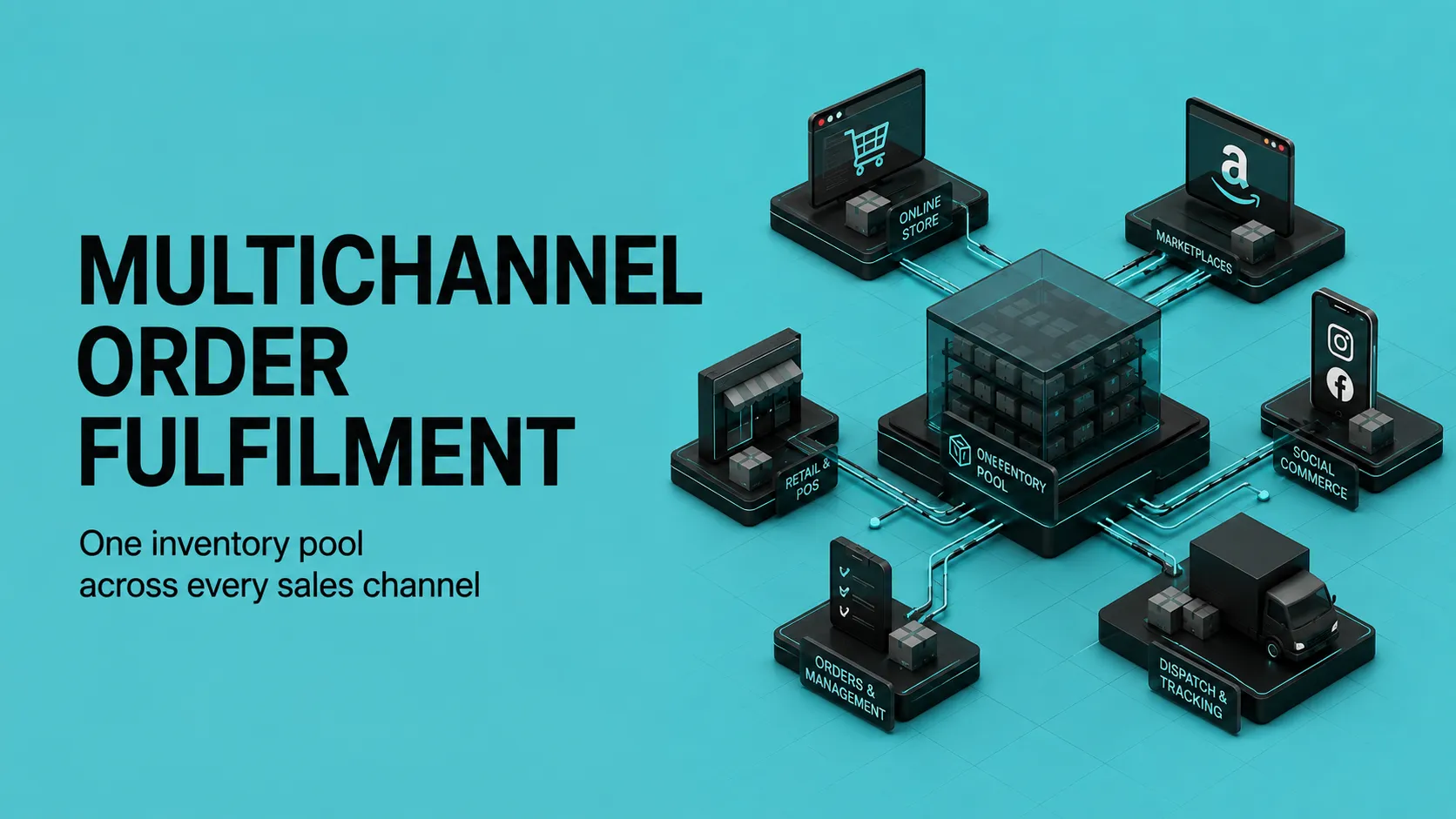
Adding another sales channel is easy compared with keeping inventory trustworthy after the channel goes live. A brand can sell the same SKU through its own store, marketplaces and social commerce, but the warehouse still has to decide whether a unit is actually available and which order receives it.
That is the core multichannel fulfilment problem: the commercial channels are separate, but the physical inventory is not. A strong model lets different order sources draw from one controlled fulfilment operation without creating duplicate orders, conflicting stock balances or channel-specific manual work that no one owns.
One inventory pool is an operating principle, not one universal number
“One inventory pool” means the business avoids permanently separating stock for each channel when the same physical units can serve several channels. The objective is better visibility and utilisation of stock.
That does not mean every system should display an identical available quantity at every moment. Safety buffers, reservations, channel rules and multiple physical locations can legitimately change the quantity offered for sale. Shopify, for example, tracks inventory independently by location when products are stocked across multiple locations or fulfilment apps.
The important requirement is that those differences are intentional and reconciled to one controlled inventory model.
SKU mapping has to be solved before order flow
Different channels can use different product identifiers, variant names or bundle structures. The warehouse needs to know that “BLACK-M” on one channel and another identifier elsewhere refer to the same physical SKU—or that they do not.
Create a channel-to-warehouse mapping for every sellable product. Treat unmatched SKUs as exceptions rather than allowing orders to enter the warehouse with ambiguous item data.
Order ingestion should prevent duplication
Every channel needs a defined route into the order-management or warehouse system. For each source, document how often orders are received, which statuses are eligible for fulfilment and what unique order ID prevents the same sale from entering twice.
Manual CSV uploads can work at low scale, but they need the same controls as an API connection. The risk is not the file itself; it is whether an order can be imported twice, missed or changed after warehouse release without a reconciliation process.
Available inventory needs a clear source of truth
Decide which system owns the operational stock quantity and how other channels receive updates. The source of truth should reflect physical receiving, reservations, picks, adjustments, returns and damaged stock.
If each marketplace is manually edited independently, the business is not running one pool—it is maintaining several guesses about the same warehouse.
Safety stock should be a rule, not hidden manual padding
A brand may deliberately show fewer units on a high-risk channel than physically exist. That can be sensible when synchronisation has delay, campaigns are running or another channel has priority.
Record the buffer logic. Otherwise staff may see a channel quantity that differs from warehouse stock and “correct” it manually, removing the protection the rule was intended to create.
Bundles are one of the hardest multichannel cases
A bundle may be represented differently across channels while consuming the same component inventory. If one kit uses Product A and Product B, a sale needs to reduce the availability of those components even if the marketplace sends only the bundle SKU.
The business needs component logic that is understood by the order and inventory systems. Without it, a successful bundle campaign can oversell the individual products.
Cancellations and order changes need channel-specific cut-offs
Marketplaces and direct stores can expose different customer actions after purchase. The fulfilment operation should define when a cancellation can still stop warehouse work and what happens after picking or carrier handover.
The difficult case is not the new order. It is the order that changes after release. Test address edits, cancellations, payment reversals, partial stock and replacement orders for each major channel.
Tracking has to return to the right customer journey
Once the parcel ships, carrier and tracking information should be associated with the correct source order. A fulfilment operation that ships accurately but leaves the marketplace showing “processing” still creates customer-service work.
Amazon’s Multichannel Fulfillment model demonstrates the general principle of using one fulfilment network and inventory pool across several sales channels, with orders and tracking flowing back to the relevant commerce environment.
Returns should preserve the originating channel
A returned item is physical inventory, but the refund, exchange and customer communication belong to the sales channel where the transaction happened. The returns workflow therefore needs both pieces of information.
Do not let returned stock lose its order context simply because it re-enters one shared warehouse.
Multichannel visibility is an exception-management problem
Dashboards are useful, but the operation becomes scalable when failures are visible. Which orders have not imported? Which SKUs failed mapping? Which stock update did not reach a channel? Which cancellations arrived after release?
Prioritise exception queues and reconciliation over adding more surface-level reports. The objective is to know when the channels and warehouse disagree before a customer discovers it.
The warehouse and technology layer have to be designed together
Multichannel fulfilment sits directly between ecommerce systems and physical operations. That makes integration and inventory technology as important as the pick-and-pack workflow.
When scoping Stashworks, provide every sales channel, SKU mapping, bundle structure, order status, cancellation behaviour and returns requirement. Then test the full event flow—not only whether a logo appears on an integrations list.
One pool works when every movement has an owner
The benefit of consolidated inventory is flexibility: the same stock can support demand from several channels instead of being trapped in separate allocations. The risk is that one incorrect order or stock event can affect all of those channels at once.
The solution is not to split inventory again by default. It is to make product identity, order flow, reservations, exceptions and reconciliation explicit enough that one physical pool remains trustworthy.
For the channel-management layer around this shared inventory model, see Marketplace Management in Singapore. Amazon sellers can also compare FBA with merchant fulfilment and an independent 3PL in Amazon Fulfilment in Singapore.
To operationalise the shared-pool model, use the Platform-to-Warehouse Integration Checklist and Omnichannel Inventory Allocation. If one order cannot be completed from a single inventory position, Split Shipments and Partial Fulfilment explains the service-and-cost trade-off.
Sources: Amazon, Multichannel Fulfillment; Shopify Help Center, Multi-Location Inventory.