“Fulfilment”, “shipping” and “3PL” are often used as if they describe the same service. They do not. That confusion matters because each term covers a different part of the operation, and comparing providers without defining the boundary can produce misleading prices and mismatched expectations.
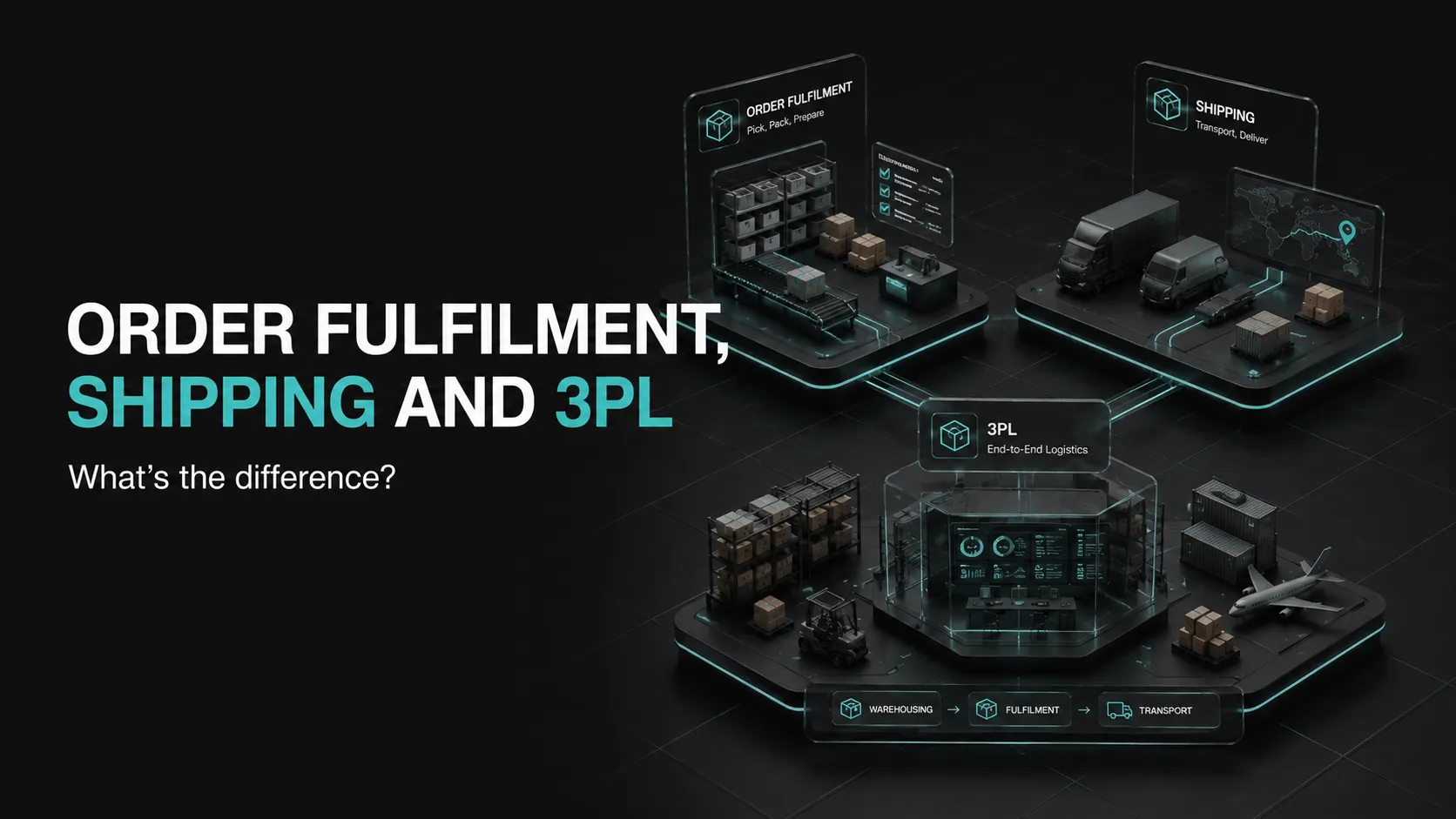
The simplest distinction is this: order fulfilment is a process, shipping is a transport step, and a 3PL is a type of provider that may perform several logistics processes on a client’s behalf. Once that is clear, it becomes easier to understand where warehousing, delivery and freight forwarding fit.
Order fulfilment is the work required to turn an order into a dispatched parcel
Order fulfilment covers the operational steps that take place after an order is ready to be processed. In ecommerce, that usually includes storing inventory, receiving the customer order, picking the correct items, packing them, preparing shipment information and handing the parcel to a carrier. Returns may also sit within the broader fulfilment scope.
The important point is that fulfilment is not the same as transportation. A fulfilment team can prepare a parcel perfectly without being the company that physically drives it to the customer.
Shipping is the movement of the prepared shipment
Shipping begins once goods are ready to move. For a consumer parcel, that may mean a courier collects it from the warehouse and moves it through a sorting and delivery network. For larger commercial shipments, shipping may involve cartons, pallets or freight rather than individual ecommerce parcels.
A shipping charge therefore should not be assumed to include storage, picking or packing. It may cover only the transport service and related carrier activities.
A 3PL describes the provider relationship, not one specific task
A third-party logistics provider performs logistics activities for another business. Depending on the provider, the scope might include warehousing, inventory management, ecommerce fulfilment, delivery coordination, returns, freight forwarding or value-added services such as kitting.
That is why two companies can both call themselves 3PLs and still offer materially different operating models. One may focus on pallet storage and distribution. Another may specialise in high-volume ecommerce orders. A third may connect freight, warehousing, fulfilment and last-mile delivery in one service environment.
Where warehousing fits
Warehousing provides the physical and system environment in which inventory is received, stored and controlled. A storage-only arrangement can stop there. An ecommerce fulfilment operation goes further by using that inventory to process customer orders.
That distinction matters when a business asks for “warehouse pricing”. The right question is whether stock will simply be held or whether the provider also needs to receive ecommerce orders, pick units, pack parcels and coordinate dispatch.
For Stashworks, the relevant service boundaries are separated across warehousing and ecommerce fulfilment, even though those services can connect operationally.
Where last-mile delivery fits
Last-mile delivery is the final movement from a local distribution point or fulfilment operation to the customer. It is one part of the post-purchase experience, but it starts after the order has already been picked, packed and released.
The handover needs clear ownership. The fulfilment operation should produce the correct shipment and tracking information; the carrier then performs the transport. Failed delivery, address problems and damage can cross that boundary, so escalation rules are important.
See Stashworks’ last-mile delivery service for the delivery side of that workflow.
Freight forwarding is different again
Freight forwarding coordinates the movement of larger or international shipments, often before inventory reaches the local warehouse or between business locations. That can involve air, sea or land transport, shipping documents and coordination across logistics partners.
An ecommerce parcel travelling from a Singapore warehouse to a customer is not the same operational problem as a supplier shipment moving inventory into Singapore. Both involve transport, but the scale, documents, service providers and decision points are different.
That is why freight forwarding and ecommerce fulfilment should be scoped separately even when the same logistics partner can coordinate both.
Why the terminology changes how you compare quotes
Imagine Provider A quotes a low “shipping” rate while Provider B quotes a higher “fulfilment” rate. The first may include only carrier transport. The second may include order processing, picking, packing and the carrier handover. Without a common service boundary, the comparison is meaningless.
Before comparing proposals, write down who owns each activity from supplier arrival to final delivery. Mark whether the cost is included, variable, passed through or separately billed.
A useful test: follow one order and one inbound shipment
Rather than asking a provider to define its services in abstract terms, give it two scenarios.
First, follow an inbound shipment from supplier arrival through receiving and storage. Second, follow one ecommerce order from checkout through picking, packing, carrier handover and any possible return. Ask which system records each step, who owns the exception and which charge applies.
The exercise quickly reveals whether the relationship is storage, fulfilment, shipping, a broader 3PL arrangement—or a combination.
The commercial question is scope, not labels
A business does not need to choose the “correct” logistics buzzword before speaking to a provider. It does need a clear operating scope. Product profile, inventory, channels, order complexity, delivery requirements and returns determine the work far more than the label on the service page.
For businesses looking for an integrated Singapore operation, review Stashworks’ logistics and 3PL services and define which parts of the flow need to be outsourced before requesting a proposal.
Sources: Shopify, Order Fulfillment Guide; Amazon, Ecommerce Fulfillment.