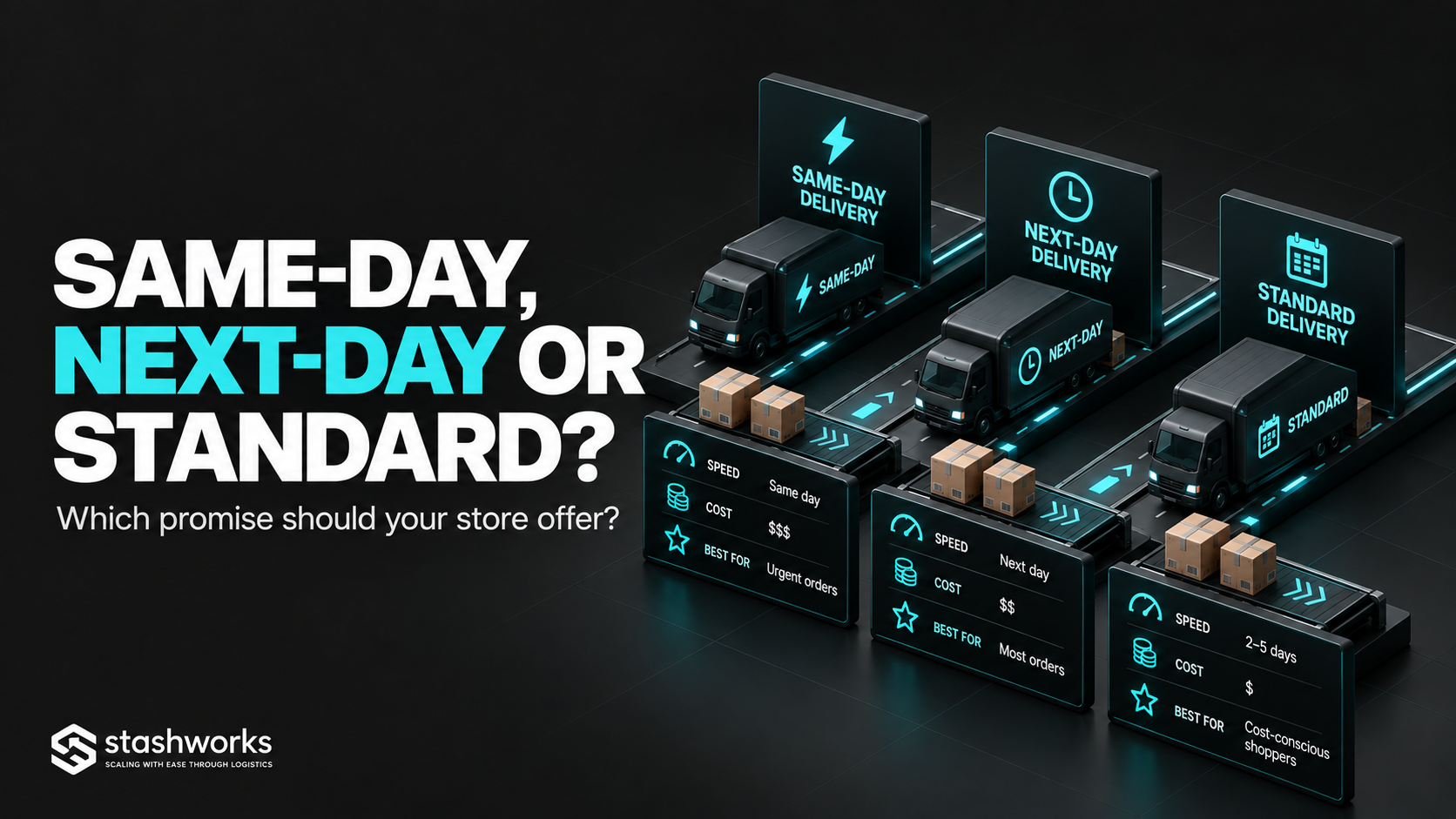
Faster delivery is attractive because it is easy to market. It is also easy to promise a service level that the warehouse and carrier cannot reliably support.
The right delivery promise is the one the complete operation can meet at a sensible cost: order release, inventory availability, picking, packing, carrier handover and final delivery all have to fit inside the same clock.
Do not start with the wording at checkout
Start with the carrier's actual service and final handover requirement. Work backward through staging, packing, picking and order release. The remaining window determines the latest safe customer cut-off.
This is the same operating principle covered in Order Cut-Off Times and Dispatch Workflows.
Same-day delivery is a capacity promise
Same-day can make sense for urgent purchases, selected local inventory, premium baskets or products where speed creates a meaningful customer benefit.
But the window is narrow. The order must arrive early enough, the stock must already be available locally, warehouse work must be completed quickly and the chosen carrier must still have a feasible collection and delivery path.
Do not offer same-day across the whole catalogue simply because one carrier can perform it for some parcels.
Next-day delivery can balance speed and operational flexibility
Next-day gives the warehouse more time to process orders while still offering a clear fast-delivery proposition. It can work well when inventory is local and carrier collection occurs after the warehouse can reliably finish the day's eligible orders.
The promise still needs rules for weekends, public holidays, late orders and products requiring special handling.
Standard delivery protects cost and capacity
Standard service can be the most economical default and gives the fulfilment operation more room to absorb order variation. It may also support a wider range of parcel types or destinations depending on the carrier network.
For many stores, standard delivery should remain the baseline while faster options are offered only where the economics and operational path are proven.
Segment delivery promises instead of using one universal rule
Different SKUs, destinations and customer baskets can justify different services. A small ready-to-ship parcel may be eligible for a faster option while a bulky item or special-handling order follows a longer process.
Use shipping rules that reflect what the operation can perform rather than hiding exceptions in customer-service fine print.
Calculate the incremental cost of speed
Compare the extra carrier cost, warehouse priority work, packaging requirements and exception risk against the commercial benefit. Faster delivery can improve conversion or customer satisfaction, but only if customers value it enough to justify the cost.
Measure contribution margin after delivery cost rather than focusing only on gross sales generated by the faster option.
A faster promise can increase failure cost
Tighter windows leave less time to recover from inventory discrepancies, label errors, address problems or missed carrier collection. A service with a high failure rate can create more support work and reattempts than a slightly slower but reliable option.
Track the percentage of eligible orders that actually achieve the promise, not only how many customers select it.
Build weekend and holiday rules explicitly
Define how orders placed on Friday night, weekends or public holidays are treated. Warehouse operating hours and carrier collection schedules may not match the customer's assumption about “next day”.
Show the applicable expectation at checkout where possible instead of relying on one static shipping statement.
Peak campaigns may require temporary promise changes
During major sales events, the same warehouse and carrier network can receive several times the normal order load. If capacity is constrained, maintaining an aggressive same-day promise can push otherwise healthy orders into failure.
Forecast the campaign and decide in advance whether cut-offs, service availability or customer messaging need to change.
Use three measures for each service level
Track selection rate, cost per successful delivery and on-time performance. Then add the reason for misses: late warehouse release, packing backlog, missed carrier handover, address exception or carrier delay.
That turns delivery speed from a marketing label into an operating service that can be improved.
Match Stashworks delivery options to the actual promise
Stashworks' last-mile delivery service connects completed fulfilment orders to multiple courier options depending on service level, destination, parcel and cost. That does not mean every speed is available for every parcel or account.
When designing the checkout promise, confirm the applicable courier services, warehouse cut-off, parcel constraints and destination coverage first. Then offer the fastest option the complete workflow can reliably support.
Sources: Stashworks, Last-Mile Delivery; SingPost, Singapore Delivery Services.