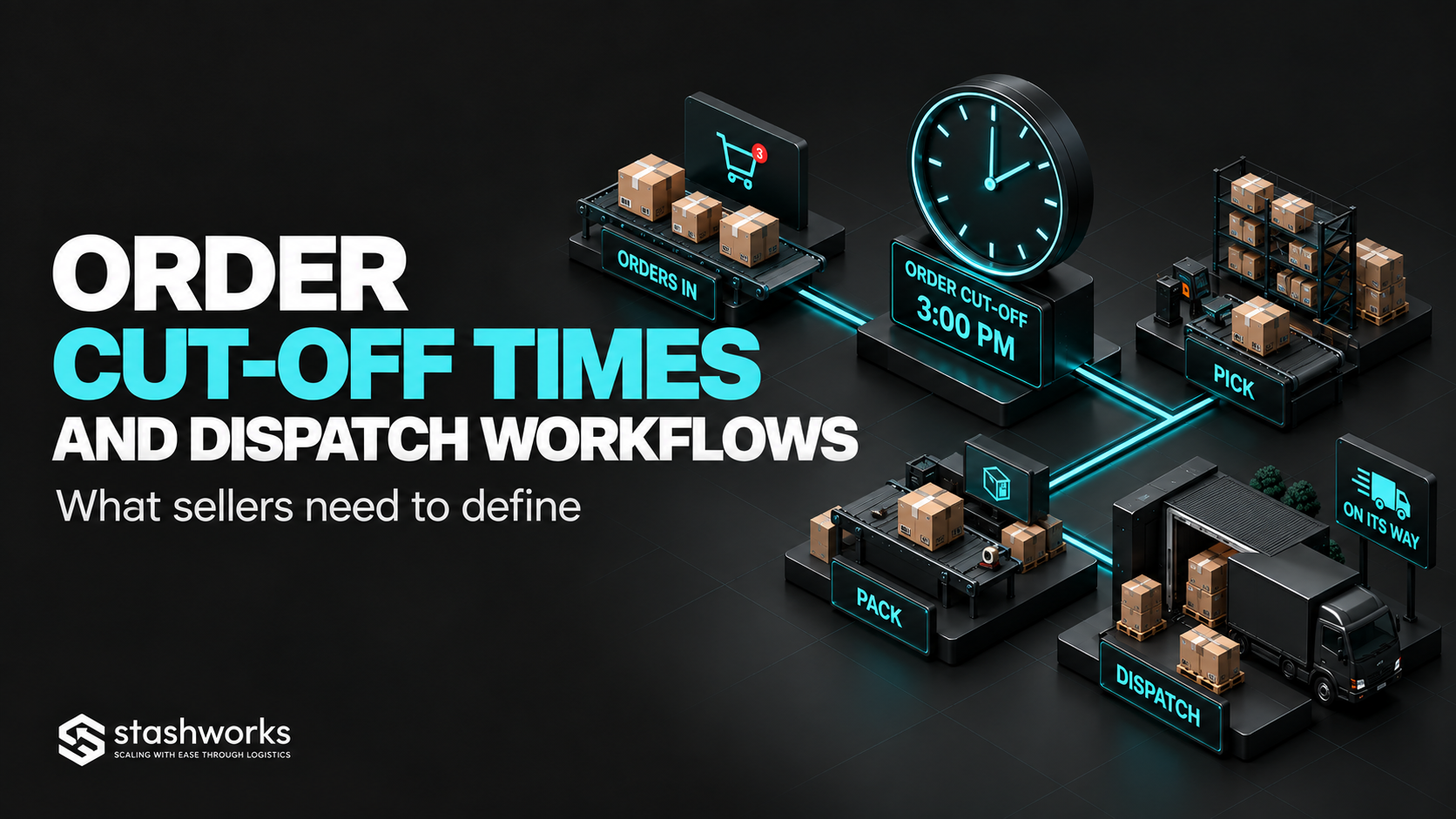
“Order before 2pm for same-day dispatch” sounds like one rule. Operationally, it can depend on several different clocks.
The order has to be eligible for fulfilment. Inventory has to be available. The warehouse needs time to pick and pack it. A label has to be generated. The parcel has to reach the correct collection or drop-off process before the carrier's final handover window. Marketplace orders may also carry their own platform deadlines.
A useful cut-off policy therefore connects the customer promise to the physical workflow behind it.
Start by defining the clocks separately
Document the times that matter to the operation: customer order cut-off, order-release cut-off, warehouse processing cut-off, carrier collection or drop-off cut-off, marketplace ship-by deadline and the final delivery expectation.
These are not interchangeable. A customer may place an order before the storefront cut-off while the order itself remains on payment review or another hold. Conversely, an order can be packed before the warehouse cut-off but miss the carrier handover.
The customer-facing cut-off should be built from the process backward
Do not choose a marketing cut-off first and hope the warehouse can meet it. Start with the final carrier handover, subtract the real time needed for staging and packing, then subtract the time required for picking, release and expected exceptions.
The remaining time becomes the latest point at which the business can safely accept the promise under normal operating conditions.
Measure fulfilment time, not only warehouse touch time
Shopify defines fulfilment time as the period between the customer placing an order and the business fulfilling it by handing the shipment to a carrier. Reviewing the order, printing labels, packaging and carrier handover all contribute to that time.
That framing is useful beyond Shopify. A five-minute pack is not a five-minute fulfilment process if the order waits three hours for release or another hour for carrier collection.
Define which order statuses are eligible for release
Write down the conditions that allow an order into warehouse work. Depending on the channel and business, that can include payment status, fraud review, inventory availability, address validity and any customer-service hold.
Once an order is released, record that moment. It separates upstream waiting time from warehouse processing time and makes late-order analysis much more useful.
Use different rules where the work is genuinely different
A single cut-off may not fit every order. Bulky products, fragile goods, custom packing, kitted products or orders requiring documentation can need more processing time than a normal parcel.
Create a small number of understandable service classes rather than one promise that silently excludes half the catalogue.
Marketplace deadlines are external constraints
Shopee, Lazada and TikTok Shop can impose their own fulfilment milestones. Those rules may vary by programme or order type and can change over time.
For marketplace orders, the warehouse's internal target should sit comfortably inside the current platform deadline. Use the live order data or current Seller Center guidance rather than relying on an old fixed number.
The detailed control model is covered in Marketplace Dispatch SLAs.
Carrier collection determines whether a packed order is actually dispatched
Map the last reliable handover opportunity for each shipping method. If the carrier collects at a defined time, the warehouse needs an earlier staging deadline. If parcels are dropped off, include the travel and acceptance time required to complete that handover.
Keep evidence of the event the operation considers complete, such as the relevant scan, manifest or collection record.
Weekends and public holidays need explicit rules
A Friday-night order can create confusion when the customer, storefront, warehouse and carrier each count business days differently.
Define whether the operation works weekends, which carriers collect, how public holidays affect processing and what the customer sees at checkout. Do not leave those rules to whoever happens to be answering customer messages that day.
Order changes need a final editable point
Customers may request address edits, product changes or cancellations after checkout. Define the latest status at which each change can still be accepted safely.
An address edit before warehouse release may be simple. The same edit after a shipping label has been created or after carrier handover can require a completely different process.
Customer service and fulfilment should use the same cut-off for these changes so one team does not promise an action the other can no longer perform.
Prioritisation rules should be visible to the warehouse
If same-day, marketplace and standard orders share one queue, define how priority is assigned. Use deadline, service class and exception status rather than relying on staff to remember which channel is most urgent.
The queue should also surface orders that cannot proceed because of no stock, a label failure, payment hold or another exception. A blocked urgent order needs a different action from a normal order waiting its turn.
Build a simple dispatch matrix
The exact times belong to the business. The value of the matrix is that every promise has an internal operational counterpart and an owner when the normal flow fails.
Measure misses by stage
Track orders that miss release target, pick target, pack target and carrier handover separately. A single “late dispatch” percentage tells you there is a problem but not where to fix it.
If most misses occur before release, the warehouse may not be the bottleneck. If orders are packed on time but repeatedly miss collection, the carrier schedule or staging process needs attention.
Review cut-offs when volume changes
A cut-off that works at 100 orders per day may fail at 1,000 if the same packing benches and collection remain in place. Re-test the promise during campaigns and after major changes to order mix, staffing, warehouse layout or carriers.
The peak-season fulfilment checklist covers how to prepare that capacity before major ecommerce events.
A 3PL needs the same rulebook
Outsourcing fulfilment does not eliminate cut-offs. It makes the boundary between client, warehouse and carrier more important.
When scoping Stashworks, define which orders are eligible for release, required service classes, marketplace deadlines, carrier arrangements, weekend expectations and how late changes should be handled. Stashworks' ecommerce fulfilment and last-mile delivery layers can then be evaluated against the actual workflow rather than a vague request for “fast shipping”.
Sources: Shopify Help Center, Fulfilment Time and Delivery Dates; Shopify Help Center, Understanding Fulfilment Time; TikTok Shop Singapore, Order Fulfilment Timelines; Stashworks, Ecommerce Fulfilment.