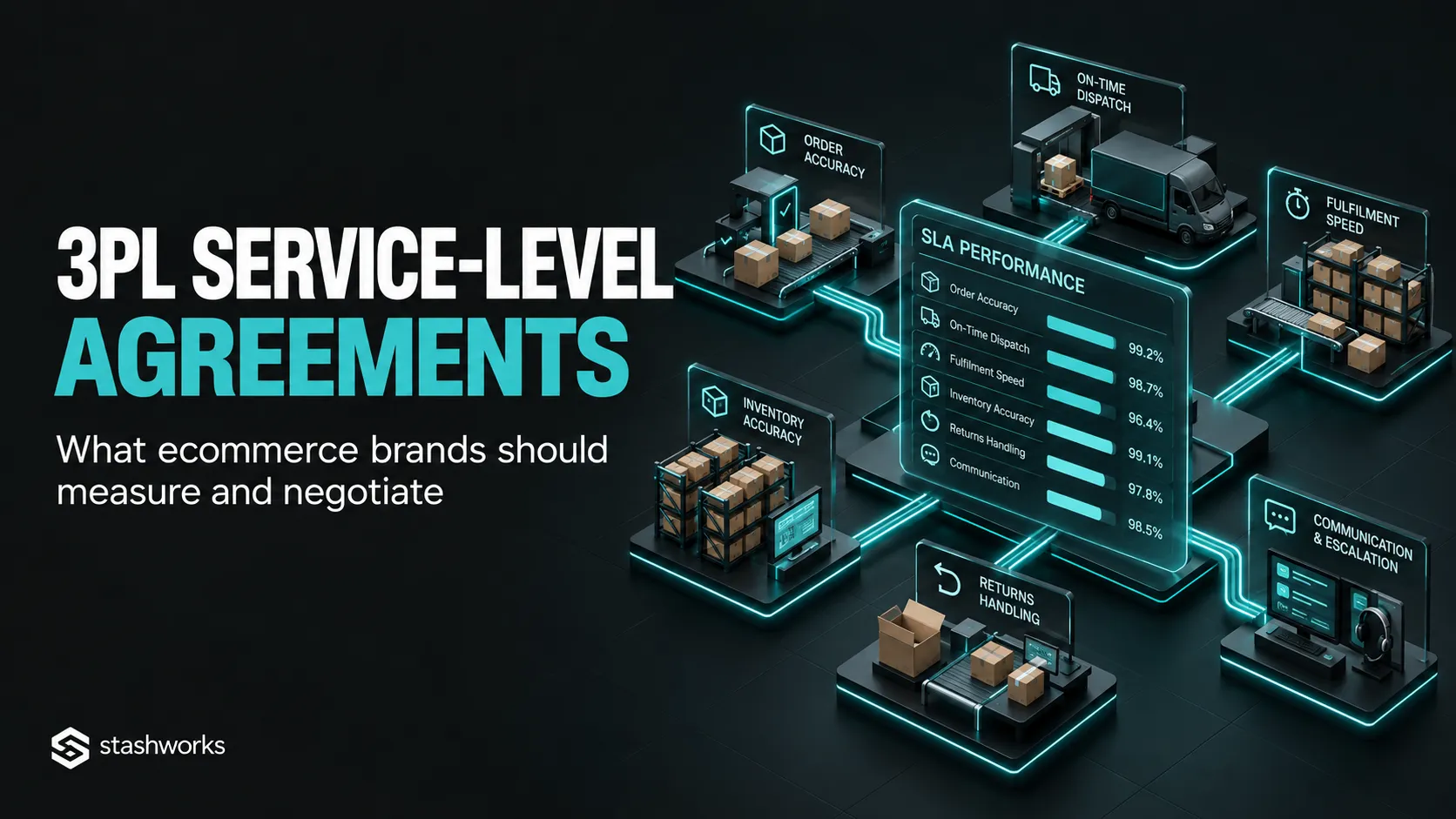
A 3PL service-level agreement should turn operational expectations into measurable commitments. The useful question is not whether a provider says it is fast or reliable. It is whether both parties have defined which outcomes matter, how performance is calculated, which exceptions are excluded and what happens when results fall below the agreed level.
For ecommerce brands, SLAs work best when they reflect the actual warehouse and order workflow rather than a generic template.
Start with the process map
List the steps the 3PL is responsible for: inbound booking, receiving, putaway, inventory control, order release, picking, packing, dispatch, returns, customer-service support and reporting where applicable.
Stashworks' current 3PL Singapore page describes a connected operation spanning receiving, storage, fulfilment, delivery handover, returns and supporting technology. Any SLA should be scoped only to the services actually included in the account.
Measure receiving separately from storage
Receiving performance can be measured against agreed inbound information, appointment compliance, quantity verification and the point at which approved stock becomes available in the system. The clock should not begin before the warehouse has the data and physical access required to perform the task.
Define how discrepancies, damaged cartons, missing barcodes or unexpected shipments affect the metric.
Inventory accuracy needs a precise definition
“Inventory accuracy” can mean unit accuracy, location accuracy, SKU accuracy or financial inventory accuracy. Choose the method, frequency and tolerance that matches the operation.
A useful scorecard distinguishes routine system accuracy from known quarantine, return and discrepancy states so unresolved exceptions do not silently disappear inside one percentage.
Order accuracy should measure what the customer receives
Order accuracy can be measured using correct SKU, correct quantity, correct pack configuration and agreed inserts or special instructions. If the operation uses system verification, the SLA should still define how customer-facing errors are counted.
Stashworks' current technology page describes system-generated picking, QR-based product verification and packing checks, but no public universal accuracy percentage should be assumed.
Processing time needs a valid starting point
Do not measure warehouse performance from the moment the customer clicks “buy” unless the warehouse receives a fulfilment-ready order at that same moment. Define the qualifying order status, cut-off, payment state, inventory availability and exception conditions.
Separate normal orders from pre-orders, address holds, fraud review, customer changes and other cases outside the standard workflow.
Dispatch performance is different from delivery performance
The warehouse can control preparation and carrier handover; the courier controls much of the transport after handover. Measure these separately so the 3PL is not penalised for a carrier event it cannot control, and the carrier problem is not hidden inside warehouse data.
Where the 3PL also manages carrier selection, define which delivery metrics sit inside the wider service review.
Returns need their own SLA
Return processing can include parcel identification, inspection, disposition, restock or quarantine and system update. Measure the part of the workflow actually owned by the 3PL.
Returned stock should not be considered available simply because it arrived at the warehouse.
Measure exception handling, not only happy-path orders
A mature SLA includes ageing for unresolved exceptions: unmatched SKUs, inventory discrepancies, failed integrations, address holds, damaged inventory and carrier claims. These queues often create more operational risk than ordinary orders.
Include reporting and escalation expectations
Define the reporting frequency, data fields, review meeting cadence and escalation contacts. An SLA without a reporting method becomes difficult to enforce because the parties may disagree about the underlying data.
Use thresholds that reflect actual business risk
Not every metric needs the same target or consequence. A small delay in a low-priority report is different from a repeated inventory discrepancy on a high-value SKU.
Rank metrics by commercial impact and decide which are service indicators, which are contractual SLAs and which require immediate escalation.
Agree exclusions before performance is measured
Typical exclusions may include late inbound information, force majeure events, customer-requested holds, system outages outside the provider's control, incomplete product data and orders outside agreed operating rules. The contract should define exclusions carefully rather than allowing them to become a blanket excuse.
Use rolling trends, not one isolated month
Monthly results are useful, but a rolling three-month view can show whether a miss was an isolated event or a recurring pattern. Pair the headline metric with root-cause information and open corrective actions.
Do not copy another brand's SLA
A fashion brand with high variant complexity needs different controls from a simple one-SKU subscription box. Build the SLA from your catalogue, order profile, channel mix, packaging and customer promise.
Negotiate remedies only after measurement is clear
Service credits, corrective-action plans, termination rights or other remedies should be discussed only after the calculation method and exclusions are unambiguous. Otherwise the remedy clause becomes a dispute over the metric itself.
Stashworks does not publish a universal SLA on its current website. Any commitment should therefore be confirmed in the actual commercial agreement rather than inferred from marketing content.
General information only: SLA terms can create contractual and legal consequences. This article is operational guidance, not legal advice.
Sources: Stashworks, 3PL Singapore; Stashworks, Technology.