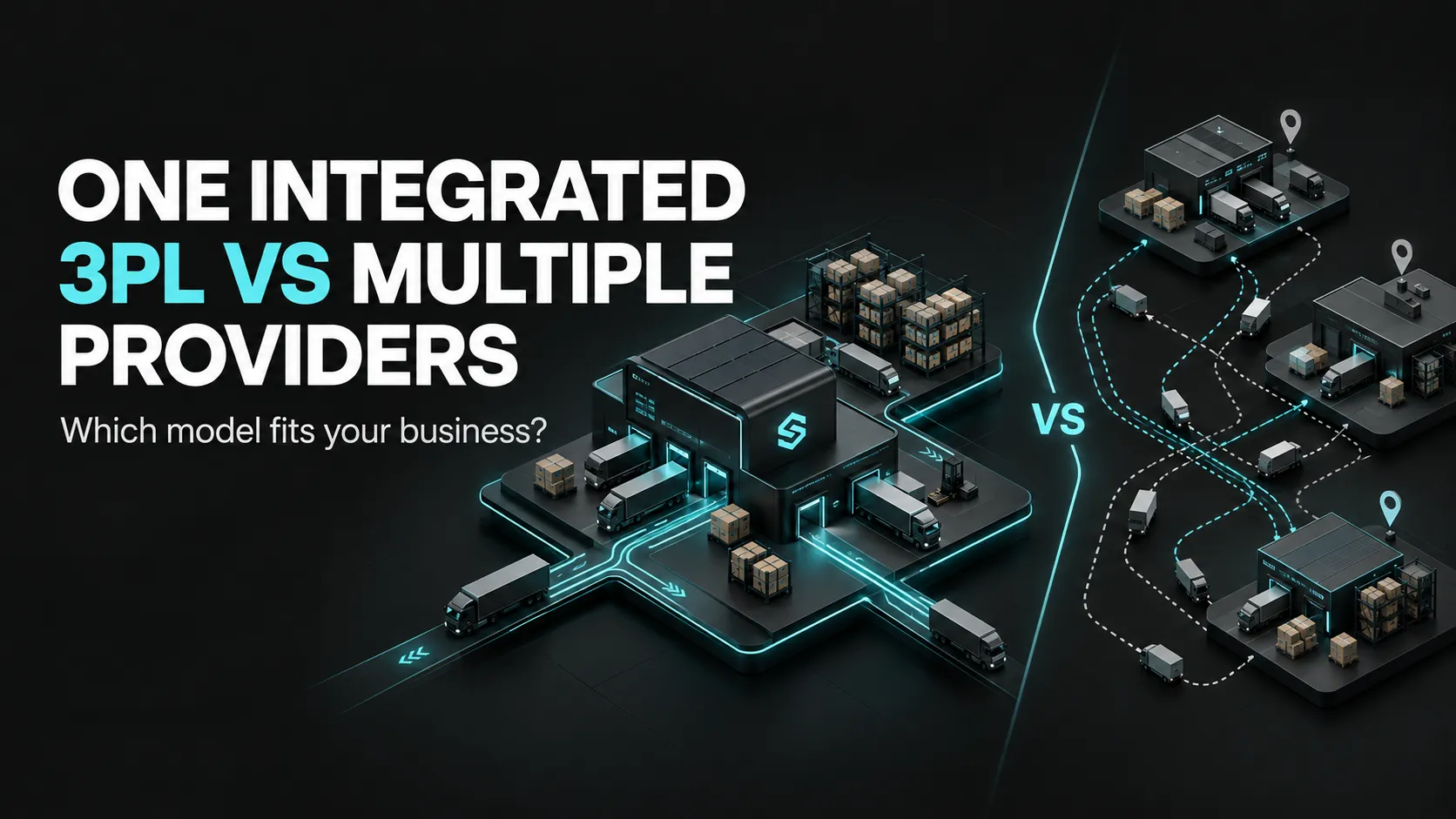
A brand can run logistics through one integrated 3PL or split warehousing, fulfilment, freight and delivery across several specialists. Both models can work. The trade-off is between coordination simplicity and provider specialisation.
The right choice depends on the complexity of the network, required capabilities and the management capacity inside the brand.
Define what “integrated” actually means
An integrated provider may combine warehousing, fulfilment, freight, delivery and technology under one commercial relationship. That does not necessarily mean every transport asset or service is owned directly by one company.
Ask which activities are delivered directly and which rely on partner networks.
One provider can reduce handoff management
With fewer commercial relationships, the brand can have one account-management route, one escalation path and a more connected view of inventory and orders.
Stashworks' current 3PL Singapore proposition is built around combining warehousing, ecommerce fulfilment, freight forwarding and last-mile delivery within one connected operation.
Multiple providers can increase specialisation
A specialist freight forwarder, warehouse and courier may each offer deeper expertise in a narrow area. This can be valuable for unusual commodities, highly specialised routes or complex delivery requirements.
The brand then becomes responsible for coordinating the interfaces between them.
Compare the data architecture
With one provider, order, inventory and shipment information may sit inside a more consolidated operational flow. With several providers, the brand may need its own OMS, ERP or integration layer to keep records aligned.
The deciding factor is not the number of dashboards; it is whether inventory, order status, cancellations and tracking remain consistent.
Look for hidden handoff risk
When freight, warehousing and delivery are separate, define who owns each transition: port to warehouse, warehouse to carrier, failed delivery to returns and data transfer between systems.
Many logistics problems occur between providers rather than inside one provider's process.
Do not assume one provider means one point of failure
An integrated 3PL may still use multiple carriers, facilities or partners. Conversely, a multi-provider model can still depend on one central system.
Assess real operational dependencies rather than counting contracts.
Compare resilience
A multi-provider model can give the brand alternatives if one supplier fails, but only if those alternatives are operationally usable. An integrated model can also provide resilience through its wider network.
Ask how capacity, carriers, systems and facilities are recovered during disruption.
Compare purchasing leverage
Consolidating volume with one provider may improve commercial leverage or reduce duplicated setup costs. Splitting volume may protect optionality but reduce scale benefits.
Model total cost, including internal management time.
Compare governance burden
Every provider adds contracts, invoices, reviews, issue logs and relationship management. A brand with a small operations team may value consolidation more than a large enterprise with dedicated logistics management.
Compare change speed
Launching a new channel or country can be faster when one provider already connects inventory and fulfilment. On the other hand, an integrated provider may be slower to adopt a specialist service it does not currently support.
Consider customer experience
The customer sees one order journey even when the brand uses several providers. Tracking, delivery status and returns should remain coherent across the network.
Use a provider-by-process matrix
List each process from inbound freight to returns and identify the provider, system, handoff and escalation owner. Gaps become obvious when one step has no single accountable party.
A hybrid model is common
Some brands use one 3PL for core warehousing and fulfilment while retaining specialist freight or delivery partners for certain lanes. The question is whether the hybrid interfaces are well controlled.
Choose based on what the brand wants to manage
If the business wants to outsource coordination as well as physical execution, an integrated provider can be attractive. If the brand wants direct control over each specialist relationship, multiple providers may fit better.
How Stashworks fits
Stashworks' live site positions its 3PL operation as a connected combination of warehousing, fulfilment, freight and last-mile delivery, with technology linking inventory and order information. It also states that individual services can be used separately.
That means a brand can evaluate Stashworks as either a broader integrated partner or one component within a multi-provider network, depending on scope.
Sources: Stashworks, 3PL Singapore; Stashworks, Services; Stashworks, Technology.