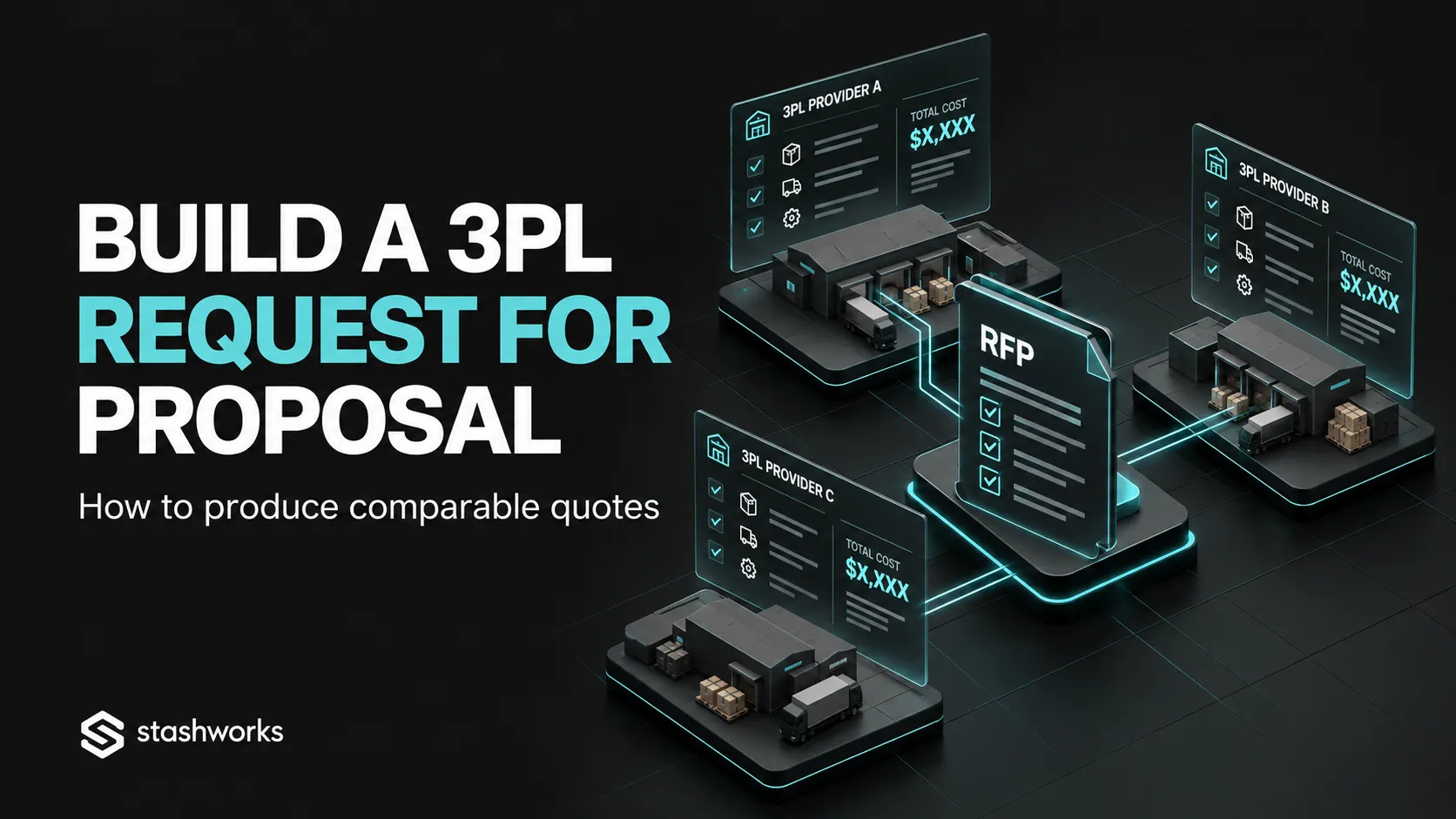
A 3PL request for proposal should make providers quote the same operation. If one bidder assumes 500 monthly orders, another assumes 5,000, and a third prices only storage, the resulting proposals are not comparable even when the rate tables look precise.
The purpose of the RFP is to create one shared operating brief and one response structure.
Describe the business before asking for rates
Explain the sales model, major channels, target markets, product categories, current fulfilment setup, reason for change and expected launch date. Providers need context to understand which services and systems are relevant.
Keep the background concise; the operating data matters more than brand history.
Give SKU and inventory data
Provide active SKU count, average and peak inventory, carton and pallet configuration, dimensions, weights, storage requirements and expected inventory growth. Identify products that need AC storage, ambient storage, controlled handling or other special conditions.
Stashworks' current 3PL Singapore page asks brands to define products, SKUs, inventory and operational requirements during solution design.
Give real order-profile data
Include monthly average orders, peak-day orders, order lines per order, units per order, common bundles, cancellation rate and major promotional spikes. If the business is seasonal, show at least one full annual pattern where available.
Averages alone can hide the capacity problem the 3PL is actually being hired to solve.
Describe the inbound profile
State shipment frequency, origin, transport mode, carton or pallet quantities, expected receiving notice and the level of product data available before arrival.
Receiving labour and storage planning depend on how inventory enters the warehouse, not only how it leaves.
Define every service in scope
Separate warehousing, ecommerce fulfilment, freight forwarding, last-mile delivery, returns, kitting, relabelling, bespoke packing and other value-added work. Ask providers to mark each item as included, optional, subcontracted or unsupported.
List every sales channel and integration
Provide the ecommerce platforms, marketplaces, OMS or ERP, expected data flows and any custom integration requirements. Ask how orders, inventory, cancellations and tracking are handled.
Stashworks currently lists integrations including Shopify, Shopee, Lazada, TikTok Shop, Amazon, WooCommerce, Magento, BigCommerce, eBay, Zalora, EasyShip and EasyParcel, together with open API connectivity. Specific account requirements still need confirmation.
Define the customer promise
State the delivery services, cut-off logic, countries or zones, packaging requirements and any marketplace dispatch obligations the operation needs to support. Do not ask providers to guess the service level from your current website.
Use a standard pricing template
Ask every bidder to price the same cost lines: setup, integration, receiving, storage, pick and pack, additional items, packaging, kitting, returns, project work, delivery, minimum commitments and one-off migration costs where applicable.
Require the unit of measure beside each rate.
Force assumptions into the open
Add a column for assumptions and exclusions. A low quote may depend on order volume, pallet profile, data quality or a minimum term that another provider priced differently.
The goal is to compare total operating cost under the same scenario, not the cheapest isolated line item.
Ask for implementation detail
Request the proposed onboarding sequence, required data, system testing, inventory transfer approach, go-live criteria and implementation responsibilities.
Stashworks' current onboarding flow includes operation review, solution design, system connection, inventory transfer, workflow testing and go-live.
Ask for governance, not only operations
Include account-management structure, review cadence, escalation path, issue management, reporting and change-control process. A provider can operate well day to day and still be difficult to manage if governance is unclear.
Ask for evidence behind claims
Request current certifications, facility information, relevant operating references and examples appropriate to your requirements. Verify the specific relevance of each credential rather than treating logos as proof of every capability.
Build a weighted scoring model
Score commercial fit, operational capability, technology, implementation, governance, risk, references and cost separately. Weight the categories according to the business rather than allowing the lowest total quote to decide the outcome automatically.
Run clarifications before final scoring
Give bidders one controlled opportunity to answer missing items and confirm assumptions. Record all material clarifications so the final comparison remains fair.
Use the RFP as the starting point for the contract
The approved scope, pricing assumptions, implementation responsibilities and service requirements should flow into the statement of work or contract. Otherwise important commitments can disappear between selection and onboarding.
General information only: An RFP is an operational procurement tool, not a substitute for legal review of the resulting contract.
Sources: Stashworks, 3PL Singapore; Stashworks, Technology and Integrations.