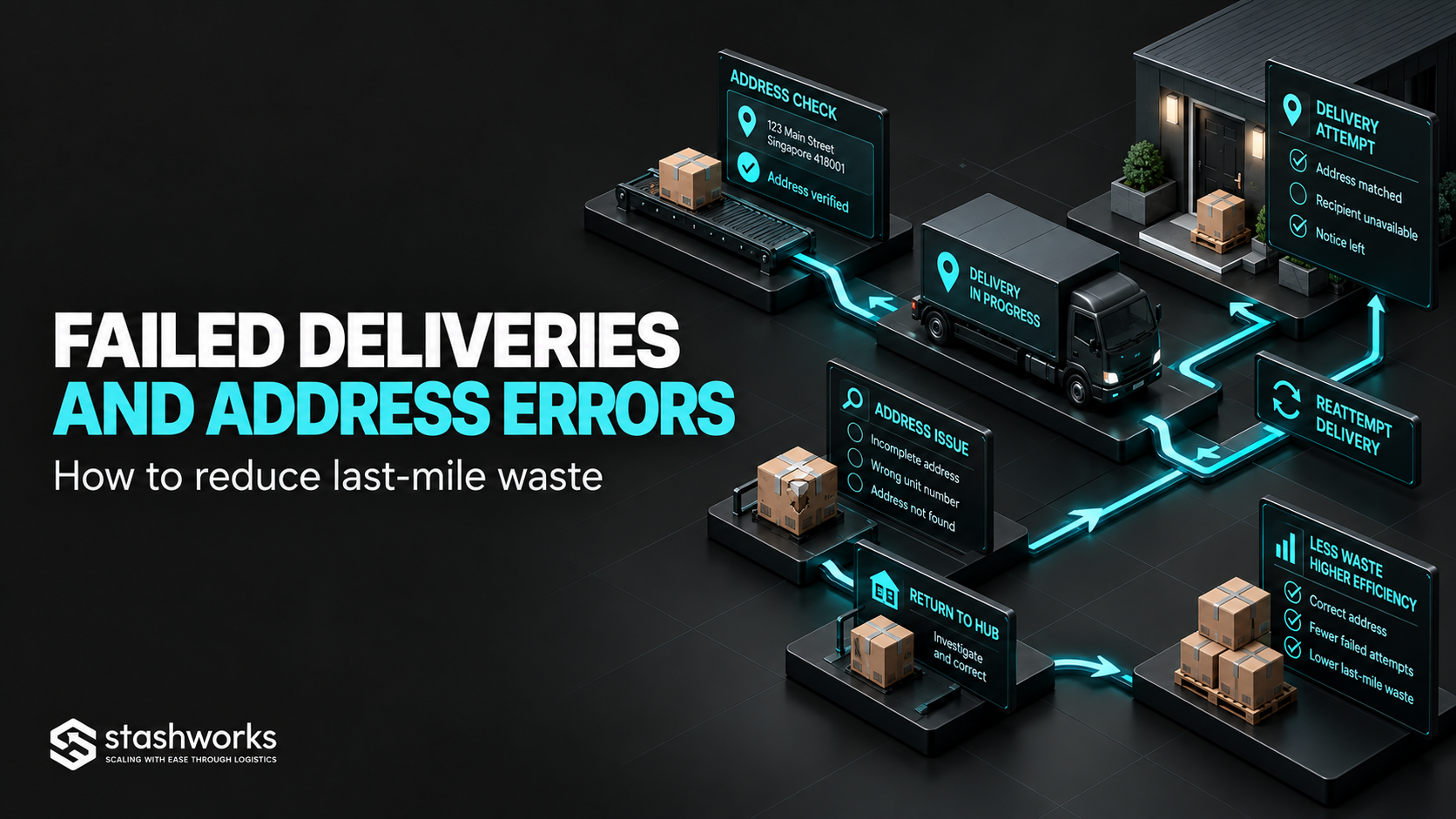
A failed delivery is more than a courier problem. It can create a reattempt, customer-service conversation, return-to-sender movement, delayed refund or a parcel that has to be received and processed again.
Many failures cannot be eliminated, but a large part of the waste can be reduced before the parcel leaves the warehouse.
Start with complete address data at checkout
Require the fields needed for the destination: recipient name, street address, unit number where applicable, postal code and an appropriate contact method. Missing apartment or unit information can leave the carrier with a technically valid building address but no practical way to complete the delivery.
Keep the address structure consistent when order data moves from the storefront into the fulfilment and carrier systems.
Use validation as an exception signal
Modern ecommerce platforms can identify some address errors or suspicious combinations before fulfilment. Treat those warnings as an opportunity to resolve the order rather than blindly passing the same bad data to the carrier.
Validation capability differs by platform and country, so do not assume every Singapore address will be corrected automatically. The principle is to surface high-confidence problems early.
Protect customer edits from creating label mismatches
If a customer changes the address after ordering, define which system owns the final version and the last point at which an edit is allowed. An order should not show one address in customer service while the shipping label still contains another.
Once the parcel has been handed to the carrier, route changes may need to follow the carrier's process rather than a warehouse edit.
Give the carrier usable contact information
Where the service requires it and privacy rules permit, make sure the shipment contains the appropriate recipient contact information. This can help with access, delivery instructions or exception communication.
A phone number is not a substitute for a complete address, but it can prevent a solvable access problem from becoming a failed attempt.
Track the parcel after handover
A tracking number is useful only when someone can act on the status. Monitor delivery exceptions and identify orders that are stalled, awaiting recipient action or returning to sender.
Customer notifications can also reduce uncertainty and give the recipient a chance to follow the carrier's available redelivery or collection process.
Use lockers or collection points where they fit
A collection option can reduce dependence on the recipient being present at a specific address. Singapore's parcel-locker network is designed to aggregate deliveries and provide more flexible collection.
The option still needs to match parcel dimensions, carrier support and customer preference. Do not force every parcel into a locker workflow.
Define the reattempt policy
Know what happens after the first failed attempt: whether another attempt is automatic, whether the recipient must act, whether a collection point is offered, and when the parcel becomes return-to-sender.
The exact rule belongs to the selected carrier and service. Capture it in the customer-service SOP so staff do not make promises that the delivery service cannot perform.
Separate address failures from recipient-availability failures
Use reason codes. “Failed delivery” is too broad to improve. Track incomplete address, invalid postal code, no unit number, recipient unavailable, restricted access, refusal, damaged parcel and carrier exception separately where data allows.
The patterns tell the business where to intervene: checkout, customer communication, packaging, carrier selection or service rules.
Return-to-sender should reconnect to the original order
When a failed parcel comes back, identify the original order before it enters normal inventory. Confirm parcel condition, product condition and the commercial decision for the customer.
Only restore the unit to saleable stock after the appropriate warehouse inspection.
Measure cost per successful delivery
Useful measures include first-attempt delivery success, address-error rate, reattempt rate, return-to-sender rate and the cost associated with failed attempts.
Segment those measures by carrier, service level and destination. A low quoted delivery rate can be misleading if the service generates materially more exceptions.
Connect warehouse and last-mile exception data
Some failures originate before the carrier receives the parcel: wrong label, incomplete data, late handover or an order changed after packing. Others occur in the delivery network. Keep timestamps and reason codes so responsibility is visible.
Stashworks' last-mile delivery connects carrier handover to the fulfilment workflow and can support multiple courier options. For a specific implementation, confirm what tracking and exception events are available from the selected courier and how returns are routed back into the warehouse process.
Sources: Shopify Help Center, Shipping Address Validation; SingPost, Parcel Lockers; IMDA, Nationwide Parcel Locker Network; Stashworks, Last-Mile Delivery.