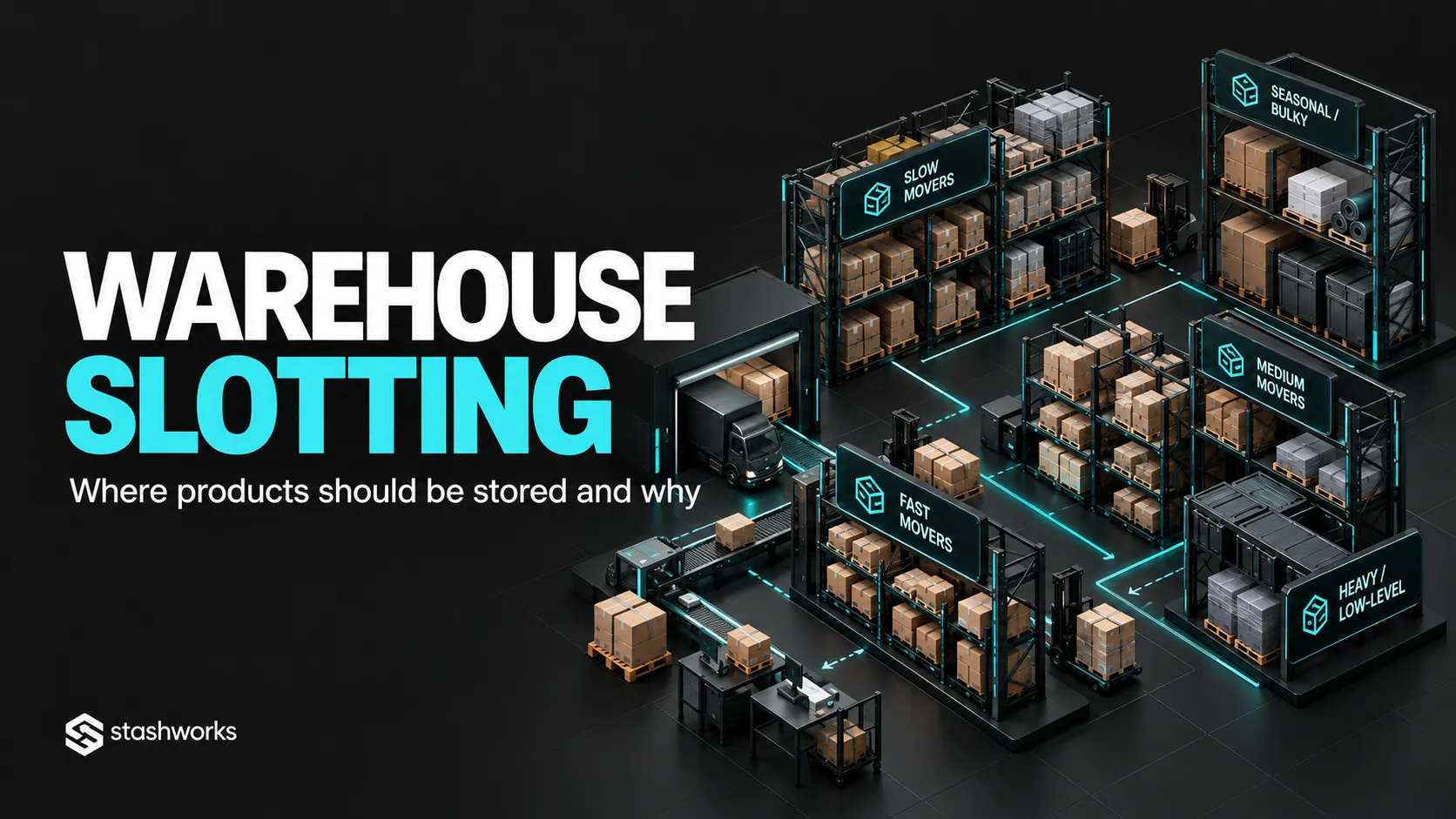
Warehouse slotting is the decision about where each product should live inside the storage and picking operation. The objective is not to make shelves look organised. It is to reduce unnecessary movement while keeping inventory safe, identifiable and easy to replenish.
A good slotting plan changes as the product mix and demand pattern change.
Separate reserve storage from pick locations
Fast-moving products may have a forward pick location replenished from reserve stock. This keeps frequently picked inventory close to the picking path without using the entire prime area for excess units.
The exact structure depends on warehouse scale and product profile.
Use velocity, not product name, as the first signal
Products that generate the most pick activity generally deserve easier access than slow-moving items. Analyse order lines and units picked, not only sales revenue.
An expensive product can be commercially important while creating very little warehouse travel.
Review velocity by season
ABC classifications change. A gift product may become an A-item during peak campaigns and return to low velocity afterwards.
Slotting should therefore be reviewed around major range changes and demand cycles rather than treated as permanent.
Keep high-affinity products closer together where it helps
Order affinity measures how often products appear together. If two SKUs are frequently bought in the same order, placing them in the same practical pick zone can reduce travel.
Do not cluster them if doing so creates congestion or violates handling requirements.
Match the slot to product dimensions
A small fast-moving item should not consume a pallet location if a bin can hold the required pick quantity safely. Oversized products need storage that avoids repeated handling or obstruction.
Use actual packaged dimensions and weight rather than catalogue estimates.
Consider weight and ergonomics
Heavy units should be stored at safe heights and in locations that reduce unnecessary lifting. Frequently picked items should be accessible without creating unsafe repeated movement.
Separate fragile and high-risk products
Fragile, high-value, regulated or easily damaged goods may require dedicated zones or controlled access even if that increases travel distance.
Operational risk can outweigh pure pick-speed optimisation.
Use barcode and location controls together
A location code tells the WMS where the unit should be; a product scan confirms what the worker actually found. Together they reduce reliance on visual memory.
The barcode framework in Barcode Strategy for Ecommerce Warehousing explains the identification layer.
Plan replenishment before shrinking the pick face
A very small forward-pick slot can save space but create constant replenishment work. Estimate peak daily demand, case pack and replenishment frequency before setting the slot size.
Replenishment should happen before the picker reaches an empty location.
Use demand variability, not only average demand
Products with irregular spikes may need more buffer in the pick face during campaigns even if their monthly average appears modest.
Coordinate slotting changes with the campaign calendar.
Separate similar-looking variants where risk is high
Putting nearly identical sizes or colours beside each other can increase mis-picks. Scan verification helps, but slotting can reduce the opportunity for error as well.
Do not encode the slot into the SKU
Locations change as demand changes. The product identifier should remain stable while the WMS records the current bin or zone.
Use slow-moving space deliberately
Long-tail inventory does not need prime access, but it still needs a defined and searchable location. Poorly slotted slow stock becomes difficult to count and easy to lose.
Review congestion as a slotting signal
A theoretically optimal zone can perform badly if many pickers converge on the same aisle. Observe actual travel, waiting and replenishment interference.
Measure the effect of changes
Useful measures include travel time, lines picked per hour, replenishment frequency, pick errors and congestion. Compare before and after a major re-slot rather than assuming movement creates improvement.
Use the WMS as the location source of truth
Stashworks' Warehousing and Technology pages describe location-based inventory control and WMS-supported warehouse execution. The exact slotting and replenishment logic for a specific operation should be confirmed during solution design.
Sources: Stashworks, Warehousing; Stashworks, Technology; Shopify Help Center, Viewing Inventory and Bin Names.