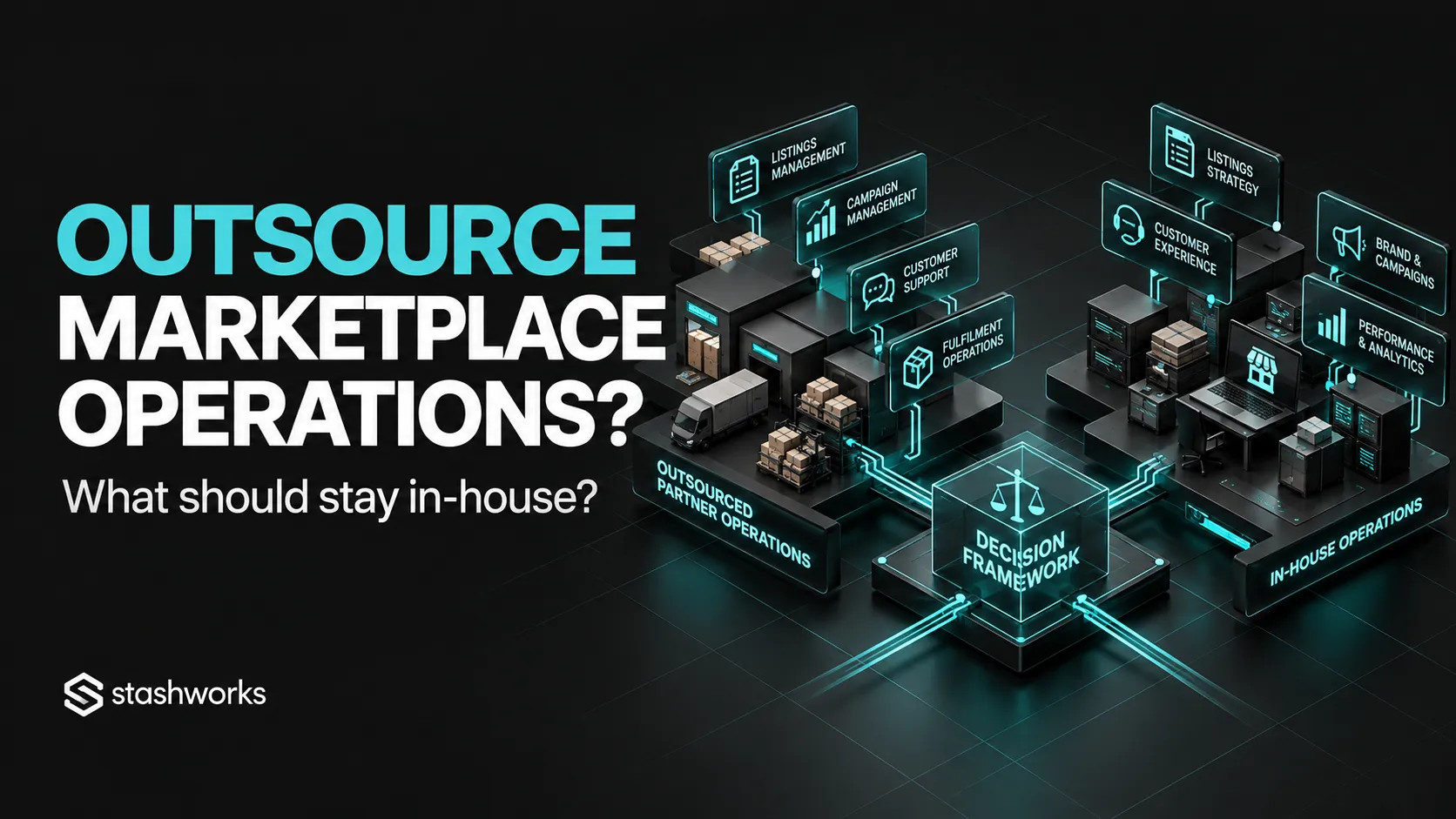
Marketplace operations are a good outsourcing candidate when repetitive execution is consuming internal time, but outsourcing works best when the brand does not hand over every decision simply because an external partner can perform the task.
The practical model is usually hybrid: outsource work that benefits from repeatable processes and platform attention, while retaining the decisions that define the brand, commercial risk and legal responsibility.
Outsource the work that is repetitive and operationally defined
Tasks are easier to outsource when they have clear inputs, outputs and approval rules. Catalogue maintenance, marketplace administration, routine listing updates, campaign setup support and agreed customer-service workflows can fit this pattern.
Stashworks' current Ecommerce Enablement service is structured around marketplace management, listings, campaign support, customer support and fulfilment coordination rather than replacing the brand's overall ecommerce strategy.
Keep brand strategy in-house
The brand should retain ownership of positioning, target customer, assortment strategy, product roadmap and the commercial role each marketplace plays. An operator can execute a channel plan, but it should not have to invent the brand's strategic priorities.
Without that distinction, operational decisions can start shaping the business simply because they are the easiest decisions for the external team to make.
Keep pricing authority clearly controlled
An external partner may configure approved prices, vouchers or promotions, but the brand should define who can authorise changes that affect margin or commercial commitments.
A useful setup separates preparation from approval: the operator prepares the campaign or price change; an authorised brand stakeholder approves it before launch where required.
Retain approval over product claims and sensitive content
Listings can include claims about ingredients, performance, compatibility, warranties, origin, safety or regulated product characteristics. Those statements should come from approved brand or compliance sources rather than being created independently by a marketplace operator.
The operator can format and maintain the content while the brand remains responsible for the underlying factual approval.
Outsource campaign execution, not demand planning blindly
Campaign setup is a natural operational task, but the brand still needs to approve participating products, discount strategy and demand assumptions. Inventory and fulfilment teams also need to confirm readiness.
The existing peak-sale planning checklist shows why a promotion decision can affect receiving, storage, picking, packaging and carrier handover.
Customer support can be outsourced with decision limits
Routine product and order enquiries can be handled externally when the operator has accurate information and clear escalation paths. The brand should retain control over exceptions that require product judgement, policy interpretation, significant financial discretion or regulatory decisions.
Define the threshold for escalation before the first customer issue rather than negotiating it case by case.
Do not outsource ownership of marketplace accounts
External operators may need access, but the brand should retain account ownership and administrative control wherever the platform structure allows it. Use delegated roles, users or partner access instead of transferring the practical control of the account to one outside individual.
This makes the operating relationship easier to change without losing continuity.
Keep financial and payout controls restricted
Marketplace operations may require visibility into sales or campaign data, but access to banking, payouts, tax settings or high-level financial controls should be granted only when the task genuinely requires it.
Role-based permissions are useful because they allow operational access without exposing unrelated sensitive functions.
Use a responsibility matrix before outsourcing
A responsibility matrix makes the hybrid model explicit. The table below is an example framework, not a fixed Stashworks scope.
Outsource when internal opportunity cost becomes too high
The right trigger is not simply that the work is annoying. Look at how much skilled internal time is being consumed, whether backlogs are increasing, whether errors are becoming common, and whether channel growth is being limited because nobody has enough time to operate the marketplaces properly.
This is different from the question in When Should You Outsource Ecommerce Fulfilment to a 3PL?, which focuses on physical storage and order execution. Marketplace outsourcing is about the digital operating layer around the channels.
Use service levels that match the outsourced responsibilities
If a provider manages listing queues, measure listing backlog and error resolution. If it manages customer enquiries, measure backlog and escalation. If it manages campaign operations, review readiness exceptions and execution accuracy.
Avoid holding an operator responsible for sales outcomes driven by pricing, product demand or advertising decisions that remain outside its scope.
Build the handover so the brand can still operate without the partner
Product files, campaign calendars, access records, issue logs and marketplace documentation should remain available to the brand. Processes should be documented enough that another authorised team could understand the account if the relationship changes.
Good outsourcing reduces operating workload without creating dependency on undocumented knowledge.
Where Stashworks fits
Stashworks positions Ecommerce Enablement as an agreed operating scope around marketplaces and stores, with onboarding that includes platform access, catalogue information, fulfilment connection and a responsibility split. That makes the responsibility matrix a central part of the service rather than an administrative afterthought.
Before outsourcing, decide what the brand wants to stop doing, what authority it is prepared to delegate and what must remain under internal control. That produces a clearer scope and a healthier long-term operating relationship.
If the outsourced scope will support entry into a new country, run the additional checks in the SOBAAS Due-Diligence Checklist before appointing a sell-on-behalf partner.
Sources: Stashworks, Ecommerce Enablement; Shopify Help Center, Custom role examples; TikTok Business Center, Account and asset-level permissions.