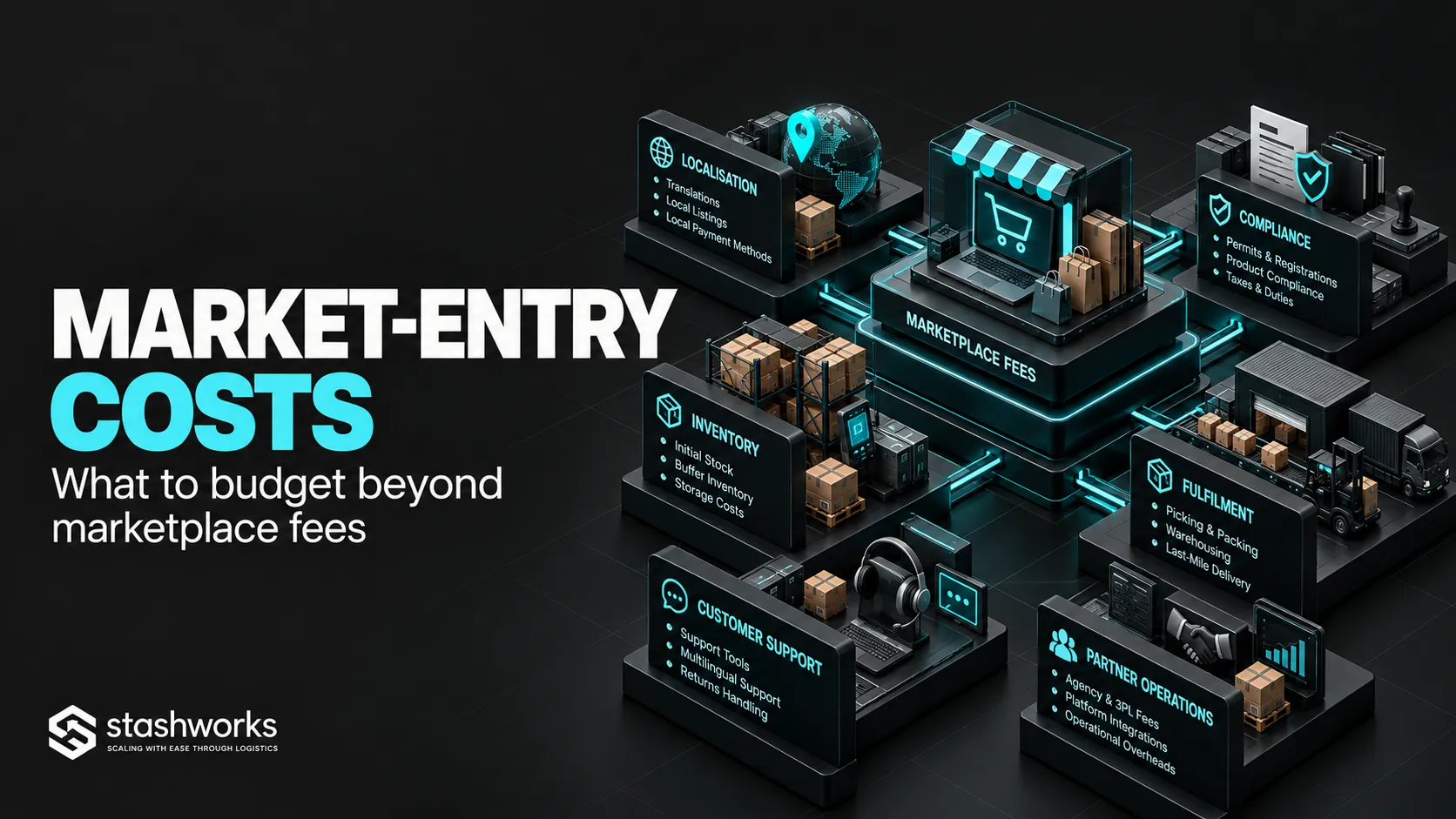
Marketplace commission is one of the easiest market-entry costs to see, which is why it is often over-weighted in early planning. The more important budget is the complete cost of making a product legally sellable, physically available, discoverable, deliverable and supportable in the new market.
A useful budget separates one-off setup costs, recurring operating costs, variable order costs and working-capital requirements.
Start with the cost of the market-entry structure
If the brand establishes its own local entity, include incorporation, corporate-service support, accounting, filing, banking, local officers or representatives where required and ongoing administration. If it uses a distributor or sell-on-behalf arrangement, include the commercial fees, margins, minimums or project charges in that model instead.
Do not compare only “entity cost” against “provider fee”. Compare the responsibilities included in each option.
Budget for legal and tax advice
Market-entry decisions can affect tax registration, contracts, importer responsibilities, consumer obligations and the seller relationship. A small advisory budget early in the process can be cheaper than restructuring a live operation after inventory has already moved.
For Singapore, ACRA and IRAS publish current official guidance, but applying those rules to a specific cross-border structure can still require professional advice.
Product compliance can be a launch cost
Depending on category and country, products may need registration, notification, testing, certification, approved labels, licensed importers or other pre-market work. Some costs apply per product, variant, consignment or renewal.
Singapore examples include HSA cosmetic notifications, SFA food-import licensing or registration, and conformity assessment or registration requirements for controlled household goods under the Consumer Protection (Safety Requirements) Regulations.
Packaging and labelling changes can be material
A new market may require different labels, warnings, languages, units, importer information or packaging claims. Even when no mandatory label change applies, commercial localisation can still require new stickers, inserts or pack sizes.
Include design, regulatory review, printing, relabelling labour and the write-off risk if requirements change after packaging is produced.
Model inbound freight separately from import charges
International freight is only one part of bringing stock into a market. Budget origin handling, freight, insurance where applicable, destination charges, customs-clearance support, duties where applicable, import GST or VAT, permits and delivery from the port or airport to the warehouse.
For Singapore, use the full framework in How to Calculate Landed Cost When Importing into Singapore.
Include the cost of inventory commitment
Local stock ties up cash before the customer buys it. Budget not only the purchase value but also financing or opportunity cost, safety stock, slow-moving inventory and the downside of an unsuccessful launch.
A market test should set a maximum inventory exposure rather than treating stock as an asset that will inevitably convert to cash.
Receiving and storage are different cost lines
A warehouse may charge for receiving, pallet or carton handling, storage, cycle counts, relabelling, kitting or special projects. The rate structure depends on the provider and product profile.
Request a quote based on real SKU count, carton configuration, inbound frequency, storage type and peak inventory rather than asking for a generic “warehouse price”.
Fulfilment cost depends on the order profile
Pick-and-pack cost can vary with order lines, units, product size, packaging, inserts, bundles and special instructions. A catalogue dominated by one-item orders behaves differently from a beauty bundle or multi-SKU electronics order.
Model the expected order mix, not only average monthly orders.
Packaging materials belong in the unit economics
Boxes, mailers, tape, labels, inserts, dunnage and branded packaging can become meaningful at scale. Custom packaging may also create minimum order quantities and unused-stock risk if the launch changes.
Last-mile delivery must include exceptions
Use the actual delivery services, zones, parcel dimensions and expected customer promise. Then add failed-delivery, redelivery, return-to-sender and remote-area costs where relevant.
The article Failed Deliveries and Address Errors explains why avoidable last-mile waste can materially change acquisition economics.
Returns need their own budget
Return shipping is only the first step. Include inspection, repacking, restocking, disposal, refurbishment, customer support and the loss on items that cannot return to saleable inventory.
For cross-border setups, determine whether returned goods stay in-market, move back across the border or are handled through another disposition route.
Marketplace fees are broader than commission
Depending on platform and programme, there may be transaction fees, fulfilment-related charges, advertising spend, campaign participation, payment processing, vouchers or other service costs.
Use the seller account's current fee schedule rather than copying a percentage from an old article or another country.
Localisation has people costs
Translation, copy adaptation, image production, customer-service scripts, product-data cleanup and local campaign calendars all require labour. If the brand uses an external ecommerce-enablement partner, include that scope in the operating budget.
Stashworks' Ecommerce Enablement service covers agreed marketplace, listing, campaign and support activity, while SOBAAS can connect those functions to a broader market-entry setup.
Customer service scales with exceptions
Budget routine enquiries, order-status support, returns and escalations. Weak listing information, late delivery or poor inventory accuracy can increase support cost even when order volume is modest.
Currency and payout timing affect cash flow
Model the currency in which inventory, freight, marketplace fees and customer revenue are paid. Include conversion spreads and the time between customer payment and marketplace settlement.
The working-capital requirement can be larger than the accounting profit suggests because the brand may need to fund replenishment before previous sales have paid out.
Set aside a contingency for launch exceptions
Initial shipments can reveal labelling errors, relabelling needs, additional documentation, unexpected storage requirements or channel-setup changes. A contingency is not a substitute for research; it is protection against normal launch uncertainty.
Budget the cost of exit as well as entry
If the market test fails, the business may need to sell down, transfer, return or dispose of inventory, cancel software or service arrangements, remove marketplace access and close local registrations where applicable.
Include these costs in the downside case before approving the launch.
Build a three-scenario model
Use conservative, expected and strong-demand scenarios. Change order volume, return rate, inventory turns, advertising efficiency and storage duration while keeping fixed setup costs visible.
The model should show when the business breaks even and which cost becomes the constraint as volume changes.
General information only: Tax, legal, import and regulatory costs depend on the country, product and selling arrangement. Verify current requirements and obtain professional advice where appropriate.
Sources: ACRA, Foreign business setup options; IRAS, GST registration; Singapore Customs, Import Procedures Overview; HSA, Cosmetic Product Notification; SFA, Food Import Requirements.