A rising warehouse bill does not always mean the storage rate changed. Sometimes the business is paying for the same products to occupy the same locations for longer.
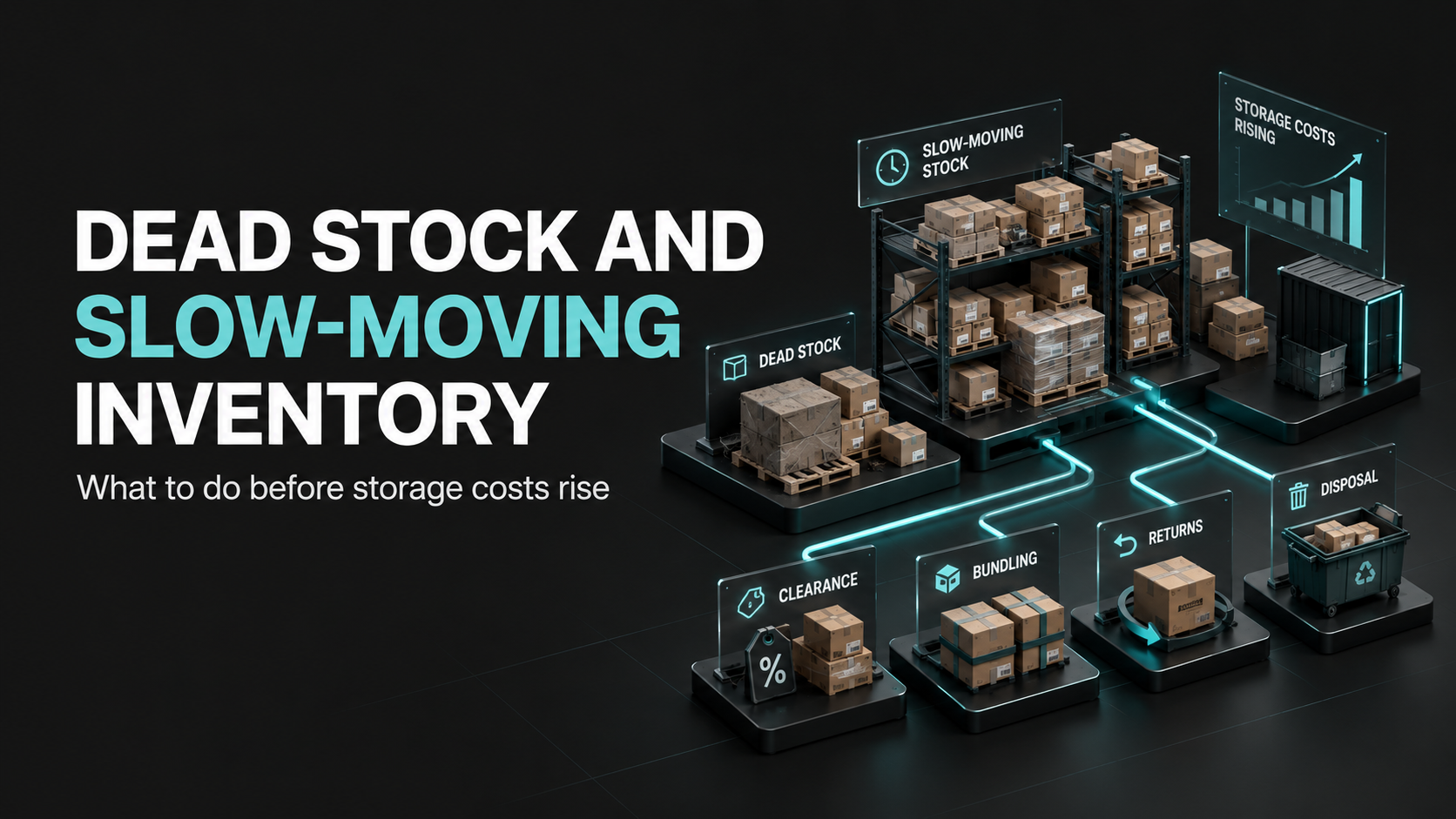
Slow-moving and dead inventory create two costs at once: cash remains tied up in products that are not returning it, and warehouse capacity is consumed by stock that contributes little to current order flow. The operational mistake is waiting until the shelf is obviously full before deciding what to do.
The better approach is to identify ageing inventory while there is still a realistic commercial choice.
Slow-moving and dead stock are different decision states
Shopify’s 2026 inventory-aging guidance distinguishes slow-moving stock from dead stock by remaining demand. Slow-moving inventory is still selling, but below the expected velocity. Dead stock has reached the point where normal demand at the current proposition is no longer a realistic path out.
Do not use one universal number of days for every product. A seasonal gift item, a replenishment staple and a limited-edition launch have different expected lifecycles. Define ageing thresholds by category and commercial plan.
Start with an ageing report, then add velocity
An inventory-aging report groups stock by how long it has been held. That identifies where capital is sitting, but age alone does not tell you whether the item is unhealthy.
Add recent sales velocity, sell-through, days on hand, margin, expiry or obsolescence risk and the quantity already inbound. A SKU that is 120 days old but sells consistently may be healthier than a 45-day-old launch that stopped selling immediately.
Measure the warehouse footprint as well as the inventory value
One low-value bulky product can consume more storage capacity than many high-value small items. If the objective is to free warehouse space, prioritisation should include pallet positions, CBM, shelves or bins occupied—not only book value.
This connects directly to how warehouse storage pricing works: aged stock becomes more expensive when it continues to consume billable locations across multiple billing periods.
Stop replenishing before you start clearing
It is surprisingly common to run a promotion on slow stock while an automatic reorder rule or open purchase order sends more of the same SKU toward the warehouse.
Before clearance activity, review purchase orders, safety-stock settings, reorder points, supplier commitments and bundle component demand. Pause or adjust replenishment where commercially appropriate so the recovery plan is not working against inbound inventory.
Verify that the problem is real demand, not bad inventory data
A product can appear slow if sales are mapped to another SKU, stock is unavailable because it sits in the wrong status, or a channel listing is disconnected. Before writing the inventory off commercially, reconcile the physical stock, channel mapping and availability.
If the warehouse shows units available but the ecommerce channel cannot sell them, that is an integration or catalogue problem rather than dead stock.
Use the least destructive commercial action first
Where demand still exists, options can include improving merchandising, moving stock to a channel or location where it performs better, adjusting price, creating a genuine bundle, or supporting a planned promotion.
Bundling should solve a customer or merchandising need, not simply hide unwanted products in another SKU. The warehouse implications of assembling bundles are covered in the Stashworks kitting guide.
Liquidation is a tool, not a failure state
When ordinary demand is no longer a sensible recovery path, the objective changes from maximising margin to recovering cash and capacity deliberately. Shopify’s 2026 liquidation guide includes clearance, secondary buyers, wholesale, supplier returns, donations, bundles and disposal among possible approaches.
The right path depends on brand positioning, product condition, contractual restrictions, tax treatment and the cost of handling the exit. A deep discount that creates months of pick-and-pack work may recover less than a faster bulk sale once labour and storage are considered.
Supplier return rights should be checked early
Some supplier agreements allow returns, exchanges or credits under specific conditions. Those rights can expire or depend on packaging and product condition.
Record them when purchasing, not when the warehouse is already full. If supplier return is possible, model freight, handling, restocking charges and the credit actually recoverable.
Donation, recycling and disposal need product-specific checks
Not every product can be donated or disposed of through the same route. Cosmetics, food, batteries, controlled goods and products carrying customer data can require special handling.
Confirm the applicable legal, tax and environmental treatment before using these options. The warehouse should have written authorisation for any destruction or disposal movement because it changes both physical inventory and accounting records.
Write-offs need a warehouse event as well as a finance event
Reducing the accounting value does not remove the cartons from storage. If stock is written down or written off, define the physical disposition: remain for future clearance, transfer, return, donate, recycle or dispose.
The inventory system should reflect that state so written-off stock is not accidentally allocated to normal customer orders.
Calculate the cost of waiting
For each ageing SKU, estimate current inventory value, expected recovery value, storage footprint, monthly storage cost, handling required to exit and the likelihood of further value deterioration.
This turns “maybe it will sell eventually” into a decision. If another three months of storage and handling are likely to cost more than the additional margin the business hopes to recover, waiting has an economic price.
Feed the cause back into purchasing and product decisions
After clearing the stock, identify why it accumulated. Common causes include optimistic forecasts, supplier minimums, campaign overbuying, duplicated SKUs, poor channel visibility, product changes, returns or replenishment rules that continued after demand slowed.
Shopify’s 2026 inventory-reduction guidance similarly links excess inventory to forecasting and supply-chain decisions. The useful outcome is not simply an emptier shelf; it is a purchasing rule that makes the same problem less likely to recur.
Warehouse capacity should follow demand, not historic optimism
A healthy ecommerce warehouse will always contain some slower products. The problem begins when aged inventory grows without a decision owner.
Review inventory age on a recurring schedule, assign an action to material exceptions and keep the physical disposition connected to the commercial decision. Stashworks’ managed warehousing can hold and control the stock, but the decision to markdown, return, liquidate or discontinue remains a brand and finance decision.
Sources: Shopify, Inventory Aging Report; Shopify, Inventory Liquidation; Shopify, Inventory Reduction.