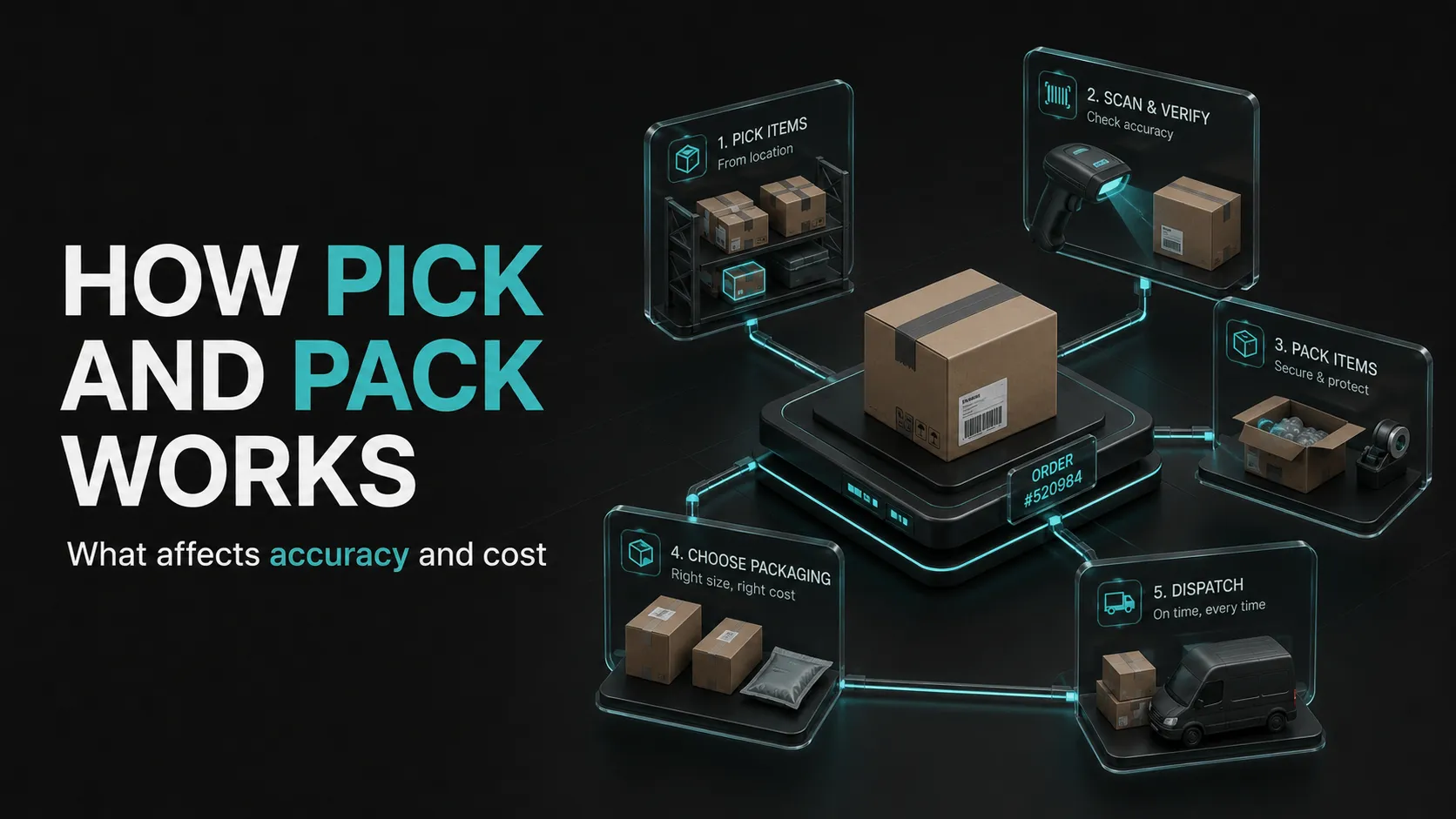
Pick and pack sounds like one warehouse activity. In practice, it is a chain of decisions: where the item is stored, how the picker is directed, how the SKU is verified, how many units are required, which packaging is selected and what must be checked before the parcel is sealed.
That is why two businesses shipping the same number of orders can have very different fulfilment costs and error risks. Order count is only one variable. SKU count, items per order, product size, storage layout, bundles, packaging rules and exception handling all change the amount of work behind each dispatch.
Picking begins with a reliable location and product identity
The picker needs to know exactly what to retrieve and where to find it. That depends on three foundations: a clean product master, an accurate location record and a picking instruction that reflects the live order.
Visually similar variants are a common source of risk. A black medium T-shirt and a black large T-shirt may look almost identical at speed. Unique barcodes and scan-based checks reduce dependence on memory, but the barcode, SKU and warehouse record must all map to the same product.
GS1’s logistics guidance emphasises unique identification and scanning through warehouse processes because manual data entry and weak identification introduce both delay and error.
The picking method changes as the operation changes
A small operation may pick one order at a time. As volume grows, other approaches can become useful: batch picking groups similar orders, zone picking divides the warehouse into areas, and wave picking releases work in planned groups.
No method is automatically superior. The right choice depends on order profile. A high-SKU beauty brand with small multi-item orders may need a different approach from a business shipping one bulky product per order.
Travel time is often a hidden cost driver
Picking is not only the moment an item leaves a shelf. It includes the travel required to reach it. Poorly located fast-moving products, fragmented storage and frequent replenishment interruptions can make the walking or equipment movement around the warehouse more expensive than the physical pick itself.
Slotting decisions therefore affect cost. Frequently ordered items may deserve easier access, while slow-moving products can occupy less convenient locations. The objective is not to redesign the warehouse for every campaign; it is to align layout with the actual order pattern.
Verification should happen at the points where mistakes can enter
A scan at picking can confirm that the selected SKU matches the instruction. A second check at packing can confirm the final parcel contents before shipment. Those controls address different failure points.
Stashworks’ published technology positioning describes WMS-enabled inventory and order visibility. When evaluating any fulfilment workflow, ask what is scanned, what happens when the scan fails, and whether an override leaves an audit trail.
Packing starts with another accuracy decision
The packing station should not assume the tote or picked order is correct. It is the last controlled point inside the warehouse before the parcel enters the carrier network.
Typical checks may include SKU, quantity, visible condition, bundle completeness, inserts and channel-specific requirements. The exact process should match the product risk. A simple low-value item does not need the same inspection as fragile electronics or a complex promotional kit.
Packaging selection affects more than material cost
The packer has to choose a container that protects the product without creating unnecessary volume. Oversized packaging can increase material use and may also increase carrier cost when dimensional or volumetric weight applies. Undersized or weak packaging can create damage, rework and returns.
Amazon’s fulfilment guidance notes that packing decisions affect both protection and parcel size. The practical goal is to standardise enough packaging options to keep work efficient without forcing products into unsuitable formats.
Why the base pick-and-pack rate rarely tells the whole story
A headline rate often assumes a defined order profile. It may cover one order, one line, one unit and standard packaging—or a different combination. Additional units, heavy handling, serial capture, kitting, special materials or manual order changes may add work.
That does not make the pricing unfair. It means the quote needs an explicit boundary. Compare providers using a representative order basket rather than the cheapest single-item rate.
Order complexity should be measured, not described vaguely
Instead of telling a provider that orders are “usually simple”, calculate the distribution. What percentage contain one unit? Two to three lines? Bundles? Oversized products? Gift notes? International documents?
Averages can hide the workload. An average of two units per order could mean every order contains exactly two units, or half the orders contain one and the other half contain three. Those patterns can create different picking paths and packing work.
Accuracy problems should be classified by root cause
When a wrong order ships, record more than “packing error”. Identify where the mistake entered the process: wrong master data, incorrect receiving, stock in the wrong location, mis-pick, quantity error, bundle instruction, pack verification or label application.
That classification matters because adding another final check will not fix an upstream product-data problem. Effective controls sit as close as possible to the point where the error can occur.
Cost and accuracy have to be managed together
The cheapest process is not necessarily the one with the fewest checks, and the most accurate process is not necessarily the one with the most manual inspection. Well-designed identification, location control and scan-based verification can reduce both rework and dependence on memory.
When scoping ecommerce fulfilment, provide Stashworks with the SKU profile, lines and units per order, bundle logic, product handling and packaging requirements. Those variables describe the real pick-and-pack workload far better than monthly order volume alone.
Sources: Shopify, Pick and Pack Fulfillment; Amazon Supply Chain Services, Pick, Pack and Ship; GS1, Barcode Implementation Guidance.