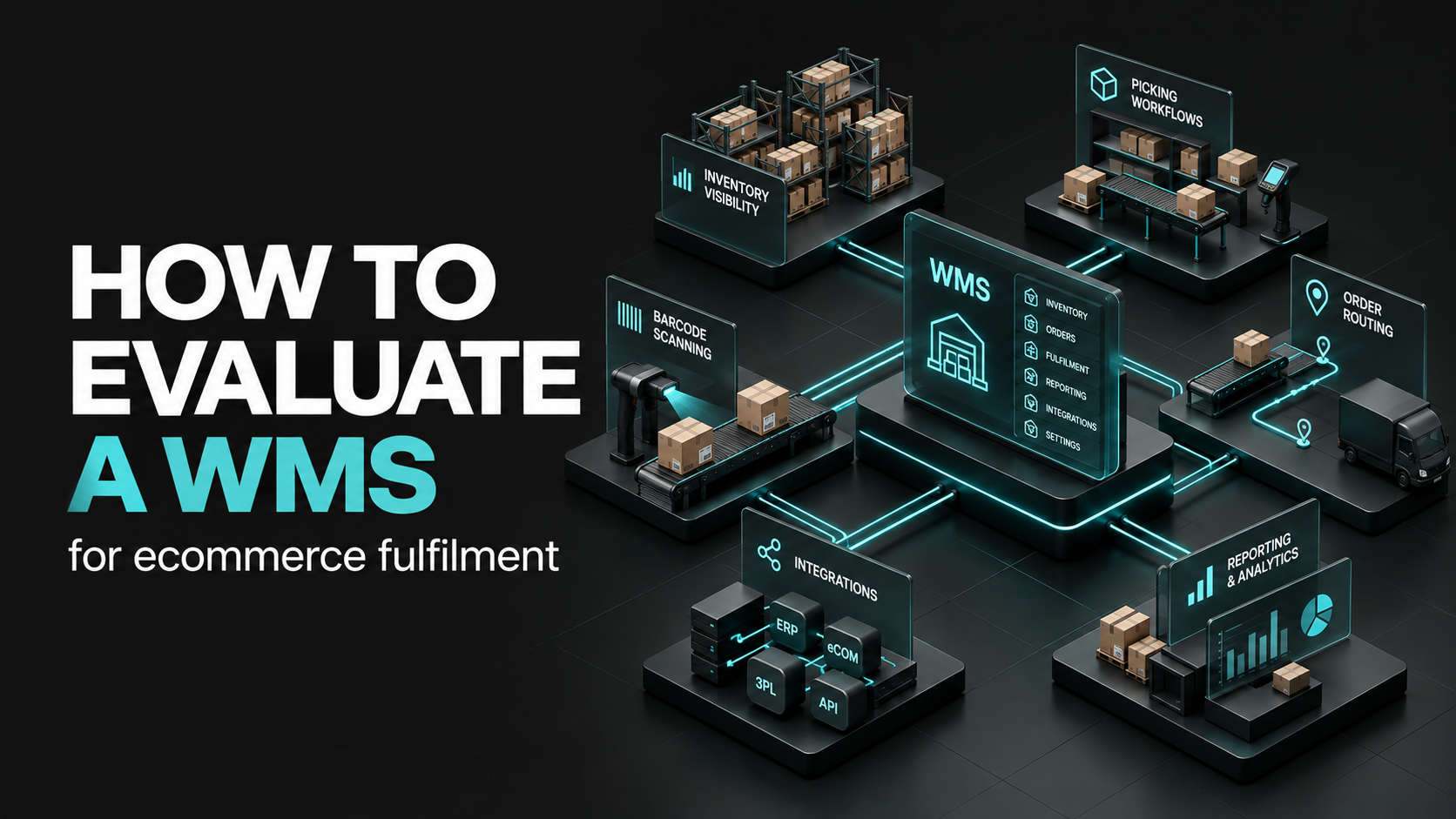
A polished WMS demo can make very different systems look remarkably similar. Inventory appears on a dashboard, orders move through a workflow, and a scanner confirms a pick. The important differences often appear only when the normal flow breaks.
A supplier sends less than expected. A barcode does not match. A marketplace order is cancelled after release. Stock exists physically but is quarantined. A bundle is short one component. A return is received but not saleable.
That is why a WMS should be evaluated through real operating scenarios and exceptions, not by counting features on a comparison sheet.
Define the warehouse operation before evaluating software
A warehouse management system coordinates physical warehouse processes and the inventory records behind them. Microsoft’s Warehouse Management documentation includes inbound receiving, location control, inventory status, counting, picking, packing, labels and outbound work among the core process areas.
But a feature is useful only when it matches the operation. Write down your product types, locations, order profile, sales channels, receiving method, picking model, packaging, returns, kitting, batch or serial needs and user roles before the first demo.
Separate WMS responsibilities from the surrounding systems
An ecommerce stack may include storefronts, marketplaces, an ERP or accounting system, an order-management layer, carrier tools and a WMS. Decide which system owns each type of data.
The WMS should normally be authoritative for physical warehouse movements, but product master data, commercial orders or financial value may originate elsewhere. Evaluation becomes much clearer when the integration boundary is drawn before discussing connectors.
Test receiving with imperfect inbound shipments
Do not demo only a purchase order that arrives exactly as expected. Ask the system to handle partial quantity, overage, damaged units, an unknown barcode and a product requiring quarantine.
Observe whether the WMS preserves the expected-versus-actual record, creates an exception, separates unsaleable stock and records who resolved the difference. Receiving quality affects every later inventory decision.
Test location and inventory-state control
The system should distinguish both where stock is and what can be done with it. Available, reserved, damaged and quarantined units should not collapse into one misleading on-hand number.
If the operation uses batch, serial or expiry controls, test them directly with representative products. Do not accept “supported” as the end of the conversation; see how the warehouse user captures the data and how it appears in later picking and traceability.
Evaluate counting and adjustments through the audit trail
Ask how cycle counts are initiated, whether blind counting is possible, what happens when the physical result differs and who can approve an adjustment.
The strongest evidence is not the ability to change a number. It is whether the system preserves reason, user, time and movement history so recurring discrepancies can be investigated.
Outbound testing should use the real order mix
A one-line, one-unit order is useful for orientation but insufficient for selection. Test multi-line orders, similar variants, bundles, several units of one SKU, special packing rules and the picking method expected at peak.
Shopify’s current warehouse-management guidance describes WMS selection in the context of storage, inventory and fulfilment processes. For ecommerce, the practical question is whether the system turns each order type into efficient, unambiguous warehouse work.
Make the scanner fail during the demonstration
Scan the wrong SKU, wrong location or unexpected quantity. A useful WMS should respond with a clear exception rather than relying on the user to notice the mistake.
Then test override permissions. If an authorised user can continue, the system should leave enough evidence to explain what happened later.
Packing and shipping need an order-to-label control
At packing, test item verification, quantity, bundle completeness, packaging instructions and the creation or association of the correct carrier label. If shipping data is generated externally, test how the WMS knows which tracking number belongs to which order.
A warehouse can pick accurately and still create a customer problem if the wrong label is applied to the parcel.
Returns should not be an afterthought
Ask the system to receive a return, identify the original order, record condition and move the unit into several possible dispositions. A returned item should not become saleable simply because it crossed the warehouse door.
If the brand performs exchanges, rework or repacking, test how those flows are represented rather than assuming the outbound module covers them.
Integrations should be tested as event flows
“Integrates with ecommerce platforms” is too broad for procurement. Map the events: product creation or mapping, new order, reservation, cancellation, shipment, tracking, stock adjustment and return.
For each event, ask which system initiates it, how quickly it is expected to move, what happens when the connection fails, whether retries occur and where an unmatched record appears for human resolution.
Use one demonstration script for every shortlisted system
Performance matters at the peak, not only in a quiet demo
Ask how the proposed configuration handles your expected peak orders, users, SKUs and locations. Request relevant references or test evidence rather than accepting a universal performance claim.
Also clarify support ownership, maintenance windows, incident escalation and what warehouse work can continue if an external integration is temporarily unavailable. The exact service commitments belong in the contract.
Implementation quality can matter as much as software selection
Even a capable WMS will struggle with duplicate SKUs, unreliable barcodes, undefined locations and unclear processes. Plan data cleansing, configuration, integrations, user roles, training, stock reconciliation and cutover before go-live.
A pilot should test real products and real exceptions. Do not use a perfect test catalogue that avoids the cases causing problems in the current operation.
For a 3PL, evaluate the WMS as part of the service
When the provider owns the warehouse system, the business is not selecting software in isolation. It is evaluating how the provider’s WMS, processes, integrations and support model work together.
Stashworks positions its technology and WMS layer as part of its logistics operation. The useful evaluation is to ask for the actual workflows relevant to your business—receiving, inventory states, order imports, scanning, packing, returns and exceptions—rather than a generic feature tour.
The best WMS is the one that makes difficult work controlled
Feature breadth matters, but warehouse reliability comes from how consistently the system turns physical events into correct records and clear next actions.
Build a test script from your normal flow and your most expensive exceptions. If a shortlisted WMS can handle both in a way the operation can explain and audit, the feature checklist becomes much more meaningful.
Sources: Shopify, Warehouse Management Guide; Microsoft Learn, Warehouse Management Overview.