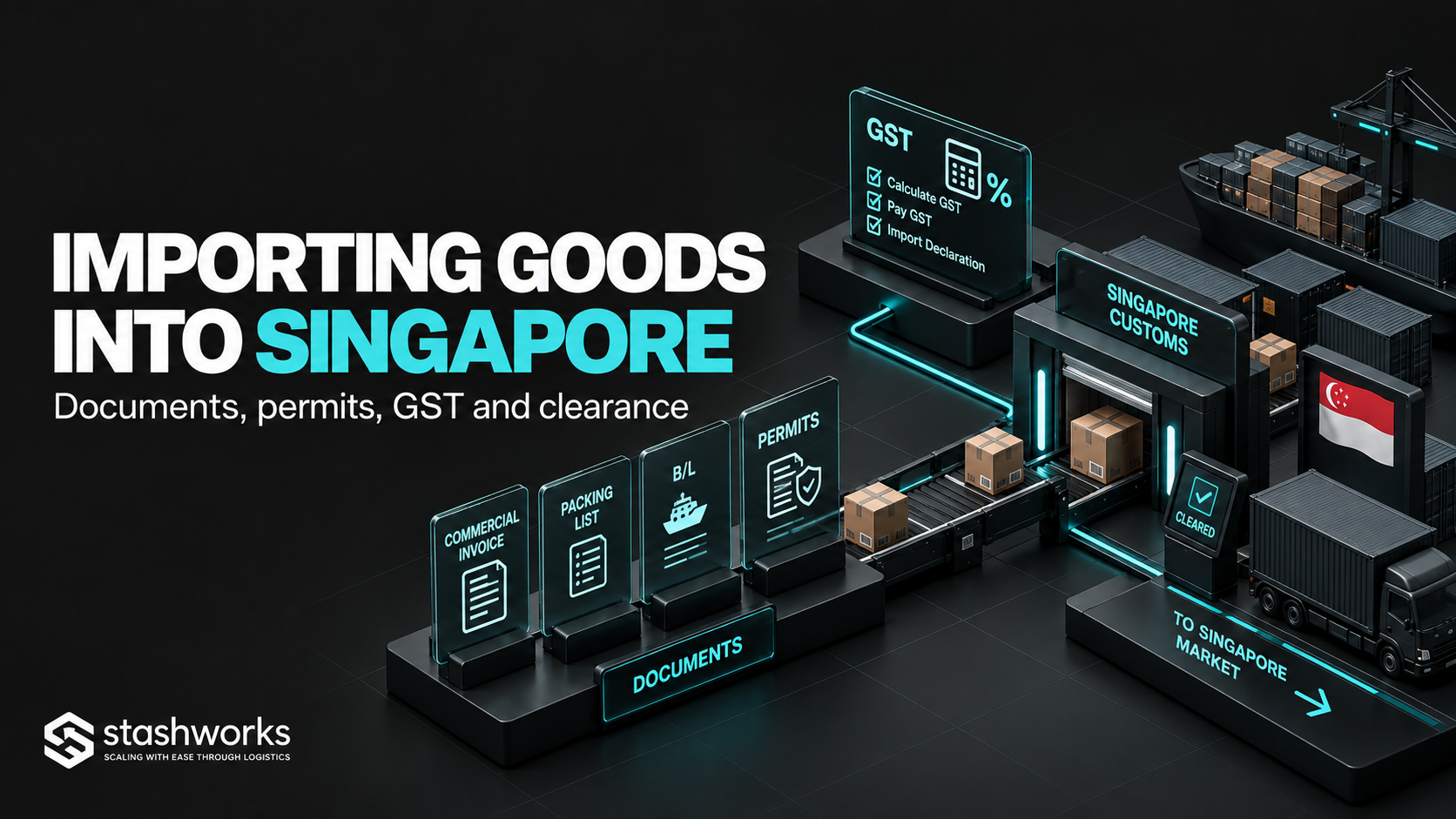
Importing commercial goods into Singapore is manageable when the responsibilities are separated into the right sequence: identify the importer, set up the customs account, classify the goods, check controls, prepare documents, obtain the permit, account for GST or duty, and coordinate the physical clearance and delivery.
This guide is an operational overview for ecommerce businesses. It is not legal, tax or customs advice; requirements can vary by product, transaction and import scheme.
1. Start with the importing entity and UEN
A business importing goods into Singapore generally needs a Unique Entity Number and must activate its Customs Account with Singapore Customs before transacting with Customs.
Do this before cargo is already in transit. Customs setup is part of supplier and replenishment planning, not a task to discover when the shipment reaches port or airport.
2. Decide who will submit customs declarations
Import permit applications are submitted electronically through TradeNet, Singapore's national single window for trade declarations.
A trader can appoint a Declaring Agent to submit permit applications on its behalf, or register and make declarations itself where the relevant requirements are met. A freight forwarder may also provide or coordinate declaring-agent services, but do not assume that every freight booking automatically includes this role.
3. Classify the goods correctly
The Harmonised System code is used to classify the product for customs purposes. Classification affects whether the goods are dutiable, controlled or subject to another regulatory requirement.
Singapore Customs identifies four broad categories of dutiable goods: intoxicating liquors, tobacco products, motor vehicles and petroleum products. Other goods can still be subject to import GST and may be controlled by another authority.
4. Check whether the goods are controlled
Controlled goods can require licences, approvals or conditions from the relevant Competent Authority. The appropriate check depends on the HS code and the nature of the product.
Examples across ecommerce can include food, health-related products, telecommunications equipment or other regulated categories. Do not rely on a supplier's statement that a product is “normal consumer goods”; verify the Singapore requirements before shipment.
5. Prepare the commercial and transport documents
The supporting documents vary, but common records include the commercial invoice, packing list, purchase-order or shipment references and the relevant transport document, such as an air waybill or bill of lading.
Keep product descriptions, quantities, values and shipment references consistent across the records. Inconsistent information creates avoidable questions during declaration, clearance and warehouse receiving.
6. Obtain the required import permit through TradeNet
Singapore Customs requires the appropriate permit for imported goods. The permit application should reflect the correct importer, goods classification, value, movement and any applicable regulatory approvals.
The permit should be handled at the required point in the shipment process rather than after goods have already moved contrary to the customs procedure.
7. Understand import GST and customs duty
Singapore's prevailing GST rate is 9%. For ordinary imports, import GST is generally calculated using the customs value of the goods, with applicable duties and specified incidental charges included according to the customs rules.
Customs value commonly reflects the cost, insurance and freight value for imported goods. Dutiable goods also require the applicable customs or excise duty calculation before the GST treatment is finalised.
Special schemes, reliefs and GST accounting arrangements can change the cash-flow or tax treatment. Confirm the applicable treatment with Singapore Customs, IRAS or a qualified adviser.
8. Separate customs clearance from physical delivery
A customs permit does not put stock on the warehouse shelf. The physical cargo still needs to be released from the transport or terminal process, collected and delivered to the receiving location.
Coordinate the destination handoff in advance: delivery booking, vehicle requirements, carton or pallet references, expected quantities and the receiving record inside the warehouse system.
9. Reconcile what was declared, transported and received
After receiving, compare the supplier documents, customs declaration, freight records and warehouse receipt. Investigate shortages, overages, damaged goods or product mismatches while the shipment evidence is still easy to trace.
This is particularly important for multichannel ecommerce because inventory should not become sellable until the warehouse has confirmed the physical quantity and condition.
10. Keep records organised for future imports
Build a repeatable shipment file containing product classification, permits, invoices, packing lists, transport records, GST or duty records, receiving evidence and discrepancy notes. Future replenishment becomes easier when the business does not recreate the compliance logic from memory every time.
Where freight forwarding fits
A freight forwarder can coordinate the international movement and, depending on the agreed scope, connect the shipment to customs and destination handling. The broader role is explained in Freight Forwarding for Ecommerce Businesses in Singapore.
Stashworks supports import and export cargo through its freight forwarding service and can connect incoming inventory to its warehousing and fulfilment operation. Confirm who is acting as importer, Declaring Agent and customs coordinator for the specific shipment before relying on the workflow.
Sources: Singapore Customs, Import Procedures Overview; Singapore Customs, Obtain a Customs Import Permit; Singapore Customs, TradeNet; IRAS, GST on Imported Goods.