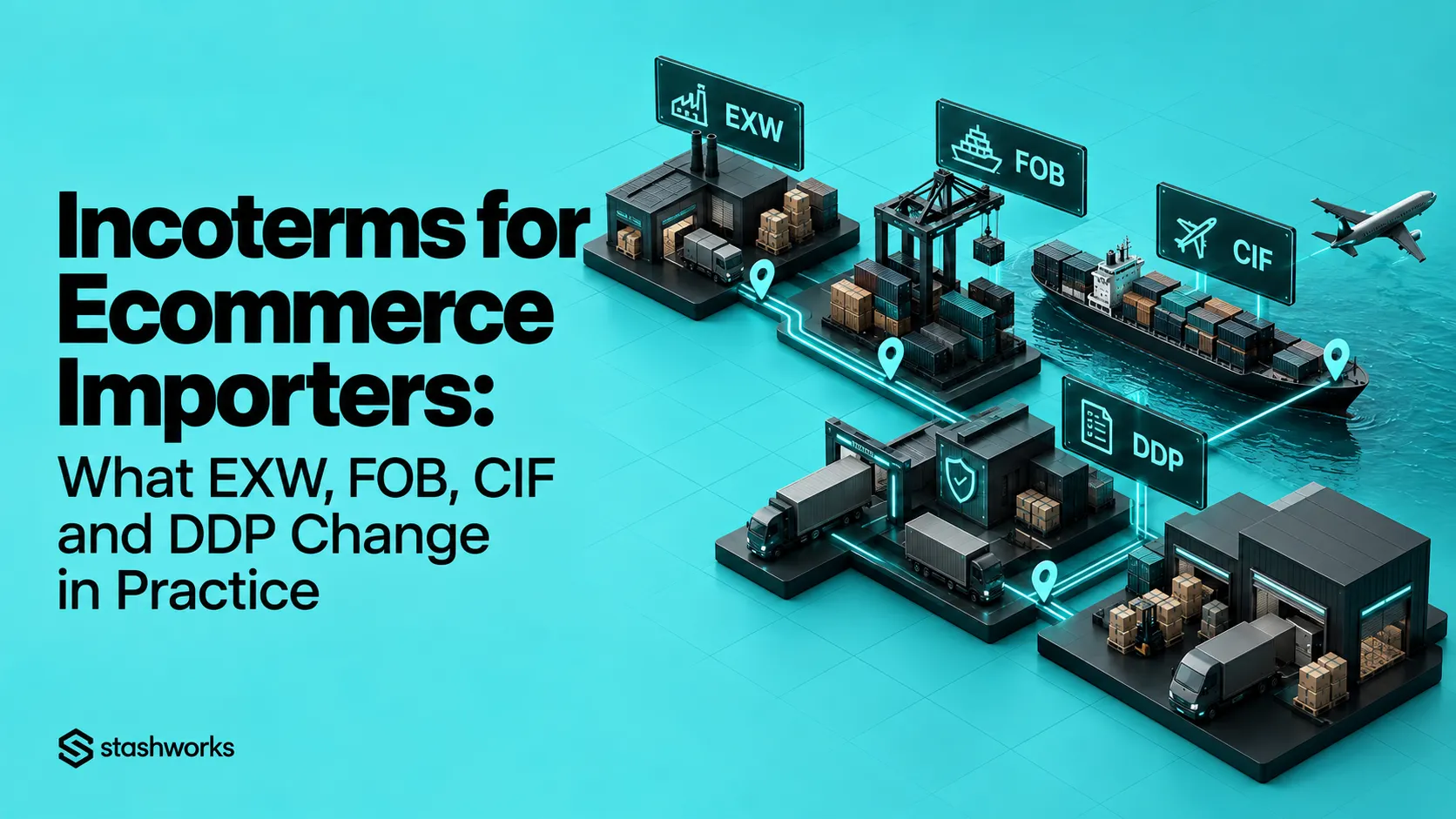
Incoterms® rules define how seller and buyer responsibilities are divided in an international sale. For ecommerce importers, the practical effect is visible in who arranges transport, where risk transfers, who handles export or import clearance and which costs are already included in the supplier's price.
They do not replace the sales contract, determine ownership of goods in every legal sense, or automatically decide tax treatment. They are a logistics and risk-allocation framework.
Use the current Incoterms® 2020 rules
The International Chamber of Commerce publishes the Incoterms® rules and currently lists Incoterms® 2020 as the operative edition. Contracts should state the rule, named place or port and edition clearly, for example “FOB Shanghai Incoterms® 2020”.
EXW gives the buyer broad transport responsibility
Under EXW, the seller makes the goods available at the named place, typically its premises. ICC notes that the seller does not have to load the goods on the collecting vehicle or clear them for export.
In practice, the buyer may need to arrange collection, export clearance, international transport, insurance, import clearance and final delivery. That can give the importer control but creates more coordination.
EXW can be difficult for international export formalities
ICC cautions that EXW is primarily suited to domestic trade because the buyer may face practical difficulty performing export clearance in the seller's country.
For containerised or multimodal movements, FCA is often worth discussing even when a supplier initially quotes EXW.
FOB transfers risk once goods are on board the vessel
Under FOB, the seller delivers the goods on board the vessel at the named port of shipment. Risk transfers when the goods are on board.
FOB is for sea or inland-waterway transport. ICC specifically notes that it is not appropriate where goods are handed to a carrier before they are placed on board, such as many container-terminal movements; FCA may fit better in those cases.
FOB leaves main carriage with the buyer
After the FOB delivery point, the buyer normally arranges and pays the international freight, insurance if desired, import clearance, duties or taxes and onward delivery.
That gives the importer more control over the forwarder and freight cost than CIF.
CIF includes freight and minimum insurance to the named port
Under CIF, the seller arranges and pays the international freight and minimum required insurance to the named destination port. However, risk still transfers earlier, when the goods are loaded on board at the port of shipment.
This difference between cost responsibility and risk transfer is one of the most commonly misunderstood parts of CIF.
CIF does not mean the seller handles Singapore import clearance
Singapore Customs explains that under CIF the buyer remains responsible for customs clearance, duties, taxes and costs after arrival in Singapore.
Do not interpret “Cost, Insurance and Freight” as an all-inclusive delivered price.
DDP puts maximum delivery responsibility on the seller
ICC describes DDP as the rule imposing the highest level of obligation on the seller. The seller delivers the goods at the named destination, cleared for import and ready for unloading.
That includes import duties and applicable taxes under the Incoterms® responsibility split.
DDP can be operationally difficult where the seller cannot import locally
The commercial promise “DDP” only works if the seller can legally and practically satisfy import obligations in the destination country. Entity, tax, customs-registration and product requirements can complicate that.
Singapore Customs requires an importer to have the relevant UEN and activated Customs account before permit applications, directly or through a declaring agent.
Incoterms® change what is inside the supplier price
An EXW price may exclude origin collection, export handling, freight and insurance. A CIF price includes freight and minimum insurance to the named port. A DDP price includes substantially more logistics and import responsibility.
Do not compare supplier quotations until the Incoterm and named place are normalised.
Customs value is not simply the invoice line
Singapore Customs uses a CIF-based customs value for valuation. If goods are purchased under EXW or FOB, freight, insurance and other relevant costs may need to be added to establish the customs value.
This is why Incoterms® affect documentation and landed-cost calculations even when the product price is unchanged.
Insurance responsibility changes by rule
Under CIF, the seller has an insurance obligation at the minimum cover specified by the rule. Under EXW and FOB, the seller does not have the same obligation to procure insurance for the buyer.
The buyer should decide whether the minimum contractual cover is sufficient for the actual product risk.
Use the named place precisely
“FOB China” is not precise enough. State the named port. “DDP Singapore” can also be too vague if the delivery point matters.
The location determines where cost and risk obligations change.
Match the rule to the transport mode
EXW and DDP can be used for any mode. FOB and CIF are rules for sea and inland-waterway transport.
For air freight or container movements delivered to a terminal before loading, discuss the appropriate multimodal rule with the supplier and forwarder.
Do not let the Incoterm replace operational instructions
The rule does not specify warehouse booking, carton labels, supplier ASN, packaging, carrier service, inspection level or receiving procedure. Those still need separate operating instructions.
Build a cost-and-responsibility table before ordering
For every supplier quote, list product cost, origin transport, export clearance, main freight, insurance, import clearance, duty or GST, destination handling and local delivery. Mark which party owns each step.
Use the Landed Cost guide to complete the financial model.
Choose based on capability, not only convenience
EXW can offer buyer control but adds coordination. CIF reduces freight arrangement for the buyer but does not move import clearance to the seller. DDP can simplify the delivered experience but requires the seller to have a workable import model.
The best term is the one both parties can execute correctly.
General information only: Incoterms® affect contractual obligations and should be incorporated carefully into the sales contract. This article is operational guidance, not legal advice.
Sources: ICC, Incoterms® 2020 Rules for Any Mode; ICC, Incoterms® 2020 Sea and Inland-Waterway Rules; Singapore Customs, Customs Valuation and Incoterms.