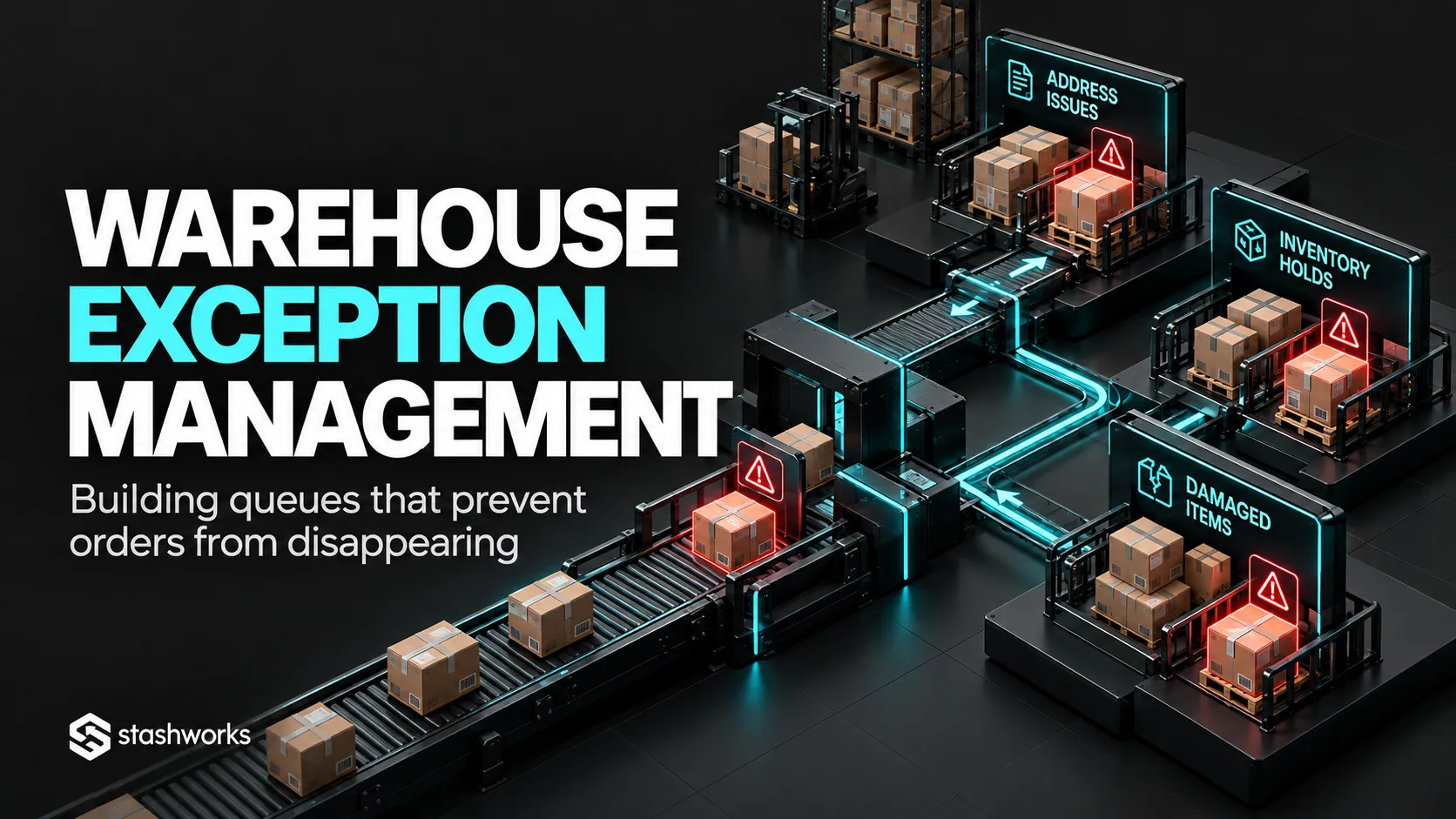
Most warehouse orders follow the normal path. The operational risk sits in the minority that do not: an SKU is unmapped, stock is missing, a barcode fails, an address is invalid, a cancellation arrives too late or an integration event never reaches the warehouse.
Exception management is the system for making those failures visible until someone resolves them.
Do not leave exceptions inside the normal queue
An order that cannot progress should move to a visible exception state with a reason. If it remains mixed with ordinary work, staff can assume someone else is handling it.
The same principle applies to inventory, receiving, returns and integration errors.
Create a small set of exception categories
Start with categories that correspond to different owners: product-data issue, inventory shortage, receiving discrepancy, order hold, cancellation conflict, address problem, integration failure, packing exception, carrier issue and return exception.
Avoid hundreds of reason codes that nobody uses consistently.
Every exception needs one owner
Assign the team or role responsible for moving the issue forward. Ownership can change during escalation, but there should never be a stage where the issue has no accountable party.
Track age from the moment progress stops
The age of an exception matters because a five-minute integration retry and a three-day unresolved order can share the same status label.
Use ageing buckets that match customer and operational risk.
Prioritise by impact, not only age
A high-value wholesale order, regulated product hold or large inventory discrepancy may need faster escalation than an older low-risk issue.
Create severity rules that combine age with business impact.
Product-data exceptions should route upstream
Unknown SKU, duplicate barcode, missing variant mapping and incorrect bundle configuration usually require catalogue correction rather than warehouse improvisation.
The Barcode Strategy and Integration Checklist cover the upstream controls.
Inventory exceptions need physical and system evidence
If a picker cannot find stock, check location, recent movements, reserved quantity, quarantine and count history before changing the system balance.
Do not resolve every shortage by creating a manual adjustment.
Integration exceptions need retry and reconciliation logic
A failed API call should create a recoverable event with identifiers and error information. After retry, confirm the transaction appears exactly once.
Silent failure is the most dangerous integration behaviour because operations can act as if the order does not exist.
Late cancellations need a decision tree
If an order has already been picked, packed or handed to a carrier, the normal cancellation flow may no longer apply. Define which stages can still be stopped and which require customer-service intervention.
Address exceptions should stop before label release
Invalid or incomplete address data should enter a hold before the parcel is committed to a carrier where possible. The support team should know exactly what customer information is required to release it.
Returns need disposition queues
Returned stock may wait for inspection, brand approval, refurbishment, quarantine or disposal. Keep those queues visible so inventory does not remain indefinitely in an undefined state.
Use reason codes for root-cause reporting
Once the issue is resolved, record the underlying cause rather than only the symptom. Repeated “inventory shortage” exceptions may actually come from supplier mislabelling or integration delays.
Set escalation thresholds
Define when an exception moves from operator to supervisor, account manager, technology team or client decision. Use both severity and elapsed time.
Give customer service visibility
Customer-facing teams do not need every warehouse detail, but they should see when an order is blocked and whether a realistic next update exists.
This reduces contradictory promises.
Review the oldest open exceptions every day
A short daily review can surface forgotten issues before they become customer escalations. Focus on aged high-impact items rather than reading every normal order.
Measure exception rate and recurrence
Track exceptions per order, average age, oldest open item and top root causes. A falling exception rate is more valuable than simply clearing queues faster if the same defects keep returning.
Feed recurring exceptions into process improvement
Repeated issues should create corrective actions in product data, receiving, slotting, integration or training.
The monthly-governance approach in 3PL Performance Reviews is a useful place to track those actions.
Where Stashworks fits
Stashworks' current Technology page describes connected order visibility, inventory management and WMS-supported warehouse execution. The exact exception queues, alerts and escalation workflow for an account should be confirmed during implementation.
Sources: Stashworks, Technology; Shopify Help Center, Inventory States.