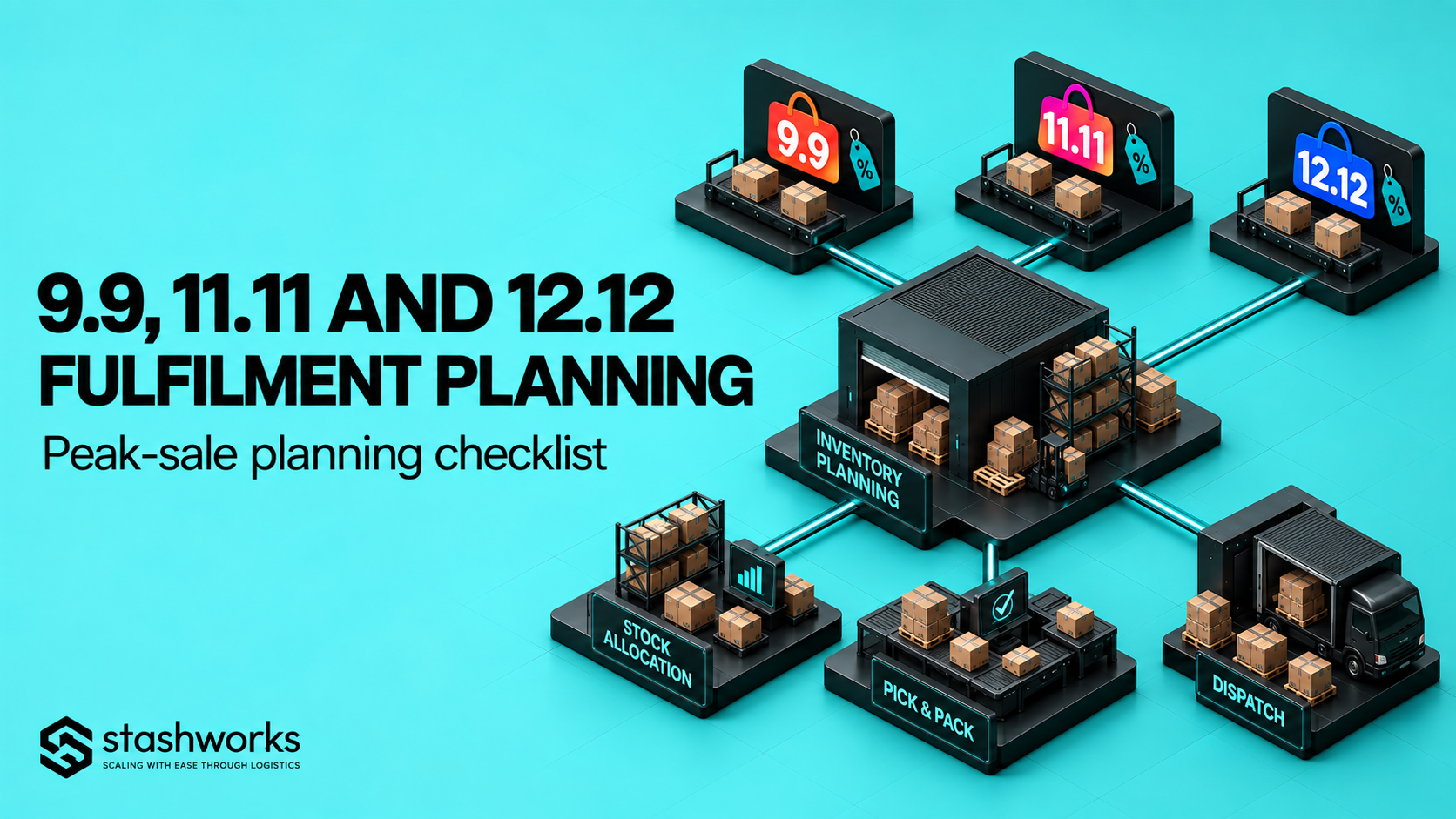
9.9, 11.11 and 12.12 are described as sale days, but the warehouse workload begins weeks earlier and can continue long after the campaign ends.
Inventory has to arrive and be received. Bundles need to be defined. Product data needs to be stable. Packaging and labour need to be available. Carrier collections need enough capacity. After the event, cancellations, returns and inventory discrepancies still have to be resolved.
The practical goal is not to predict the exact number of orders perfectly. It is to remove avoidable operational surprises before the demand spike arrives.
Six weeks out: decide what the campaign is actually selling
Start with the commercial plan. Identify the promoted SKUs, bundles, gifts, channel-specific offers and products likely to experience spillover demand.
Do not forecast only total order count. Estimate the order mix: single-item versus multi-line orders, units per order, bundle penetration, bulky products, fragile products and the share of orders expected from each marketplace. Two campaigns with the same number of orders can create very different warehouse workloads.
Six weeks out: translate the sales forecast into stock requirements
Review current sellable inventory, confirmed inbound purchase orders, supplier lead time, safety stock and the expected campaign demand by important SKU.
Use the complete replenishment path rather than supplier dispatch date alone. Stock is only useful for the campaign after it reaches the warehouse, passes receiving, is correctly identified and becomes available for orders.
The calculations behind that buffer are covered in Safety Stock and Reorder Points for Singapore Ecommerce Sellers.
Four to five weeks out: set the final inbound target
Choose the latest date by which campaign stock should be physically received and available, then work backward to supplier dispatch and freight milestones.
Leave time for shortages, overages, damaged cartons, barcode problems and relabelling. A container arriving the day before 11.11 is not the same as inventory being ready to pick on 11.11.
Share expected inbound volumes with the warehouse so receiving capacity is planned rather than discovered at the dock.
Four weeks out: clean the campaign catalogue
Confirm every promoted SKU, barcode, variant mapping, bundle relationship and channel listing. Resolve duplicates before higher order volume multiplies the error.
If Shopify, Shopee, Lazada and TikTok Shop share the same physical stock, confirm that each channel maps to the same internal SKU and that the central inventory logic is working. The architecture is covered in the multichannel inventory guide.
Three to four weeks out: decide how bundles will be fulfilled
A campaign bundle can be pre-kitted before the sale or assembled when each order arrives. Pre-kitting can make outbound work faster, but it converts components into finished kits before actual demand is known. On-demand assembly preserves flexibility but adds work during the busiest period.
Choose the method deliberately and test how component inventory changes when the bundle sells. The trade-offs are covered in Kitting and Product Bundling.
Three weeks out: clear avoidable pressure from the warehouse
Review slow-moving stock that is occupying prime pick locations, unresolved returns, old receiving exceptions and damaged inventory waiting for a decision.
The objective is not to clear every aged item at any cost. It is to keep campaign pick faces and staging areas from competing with stock that has no immediate operational purpose.
Use the framework in Dead Stock and Slow-Moving Inventory where aged stock is already consuming meaningful capacity.
Two to three weeks out: calculate the fulfilment capacity
Estimate how many orders the operation can receive, pick, pack, label and hand over per hour or per shift under realistic conditions.
Include the actual order mix. Ten simple single-line orders and ten multi-line bundle orders do not require the same work. Identify the constraint: pickers, packing benches, scanners, label printers, staging space, replenishment or carrier handover.
Add temporary capacity where it solves the real bottleneck rather than simply adding people to a crowded process.
Two weeks out: secure packaging and consumables
Count boxes, mailers, tape, labels, inserts, dunnage and any campaign-specific materials against the expected order mix.
Packaging shortages create a particularly expensive peak failure because sellable inventory can be available while completed orders still cannot leave the building.
Keep a sensible backup for the highest-use materials and confirm any custom packaging arrives before the final preparation week.
Two weeks out: review every marketplace deadline and logistics method
Marketplace fulfilment policies are live operating inputs. Review the current Shopee, Lazada and TikTok Shop requirements relevant to the campaign rather than relying on last year's notes.
Map each external deadline to an earlier internal warehouse cut-off. Confirm carrier pickup or drop-off arrangements and forecast the expected parcel volume to the logistics provider.
The operating framework is in Marketplace Dispatch SLAs.
One to two weeks out: test the complete order flow
Place representative test orders through the channels involved in the campaign. Include a normal single-SKU order, multi-line order, bundle, cancellation, inventory adjustment and return scenario where practical.
Verify that the order reaches the correct system, reserves the correct inventory, generates the expected warehouse work, receives the right label and sends shipment or tracking information back to the channel.
Fix failed mappings before the campaign instead of building a manual workaround for hundreds of orders later.
One week out: freeze unnecessary operational changes
Avoid non-essential SKU renaming, barcode changes, integration migrations, warehouse relayouts and packing-rule changes immediately before the event.
If a change is essential, document it and test it. Peak week is the wrong time for the fulfilment team to discover that the product name, barcode and marketplace listing no longer describe the same item.
Campaign week: run an exception-first control rhythm
Monitor more than total orders. Review fast-moving stock, orders approaching platform deadlines, integration failures, no-stock picks, label errors, cancellations after release and carrier handover exceptions.
TikTok Shop's current Singapore guidance includes a Fulfilment Performance page for monitoring operational metrics. Its Order Handling Capacity tool can also extend fulfilment deadlines for excess volume for selected sellers with access, but that pilot feature should not replace capacity planning.
Assign clear owners to the exception queues so urgent problems do not wait for a general operations meeting.
During the event: protect inventory accuracy
Do not let campaign pressure justify uncontrolled manual adjustments. Record shortages, found stock, damage and quantity corrections with a reason.
If a fast-moving item is close to stockout, reconcile the physical quantity and channel availability before exposing additional units. An oversell created during the final hour of the campaign becomes a cancellation problem after the campaign ends.
During the event: replenish pick faces before they become empty
High-velocity SKUs can consume the pick location much faster than reserve inventory moves into it. Monitor pick-face quantity and replenish during quieter intervals where possible.
The warehouse can own plenty of stock and still lose time if pickers repeatedly reach an empty bin while reserve cartons sit elsewhere in the building.
Immediately after: clear the backlog before declaring success
The campaign is not operationally complete when checkout volume drops. Confirm all releasable orders are packed and handed over, then isolate the orders still waiting on inventory, address resolution, cancellation, carrier movement or another exception.
Track those separately from new normal-day orders so the campaign backlog does not quietly age inside the standard queue.
Within the following week: reconcile inventory and returns
Compare channel orders, WMS movements, shipments, cancellations and physical stock. Review major variances and repeated manual adjustments.
Returns may start arriving while the next campaign is already being planned. Give them a defined inspection and disposition process so returned units do not become invisible stock.
Turn the campaign into a better operating model
Record forecast versus actual order volume, the real order mix, peak throughput, stockouts, packing-material usage, late orders, carrier exceptions, returns and the bottleneck that constrained capacity.
Use that evidence for the next event. The value of 9.9 is not only the orders it generates; it can make 11.11 easier to plan. The same learning should carry into 12.12 rather than restarting from assumptions each time.
Stashworks' ecommerce fulfilment, warehousing and technology layers can support the physical and digital operation, but campaign forecasts, promotions and commercial inventory decisions still need to be shared early enough to plan capacity.
Sources: TikTok Shop Singapore, Order Handling Capacity Tool; TikTok Shop Singapore, Fulfilment Performance Page; Stashworks, Ecommerce Fulfilment.