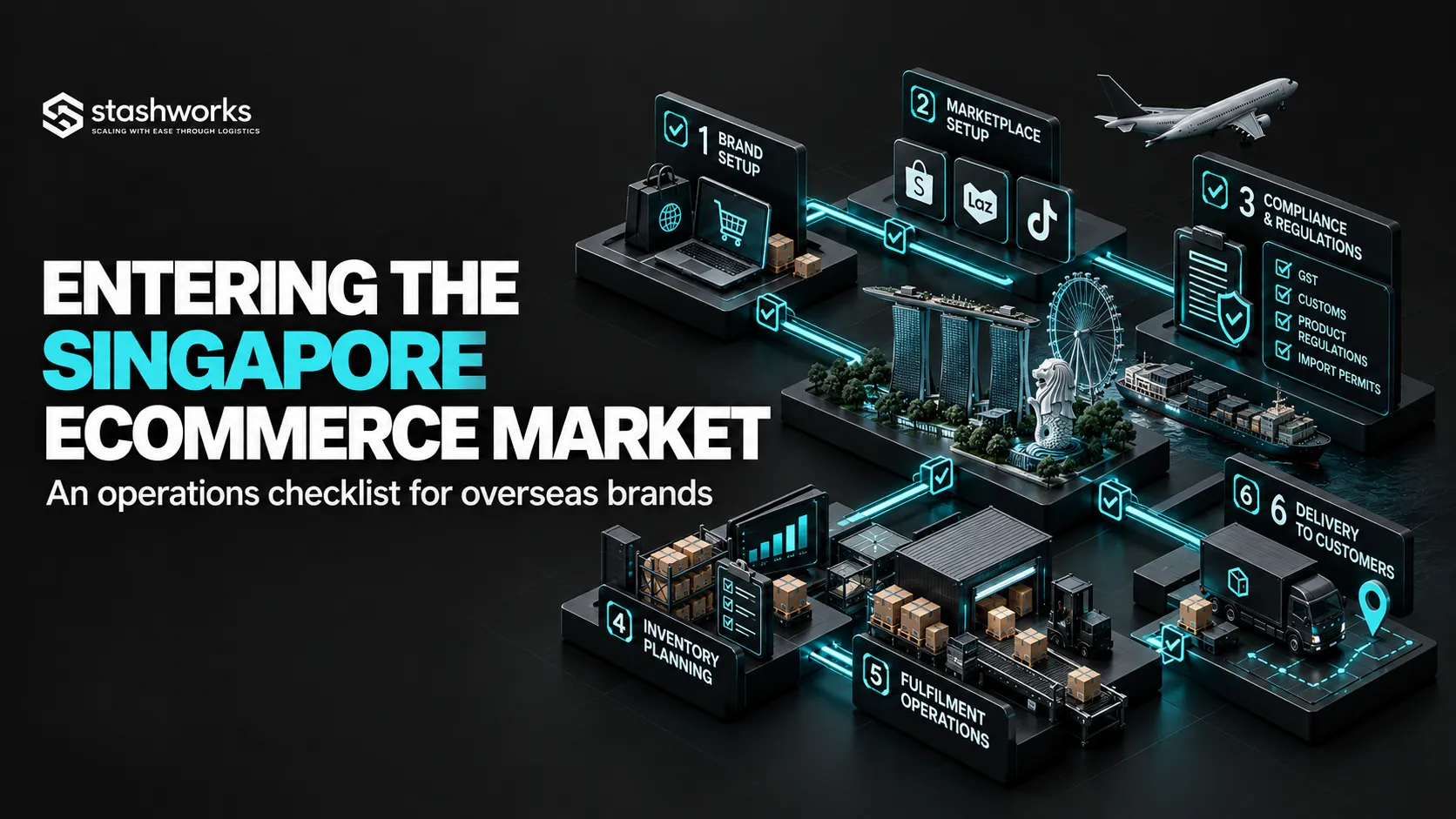
Entering Singapore ecommerce is not a single registration task. An overseas brand needs a workable route from product eligibility to importation, marketplace setup, inventory, fulfilment, delivery, customer support and returns.
The safest sequence is to validate the legal and product requirements first, then build the commercial and logistics workflow around what is actually permitted.
1. Define exactly what you plan to sell
Start at SKU and product-category level. Do not use “beauty”, “food” or “electronics” as the final compliance classification. Different products within the same commercial category can fall under different authorities and requirements.
Capture ingredients or materials, intended use, claims, country of manufacture, packaging format, barcode, dimensions, weight and any certificates already held.
2. Decide how the business will operate in Singapore
Determine whether the brand will establish its own local company or branch, use another approved commercial arrangement, appoint a distributor, or use a market-entry model such as SOBAAS.
ACRA currently sets out several options for foreign businesses, including a local subsidiary, foreign-company branch, representative office and re-domiciliation. These structures have different legal characteristics and are not interchangeable with an outsourced ecommerce service.
3. Identify the seller and contracting party
Document which entity or party will sell to the customer, own the marketplace account, invoice where relevant, receive marketplace payouts and handle refunds.
This decision can affect tax, marketplace onboarding, consumer obligations and account ownership. Confirm the model with qualified advisers rather than relying on terminology such as “local partner” or “seller of record” without a written definition.
4. Confirm the importer and Customs setup
Singapore Customs requires an import permit through TradeNet for goods entering Singapore. Before permit applications can be made, the importer needs a Unique Entity Number and activated Customs account.
Define who will act as importer, who submits permits, who provides commercial invoices and packing lists, and who pays import GST and duties where applicable.
5. Classify the product against the relevant regulator
Singapore has product-specific authorities. Cosmetics are regulated by HSA. Food imports are regulated by SFA. Certain household electrical, electronic and gas products fall under the Consumer Protection (Safety Requirements) Regulations administered by the Consumer Product Safety Office.
Other categories can involve other agencies. Use GoBusiness and the relevant regulator's current guidance to identify licensing, notification, testing, labelling or registration requirements.
6. Complete product approvals before launch inventory moves
Do not ship commercial stock first and investigate compliance later. For example, HSA states that manufacturers and importers of cosmetic products generally need to notify cosmetic products before supply in Singapore, subject to specific exceptions and ongoing requirements.
SFA requires the appropriate licence or registration for businesses importing food for commercial sale, and requirements vary by food classification.
7. Review labels and product claims
A label accepted in the home market may not automatically meet Singapore requirements. Review mandatory information, language, ingredient declarations, warnings, country-of-origin or other category-specific requirements before large packaging quantities are printed.
Marketing claims can also change a product's regulatory position. A cosmetic presented as treating a medical condition, for example, may not remain within ordinary cosmetic classification.
8. Model GST and landed cost
Imported goods can incur import GST and, for certain goods, customs duty. Singapore Customs states that most goods are non-dutiable but still incur GST, while specific categories such as liquor, tobacco, motor vehicles and petroleum products are dutiable.
IRAS also has rules for overseas entities importing goods for local supply and an Overseas Vendor Registration regime for qualifying B2C supplies of low-value goods. The tax treatment depends on the exact supply chain.
Use the detailed framework in How to Calculate Landed Cost When Importing into Singapore.
9. Confirm marketplace eligibility and account ownership
Choose the marketplaces and storefronts that fit the target customer, then confirm seller eligibility and required documents directly with each platform.
Record who owns the account, who can administer it, which party receives payouts and which assets remain with the brand if the operating partner changes.
10. Localise the catalogue
Adapt product titles, descriptions, images, variants, units, pack sizes, delivery information and support content for the Singapore customer and platform rules. Localisation should improve clarity without changing regulated product facts.
Keep the master SKU and product identity stable so the marketplace listing maps cleanly to the warehouse.
11. Choose local or cross-border inventory
Local stock can shorten the physical fulfilment route but requires an import and inventory commitment before demand is fully known. Cross-border fulfilment reduces initial local stock but can create longer delivery times and more complex landed-cost or return handling.
A hybrid model can use local stock for proven products and cross-border fulfilment for long-tail demand, where the platform and product allow it.
12. Design receiving and warehousing before the first shipment
Give the warehouse advance shipment information, SKU data, carton quantities, barcodes, dimensions and any handling requirements. Define what happens when received quantity, labelling or condition does not match the expected shipment.
Stashworks' Warehousing and Ecommerce Fulfilment services can connect receiving, storage, inventory and outbound fulfilment where the account and product are suitable.
13. Test the complete order flow
Before public launch, test a representative order from marketplace checkout through inventory reservation, warehouse release, picking, packing, tracking update and delivery. Also test cancellation and return scenarios.
The point is to confirm the systems and responsibilities work together, not only that each provider can perform its individual task.
14. Define delivery promises conservatively
Choose the customer-facing delivery promise only after confirming warehouse processing, carrier cut-offs, geographic coverage and exception handling. Avoid importing delivery expectations from another market without testing them locally.
See Same-Day, Next-Day or Standard Delivery for the operational trade-offs.
15. Build returns and customer support into the launch
Document who handles order enquiries, delivery exceptions, cancellations, returns, refunds and damaged products. Returned inventory should not automatically become saleable until the agreed inspection process is complete.
16. Set launch metrics before spending on growth
Track conversion, order volume, fulfilment accuracy, dispatch performance, delivery exceptions, returns, customer-service reasons, contribution margin and stock cover. These measures tell you whether the market is working commercially and operationally.
Do not treat sales alone as proof that the entry model is healthy.
17. Review the operating structure after the test period
Once demand is proven, decide whether the current structure still fits. The brand may keep the outsourced model, expand local inventory, change channels, establish a larger local team or create its own legal entity where appropriate.
A market-entry model should be able to evolve rather than trap the business in the launch configuration.
General information only: This checklist is operational guidance, not legal, tax or regulatory advice. Confirm obligations with ACRA, Singapore Customs, IRAS and the relevant product regulator for your exact arrangement.
Sources: ACRA, Ways to set up foreign businesses in Singapore; Singapore Customs, Obtain a Customs Import Permit; IRAS, E-Commerce; HSA, Cosmetic Products; SFA, Import of Food for Commercial Sale; Consumer Product Safety Office, Controlled Goods.