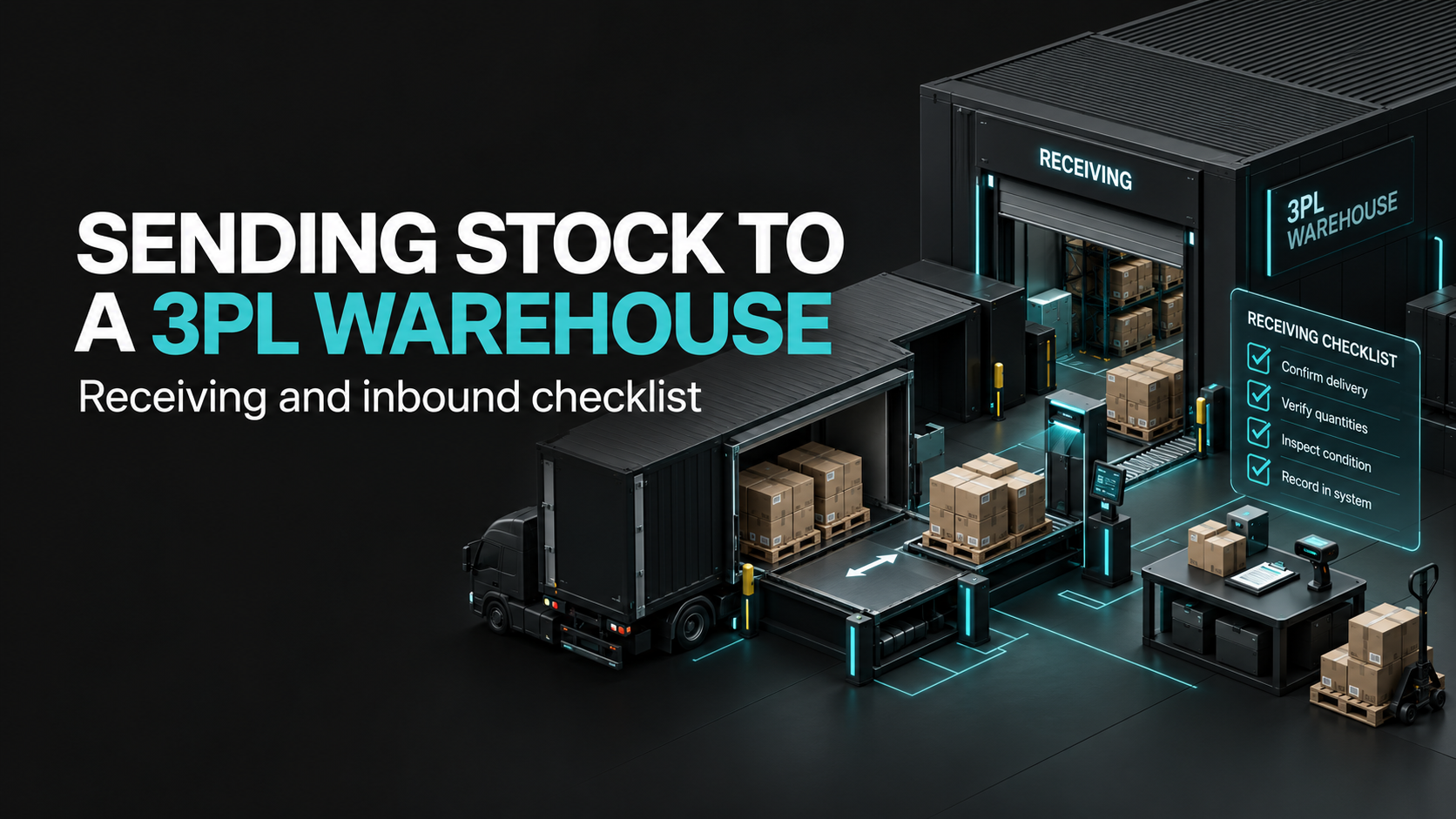
The receiving process starts before the truck reaches the warehouse.
If product data is missing, cartons contain unknown mixes, labels cannot be scanned or the warehouse is not expecting the delivery, inbound stock may spend its first hours—or days—being identified rather than becoming available for orders.
A strong 3PL inbound process therefore begins with making the shipment predictable before it moves. The exact rules vary by provider, product and transport mode, but the checklist below covers the information and decisions ecommerce brands should resolve before sending stock.
Confirm the provider’s current inbound SOP before booking transport
Every warehouse has its own receiving windows, booking method, labelling rules, pallet standards and exception process. Request the current written inbound instructions rather than relying on assumptions from a previous provider.
This article is a preparation framework, not a Stashworks-specific receiving standard. Before the first delivery, confirm the exact current requirements with the Stashworks team or any other proposed 3PL.
Complete the product master before the first shipment
The warehouse needs to know what each product is before it arrives. Provide the internal SKU, product description, barcode or GTIN where applicable, dimensions, weight, unit of measure, pack configuration and any handling requirements.
For products with batch, serial, expiry or regulated characteristics, agree what data must be captured at receiving and how it appears on the physical product.
Send an inbound notice that matches the physical delivery
An advance shipment notice, inbound order or equivalent record should tell the 3PL what to expect: supplier, expected arrival, SKUs, quantities, carton or pallet count and reference numbers.
The exact format may be a portal entry, system integration, spreadsheet or another agreed process. The important point is that the warehouse has an expected record against which the physical delivery can be checked.
Use purchase-order and supplier references consistently
If the warehouse receives against a purchase order, supplier delivery number or inbound ID, place that reference on the documentation and in the electronic notice.
A delivery with three different references across the supplier packing list, carrier paperwork and warehouse booking creates unnecessary investigation. Agree which identifier is primary and keep it consistent.
Describe carton and pallet contents clearly
Homogeneous cartons are easier to receive because one carton contains one SKU and known quantity. Mixed cartons are sometimes necessary, but their contents need clear documentation.
For pallets, indicate whether the pallet contains one SKU, several SKUs or several inbound orders. If the provider requires carton-level or pallet-level labels, confirm placement and format before the supplier dispatches.
Use scannable identification where the workflow requires it
Product barcodes help the receiving team confirm what was physically delivered. Logistic-unit identifiers can also help track cartons or pallets through transport and receiving.
GS1’s Logistic Label guideline uses the Serial Shipping Container Code (SSCC) to uniquely identify a logistic unit. That does not mean every Stashworks inbound pallet must use an SSCC; it is a recognised standard that can be appropriate where the parties and systems support it. Follow the 3PL’s actual labelling requirement.
Resolve products without usable barcodes before dispatch
If stock arrives with no barcode, duplicate codes or codes that do not map to the warehouse SKU, receiving may require manual identification or relabelling.
Agree whether the supplier should label products before shipment or whether the 3PL will perform relabelling as a separately scoped service. Do not let the first live inbound delivery become the test of whether the barcode mapping works.
Separate saleable stock from known exceptions
If the supplier already knows that some units are samples, damaged, promotional, quarantined or not for sale, identify them separately before shipment where possible.
Mixing them into normal sellable cartons forces the warehouse to discover the difference during receiving and increases the chance of the wrong inventory state being assigned.
Define the receiving check you are paying for
“Check the stock” can mean several different things. The warehouse might count cartons, count individual units, scan product codes, inspect visible damage or perform a more detailed quality-control procedure.
Document the level of checking required. A unit-level count and detailed product inspection take materially more work than confirming sealed cartons against a packing list.
Agree what happens to shortages and overages
If the inbound notice says 100 units and the warehouse counts 96, should the receipt remain open, close with a discrepancy or wait for client approval? What happens when 104 arrive?
Define tolerance and escalation. The warehouse should record the physical result rather than forcing the receipt to match the purchase order.
Damage evidence should have a standard
For visible inbound damage, agree when photographs are required, how the stock is segregated and who decides whether it can be sold, returned to the supplier or written off.
Shopify’s 2026 receiving guidance similarly recommends checking condition during receipt and documenting discrepancies before inventory is placed into normal storage.
Book the arrival around the warehouse’s receiving process
A carrier arriving without a booking can create congestion or delay even when the stock itself is perfectly prepared. Confirm delivery date, receiving window, vehicle or pallet information where requested, and the contact or reference the driver needs.
Peak campaigns can also increase inbound pressure because brands build inventory before the sales event. Forecast those deliveries rather than treating receiving capacity as unlimited.
Import clearance and warehouse receiving are separate milestones
For goods imported into Singapore, customs and tax requirements apply before or around the local movement depending on the shipment structure. Singapore Customs states that imports require the appropriate declarations and permits, with GST and/or duty applying according to the goods and procedure.
Do not assume the warehouse itself is the importer, declaring agent or party responsible for customs documentation. Confirm those roles separately. If Stashworks is also involved in freight forwarding, document where forwarding responsibility ends and warehouse receiving begins.
Define when received stock becomes available for orders
Arrival time, receiving completion and putaway completion are different events. A product may physically be inside the building but not yet be approved or located for picking.
Ask what event changes the inventory to available status and how receiving exceptions affect that timing. This definition is more useful than an undefined promise that inventory is “received quickly”.
Reconcile the first inbound before sending the next one
After the first delivery, compare what the supplier sent, what the 3PL received, what the system shows and where the stock was put away. Resolve barcode, quantity, label and product-data issues while the shipment is still easy to investigate.
That first reconciliation should feed back to the supplier and future inbound instructions. A smooth second shipment is a better sign of onboarding quality than a first shipment rescued through manual effort.
Inbound preparation is part of 3PL onboarding, but it deserves its own workflow
The broader 3PL onboarding checklist covers contracts, systems, test orders and operational cutover. This article owns the narrower physical question: how to make each inbound shipment receivable.
Before sending stock to Stashworks, share the product master, expected inbound profile, labelling situation and any special inspection requirements. Then confirm the current warehousing and receiving SOP for the actual shipment.
Sources: Shopify, Receiving Inventory; GS1 Logistic Label Guideline; Singapore Customs, Import Procedures Overview.