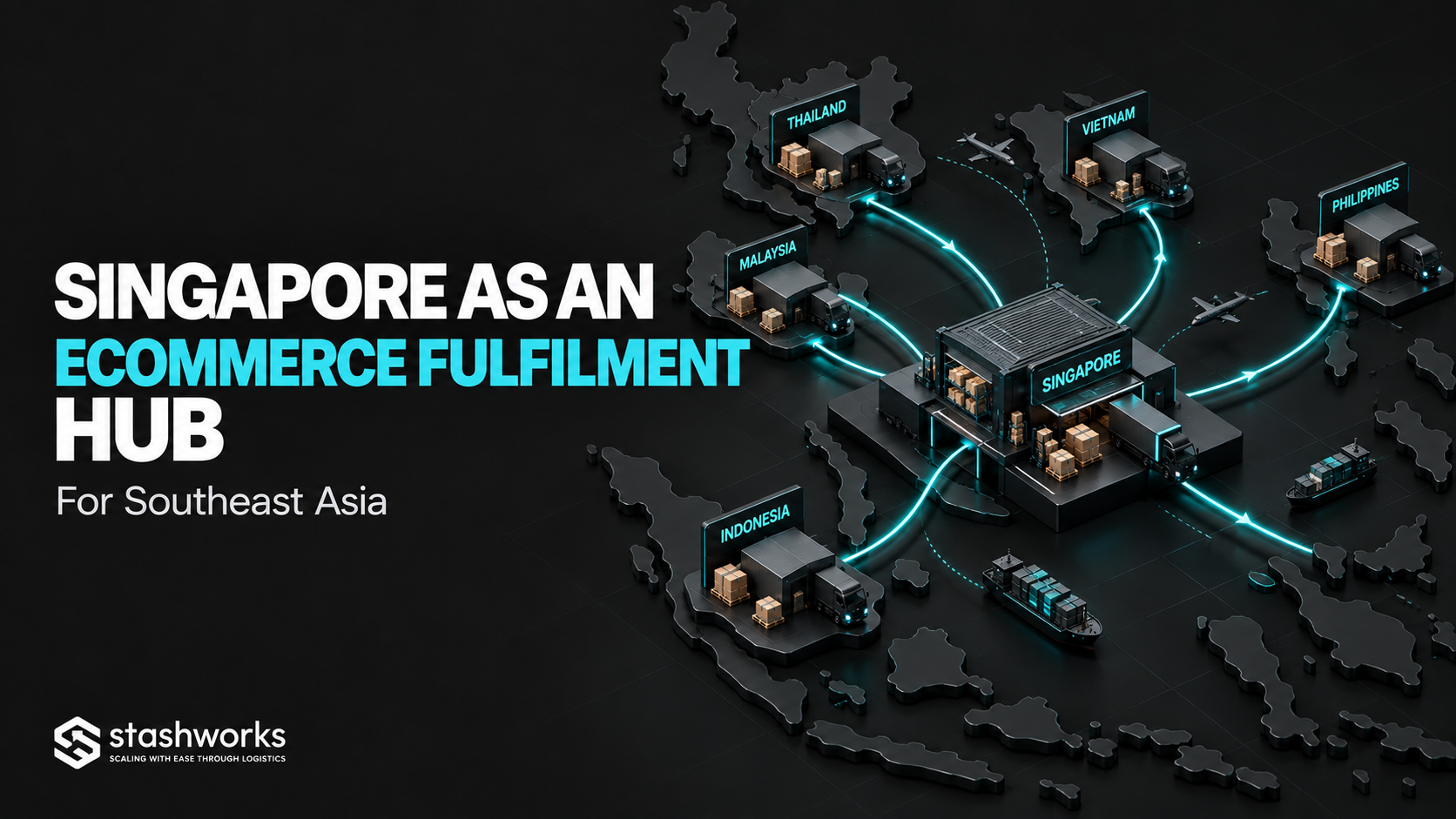
Singapore can be a strong base for regional ecommerce operations, but “use Singapore as a Southeast Asia hub” is not a strategy by itself.
The right question is whether Singapore's connectivity, logistics infrastructure and operating environment improve the movement of your specific products to your actual customer markets.
Why Singapore is considered a regional logistics hub
Singapore sits on major international shipping and aviation routes and has developed extensive port, airport and logistics infrastructure. The Singapore Economic Development Board positions the country as a regional hub and control-tower location for companies coordinating Southeast Asian operations.
That connectivity can support a model where inventory arrives internationally, is stored or processed in Singapore and then moves to domestic or cross-border customers.
A hub can centralise inventory
Instead of holding separate safety stock in every market, a business can pool some inventory in one location and allocate it according to demand. Pooling can reduce duplicated stock, but only when the cross-border lead time and cost still meet the customer proposition.
For fast-moving markets, local inventory may still be necessary. Regional operations often use a mix of central and in-country stock rather than one warehouse serving every order.
Inbound freight and fulfilment should be designed together
A hub works better when supplier freight, import procedures, receiving and ecommerce fulfilment are connected. Shipment schedules should reflect how quickly inventory is consumed after arrival.
The international movement itself is covered in Freight Forwarding for Ecommerce Businesses in Singapore.
Singapore import requirements still apply to goods entering the country
Using Singapore as a hub does not remove import procedures. The importing entity, permits, GST or duty where applicable and controlled-goods requirements still need to be addressed for inventory entering Singapore.
If goods are subsequently exported or moved under a special customs or GST scheme, confirm the correct structure with Singapore Customs and qualified advisers before relying on the expected tax or cash-flow treatment.
Cross-border orders create destination-country requirements too
A parcel leaving Singapore can face import rules, taxes, duties, restricted-goods requirements and delivery conditions in the destination market. Those rules vary by country and product.
Do not promise “Southeast Asia delivery” as one uniform service. Confirm each destination, commodity, carrier method, customs model and returns process.
Regional customer demand should drive the network
Map order volume by country, average basket, parcel size, required delivery speed and return rate. If most demand is concentrated in one large market, holding all stock in Singapore may create unnecessary cross-border cost.
If demand is spread across several markets and service expectations allow it, central inventory can be more attractive.
Inventory segmentation can improve the model
Keep long-tail or unpredictable products centrally while positioning the fastest movers closer to their major customer markets. This can preserve assortment breadth without duplicating every SKU everywhere.
Use sales velocity and service-level data rather than applying the same network rule to the full catalogue.
Returns need a regional decision
Cross-border returns can be expensive relative to product value. Decide whether returns move back to Singapore, are handled locally, are consolidated before return, or follow another approved commercial disposition.
The right approach depends on product value, condition, customs implications and the service available in each market.
Use total regional cost, not Singapore warehouse cost alone
Compare international inbound freight, Singapore import cost, storage, fulfilment, outbound cross-border transport, destination charges, failed deliveries and returns. A low warehouse rate cannot compensate for an inefficient regional transport model.
Likewise, a slightly higher central operating cost can still be sensible if it reduces duplicated stock and simplifies the network.
Singapore can also function as an operational control point
Not every regional strategy requires every parcel to ship from Singapore. Companies can use Singapore for planning, inventory control, supplier coordination or regional management while operating fulfilment nodes elsewhere.
That distinction matters when the business grows beyond what one physical hub can serve efficiently.
Where Stashworks fits
Stashworks positions its logistics and fulfilment offering around Singapore and Southeast Asia and provides freight forwarding, warehousing, ecommerce fulfilment and delivery services.
For regional expansion, confirm the exact origin and destination lanes, country capabilities, customs responsibilities, inventory locations and service levels required. The regional operating model should be designed around verified routes rather than assuming one generic Southeast Asia network.
Sources: Singapore EDB, Connectivity and Regional Access; Singapore EDB, Logistics and Supply Chain Management; Singapore Customs, Import Procedures Overview; Stashworks, Freight Forwarding.