A customer buys “Black / Medium”. A marketplace sends a listing identifier. The warehouse sees a shelf of products that may differ by one small label. Unless those views resolve to one stable product identity, the fulfilment team is being asked to interpret the catalogue every time an order moves.
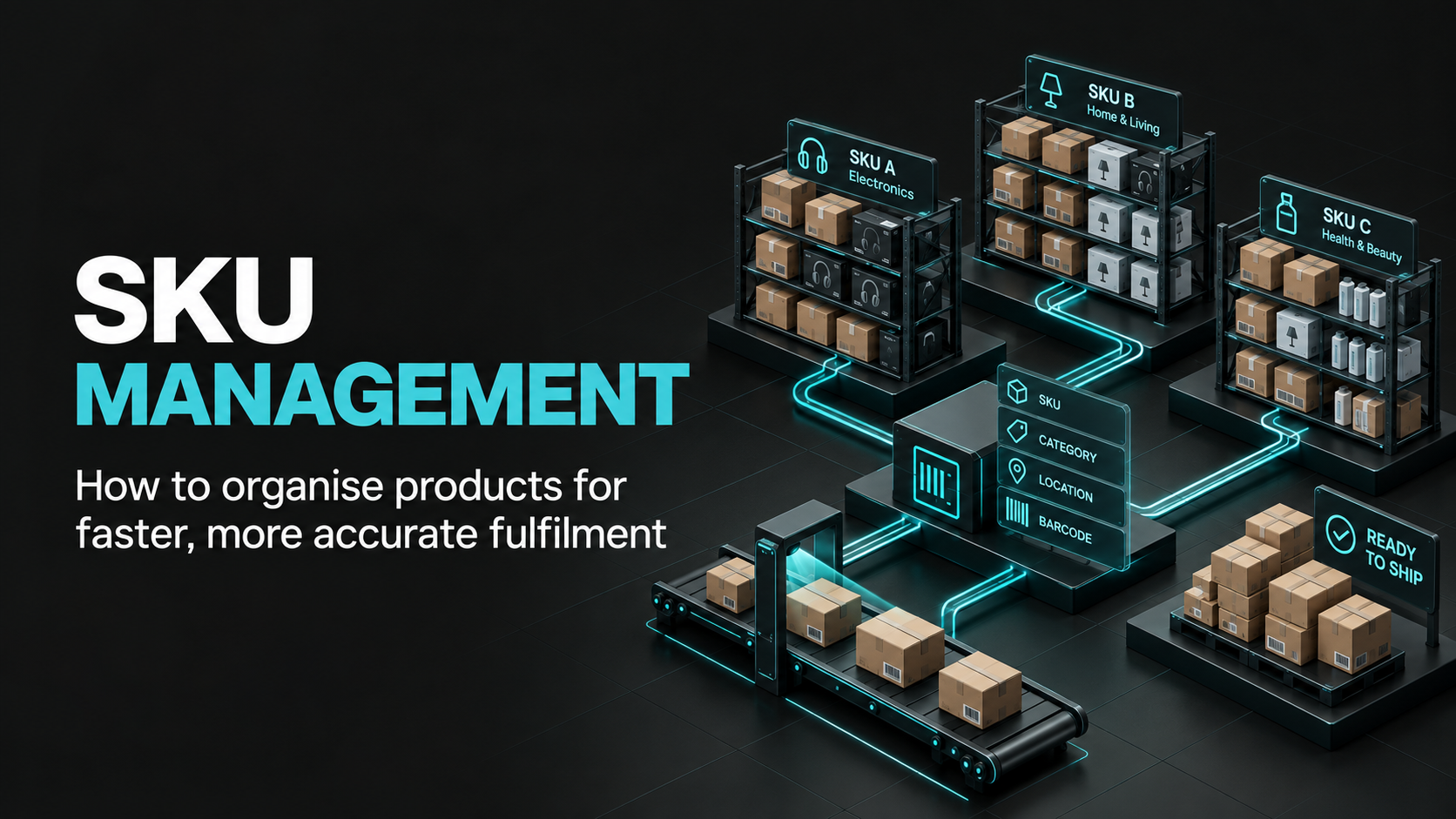
That is why SKU management is not administrative housekeeping. SKU architecture is warehouse infrastructure. A good system gives every sellable variant an unambiguous internal identity, maps that identity to barcodes and sales channels, and stays stable while product names, prices, campaigns and storage locations change.
Give every sellable variant one unique internal identity
A stock keeping unit, or SKU, is an internal code used by a business to identify and track a specific product or variant. Shopify’s current SKU guidance recommends a unique SKU for each variant because duplicate identifiers create problems for inventory tracking and third-party integrations.
If colour, size, pack quantity or another attribute changes what the warehouse must pick, it usually needs a distinct SKU. “T-shirt” is not enough if the customer can buy several sizes and colours that are stored as separate units.
Do not make the SKU carry information that changes frequently
It can be useful for a SKU to contain a small number of recognisable attributes, but avoid encoding data that will become obsolete. Price, current sales channel, temporary campaign name and warehouse location can all change without the physical product changing.
A code that has to be renamed every time merchandising changes creates unnecessary mapping work. Keep the identifier stable and store changeable attributes in their own fields.
SKU and barcode are related, but they are not the same thing
A SKU is created for the business’s own inventory system. A barcode is the machine-readable representation of an identifier. GS1 explains that a GTIN is a globally unique trade-item identifier and can be encoded in a barcode; the barcode itself is the data-capture format.
That means a business can use its own internal SKU while also storing a GS1 GTIN, UPC or EAN where the product requires one. The warehouse system needs a reliable mapping between the identifier it receives from the order and the code the scanner reads on the physical item.
Keep product names useful even when the SKU is concise
Warehouse users should not have to decode an unfamiliar string to understand what they are holding. A useful product description can include brand, product, variant and pack size in a consistent order.
This is especially important for visually similar products. If two variants differ only by a small size mark, the system description should make that distinction obvious alongside the scan control.
Units of measure need explicit rules
A supplier may ship a case of 24 while the ecommerce store sells individual units. A B2B customer may order a full case while a DTC customer orders one piece. The same physical product therefore needs a clear relationship between each handling unit.
Do not use one quantity field and rely on staff to remember whether “1” means one unit, one inner pack or one case. Define pack conversions and make the warehouse instruction reflect the unit being picked.
Bundles need component logic, not only a marketing name
A bundle can appear as one storefront product while consuming several warehouse SKUs. The order system must tell the fulfilment operation which components and quantities make one complete bundle.
If bundles are pre-kitted, the finished kit may also need its own warehouse identity. If they are assembled at order time, the component inventory needs to decrement correctly. The operational trade-offs are covered in Kitting and Product Bundling.
Channel mapping becomes critical in multichannel operations
Shopee, Lazada, TikTok Shop, Shopify and other channels can represent the same physical product with different listing or variant identifiers. The warehouse should not treat those channel IDs as independent physical products unless they genuinely are.
Maintain a mapping table from every channel identifier to the internal SKU. Treat unmatched or duplicate mappings as exceptions before orders reach picking. This supports the one-inventory-pool model described in Multichannel Order Fulfilment.
Label stock before ambiguity reaches the pick face
Products that arrive without reliable scannable identification create work at receiving and risk later. Agree who applies the warehouse label, what identifier it represents and whether supplier labels can be trusted as-is.
If relabelling is required, define whether it happens before shipment to the 3PL, during receiving, or as a separately scoped value-added activity. The important rule is that two distinct sellable variants should not become visually or digitally indistinguishable inside storage.
Do not encode the storage location into the SKU
A product can move from reserve racking to a fast-pick bin without becoming a different product. The WMS should hold location separately from SKU identity.
This separation also supports multi-location inventory. The same SKU can exist in several warehouses or bins while the system tracks how much is available at each place.
Create a controlled new-SKU onboarding process
Before the first inbound shipment, validate the SKU, product name, barcode or GTIN where applicable, dimensions, weight, unit of measure, handling notes, bundle relationships and channel mappings.
Duplicate checks matter. A team member creating a product under time pressure should not accidentally reuse an old code because it “looks available”. Once stock and transactions exist against a SKU, changing it becomes a data-migration problem rather than a simple rename.
Retire SKUs without deleting their history
Discontinued products can remain important to returns, customer service, reporting and audit history. Mark them inactive or discontinued according to the system rather than recycling the identifier for a new product.
Reusing an old SKU can make historic orders appear to contain a product that did not exist at the time and can corrupt marketplace or warehouse mappings.
Good SKU management reduces the number of decisions made at the shelf
The warehouse should receive a clear instruction, locate the expected product, scan a code that confirms it and continue. Every time a picker has to ask “Which one of these did the order mean?”, product data has pushed a decision into the most time-sensitive part of fulfilment.
Stashworks connects inventory and WMS technology with physical fulfilment. When onboarding a catalogue, provide the internal SKU structure, channel mappings, barcode data, units of measure and bundle rules so product identity is resolved before live orders begin.
Sources: Shopify, What Is a SKU Number?; GS1, GTIN, Barcode, EAN and UPC.