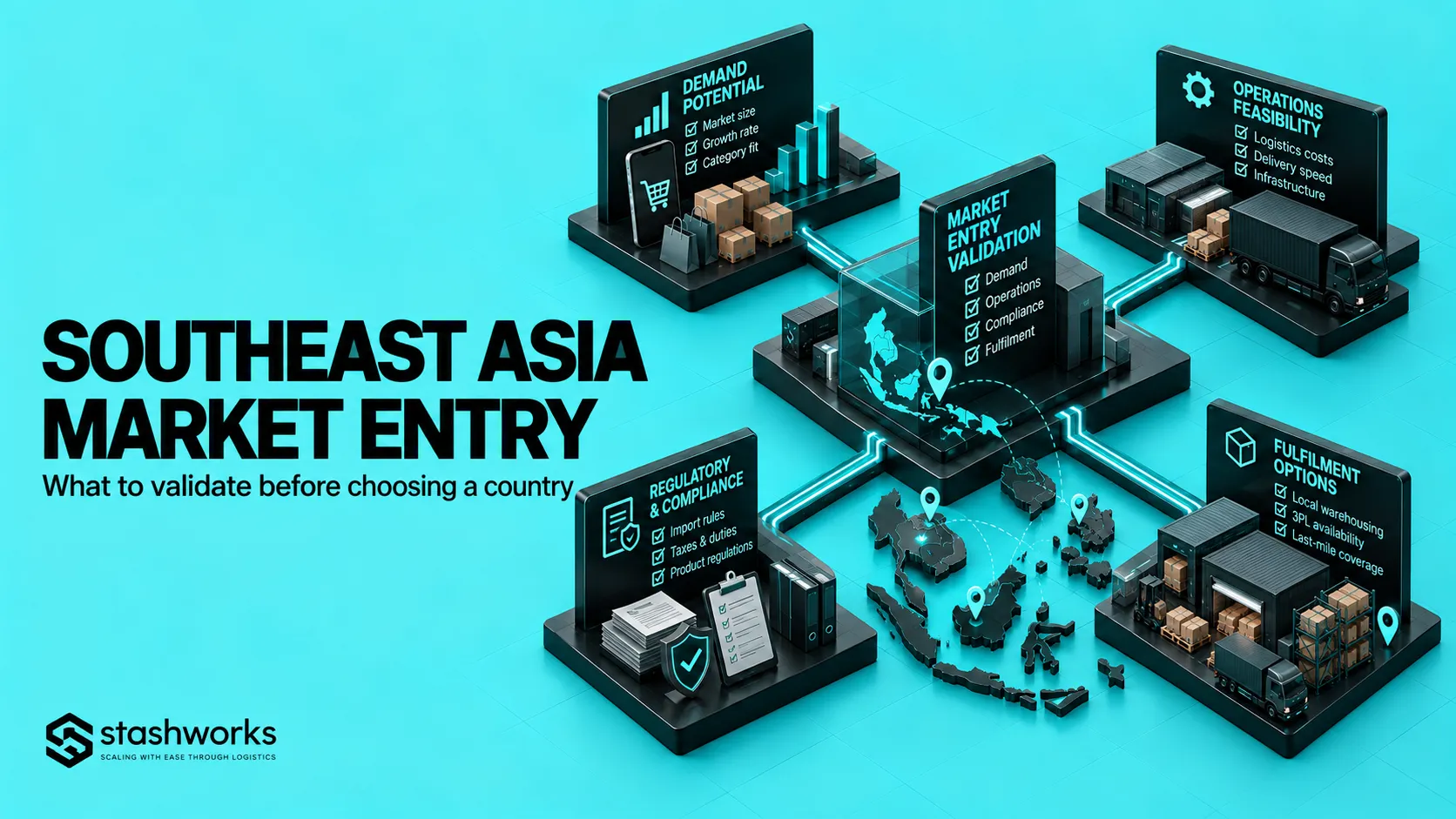
“Southeast Asia” is not one ecommerce market. The region contains countries with different population sizes, income levels, platform mixes, languages, payment habits, import rules, product regulations, tax systems and logistics networks.
A strong market-entry process therefore compares countries at operating level before committing inventory or local setup.
Start with product-market fit, not market size alone
A large population does not prove demand for a specific product. Start with the problem the product solves, likely customer segment, price position, competitor density and evidence of comparable demand.
Use first-party sales data, marketplace search behaviour, distributor feedback, customer research and small paid tests where possible. Treat broad regional growth statistics as context rather than proof.
Use comparable country data
ASEANstats provides official regional data covering population, GDP, trade and other country indicators. These measures help establish the scale and economic context of each market.
Build one comparison sheet using the same metric definitions and year for every country. Mixing different sources, dates and definitions can make one market look artificially attractive.
Identify the actual ecommerce channels customers use
Channel fit matters because a product can perform differently on a large marketplace, social-commerce channel, specialist retailer or direct-to-consumer storefront.
For each target country, record the marketplaces relevant to the category, seller eligibility, commission and service fees, advertising options, fulfilment requirements, account ownership rules and how payouts work.
Check whether the product can legally enter and be sold
Before analysing campaign strategy, determine whether the product is subject to registration, notification, testing, labelling, import licensing, sanitary rules, technical standards or other non-tariff measures.
The ASEAN Trade Repository exists specifically to improve transparency around tariffs, non-tariff measures, customs procedures and documentary requirements across ASEAN member states. Use it as a starting point, then verify the current rule with the national authority.
Separate import feasibility from selling feasibility
A product may be physically importable but still require additional steps before retail sale. Conversely, a product might be permitted for sale but require a specific licensed or registered importer.
Create two checklists: one for crossing the border and another for placing the product on the market.
Map the seller and entity requirements
Different channels and countries can require different seller documentation, local addresses, bank accounts or entity structures. Determine whether the brand can sell cross-border, needs a local entity, can appoint a local partner or can use an agreed market-entry service.
Do not assume a structure used in Singapore automatically works in Malaysia or Thailand.
Model tax and customs before comparing prices
Marketplace fees are only one part of the economics. Include import taxes, duties, GST or VAT, local corporate or withholding considerations where relevant, currency conversion and the administrative cost of compliance.
Tax rules are jurisdiction-specific and can depend on the seller, customer, shipment value and inventory location. Use local tax advisers for the proposed structure.
Compare logistics at the postcode and parcel level
Country-level averages hide practical differences. Model inbound freight, customs clearance, receiving, storage, pick and pack, parcel delivery, remote-area surcharges, failed delivery and returns.
A product with low margin or high volumetric weight can become unattractive even when customer demand is strong.
Test delivery expectations
Customer expectations are shaped by local marketplace norms. Record the delivery options offered by leading competitors and the actual service levels available to your warehouse location and customer base.
Do not promise same-day or next-day delivery simply because it is common in one city or channel.
Study payment behaviour and cash-flow timing
Understand the payment methods customers expect and the marketplace settlement cycle. The gap between paying suppliers, importing inventory, funding advertising and receiving marketplace payouts can materially change the working-capital requirement.
Include refunds and chargebacks in the cash-flow model.
Plan localisation beyond language
Titles, product benefits, sizing, measurement units, imagery, promotional calendars, customer-service tone and claims may all need local adaptation. Translation is one component, not the complete localisation process.
Keep regulated product facts consistent with approved documentation while adapting the merchandising layer.
Compare return economics
A market with strong demand can still produce poor unit economics if returns are expensive or difficult to recover. Model local return collection, inspection, restocking, disposal and cross-border return movement where applicable.
For lower-value goods, it may be uneconomic to move every returned unit back across a border.
Measure regulatory complexity by product category
The same country can be easy for apparel and difficult for food, cosmetics, health-related products or controlled electronics. Score complexity by the specific product, not by a generic “ease of doing business” impression.
The ASEAN Trade Repository's non-tariff-measure categories include technical regulations, standards, sanitary measures, licensing and documentary requirements, which is why product-level research matters.
Assess local operating partners
If the brand will use a distributor, 3PL, marketplace enabler or sell-on-behalf provider, assess which countries they genuinely support, which services are delivered directly, which are subcontracted and how account ownership, inventory and customer data are handled.
Stashworks currently lists Singapore, Malaysia and Thailand as its available SOBAAS markets, with the exact model defined by the market, product and scope.
Score markets against the same decision criteria
A weighted matrix can include demand evidence, margin, regulatory feasibility, channel access, fulfilment cost, delivery performance, localisation workload, working capital, partner availability and strategic importance.
The score should make trade-offs visible rather than hiding them inside a single market-size number.
Choose the market you can learn from
The best first market is not always the largest. A smaller market can be strategically useful if it offers faster feedback, cleaner operations and lower testing risk. The objective of the first launch may be to learn whether the proposition travels, not to maximise regional revenue immediately.
General information only: Product, tax, import and selling requirements vary by country. Confirm current requirements with the relevant national authorities and advisers.
Sources: ASEANstats Data Portal; ASEAN Trade Repository, Non-Tariff Measures; ASEAN Trade Repository, Procedures and Documentary Requirements; ASEAN, E-Commerce and Digital Economy; Stashworks, SOBAAS.