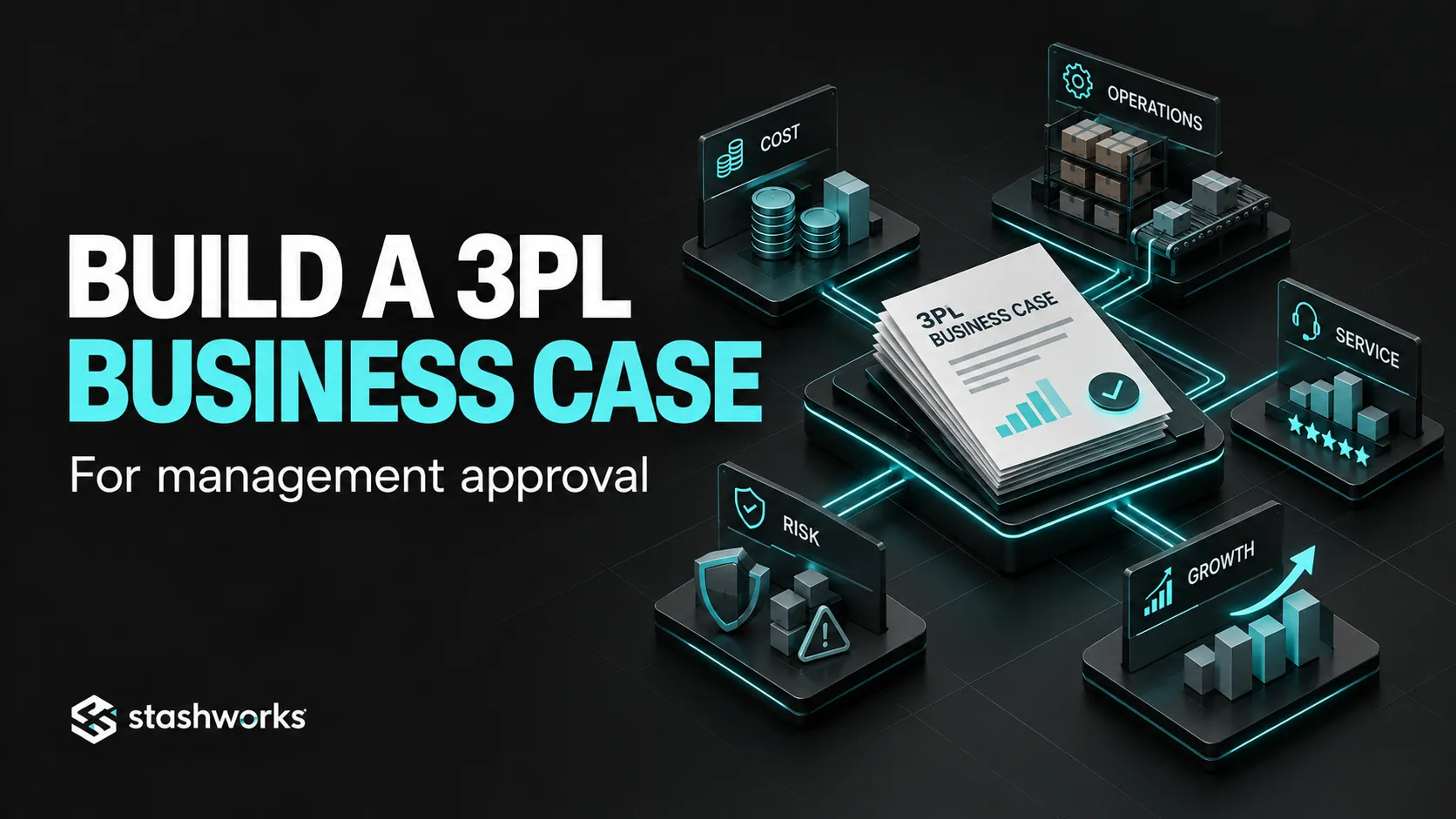
A 3PL business case should explain why outsourcing creates enough operational and financial value to justify the change. Management usually needs more than a warehouse quote; it needs a comparison between the current model, the proposed model and the risks of doing nothing.
The strongest case makes assumptions visible and separates measurable savings from strategic benefits.
Define the decision
State exactly what approval is required: outsource all fulfilment, move only warehousing, add a new market, switch providers or combine several logistics services.
A vague request for “3PL budget” is difficult to evaluate.
Build the current-state baseline
Calculate internal warehousing, labour, software, packaging, management time, courier administration, returns, equipment, rent and overflow costs. Include outsourced providers already in the network.
Use actual annual data where possible rather than one recent month.
Identify capacity constraints
Document the problems the current model cannot solve reliably: insufficient space, peak labour, marketplace deadlines, slow onboarding, inventory visibility, returns workload or regional expansion.
A business case is stronger when it shows the cost of the constraint, not only the inconvenience.
Quantify the risk of doing nothing
Estimate the operational consequences of keeping the current setup: additional lease commitments, new hires, capital equipment, recurring stock discrepancies, late dispatch, management distraction or inability to support growth.
Not every risk can be converted into an exact dollar figure, but it should still be described and ranked.
Define the proposed 3PL scope
State which services move to the provider: receiving, warehousing, ecommerce fulfilment, returns, freight, last-mile delivery, integrations or value-added work.
Stashworks' current 3PL Singapore service can connect several of these functions, while individual services can also be scoped separately.
Model the provider cost using real operating drivers
Use expected inventory, orders, order lines, units, inbound shipments, returns, packaging and delivery mix. Add setup, integration, project and minimum charges where quoted.
Do not compare an internal annual cost against a 3PL quote that excludes the services the internal team currently performs.
Include implementation cost
A move can require inventory reconciliation, stock transport, integration work, new packaging, project management, parallel operations and temporary labour.
Keep implementation cost separate from steady-state annual cost so management can see the one-time investment.
Quantify labour avoided or redeployed carefully
Outsourcing does not automatically make every internal role disappear. Identify which tasks genuinely stop, which roles can be redeployed and which governance work remains with the brand.
A credible business case avoids claiming salary savings that management does not plan to realise.
Include working-capital effects
A 3PL can change storage flexibility, inbound frequency and inventory location, which may affect how much stock the business holds. Model these effects cautiously rather than assuming outsourcing always reduces inventory.
Value scalability
One strategic benefit of outsourcing can be avoiding fixed facility and labour commitments as volume changes. Quantify where possible: extra warehouse space avoided, peak temporary labour avoided or faster channel launch.
Use conservative assumptions and explain what must be true for the benefit to occur.
Value management focus without pretending it is free money
Founders and operations leaders may spend substantial time on warehouse issues. Outsourcing can release that time, but only if the provider genuinely takes over the underlying execution.
Present management time as capacity released, not automatically as cash savings.
Include service and customer outcomes
Potential improvements can include clearer inventory visibility, more structured fulfilment controls, connected channel integrations or better peak readiness. Tie each expected benefit to a measurable operating requirement.
Do not promise a performance result the chosen provider has not contractually committed to.
Build at least three scenarios
Use low, expected and high-volume cases. Change order volume, inventory, returns and peak assumptions to see when the 3PL model becomes more or less attractive.
A business case that works only at one exact forecast is fragile.
Run a break-even comparison
Identify the point at which total outsourced cost equals the current or expanded internal model. Include fixed and variable components on both sides.
Break-even does not decide the project by itself, but it shows which assumptions matter most.
Show non-financial decision criteria
Management may accept a slightly higher operating cost for lower operational risk, faster scalability, reduced capital commitment or access to capabilities that are difficult to build internally.
Score these benefits separately instead of hiding them inside an invented financial value.
Include implementation risk and mitigations
List stock-transfer, integration, data, customer-service and cutover risks with mitigation. If switching providers, the existing Switching 3PL Providers Without Disrupting Orders guide provides the migration framework.
Define the approval conditions
Management can approve the project subject to final contract, successful testing, acceptable reference checks, confirmed pricing assumptions and agreed SLAs.
This allows the decision to move forward without pretending every implementation detail is already final.
Present the recommendation in one page
Lead with the problem, recommendation, financial summary, key benefits, major risks and next decision. Put the detailed assumptions and model behind it.
A good business case should make it easy for an executive to understand why the proposal exists and what would change after approval.
Keep Stashworks-specific economics quote-based
Stashworks' public site explains the factors that affect pricing but does not publish a universal rate card or guaranteed savings percentage. Any business case using Stashworks should therefore use an actual quotation and the agreed scope rather than invented benchmark rates.
Sources: Stashworks, 3PL Singapore; Stashworks, Services.