
Marketplace management is not one task. It is a recurring operating system for keeping product data, promotions, customer enquiries, inventory and fulfilment aligned across channels.
As a seller adds Shopee, Lazada, TikTok Shop, Amazon or other marketplaces, the challenge is usually not opening another seller account. It is controlling the growing number of daily decisions and exceptions without creating a separate mini-business for every platform.
Start with one operating owner for each workflow
Multichannel growth becomes fragile when responsibility is spread informally. The first design decision is to define who owns catalogue changes, campaign setup, price approvals, customer enquiries, stock decisions, order exceptions and platform access.
Stashworks' current Ecommerce Enablement page reflects this model by separating marketplace management, listings, campaign support and customer support, then connecting them to fulfilment.
Treat the product catalogue as shared infrastructure
Each marketplace has its own fields, categories and content rules, but the brand still needs one governed source of product truth. Product names, variants, SKUs, barcodes, pack sizes, dimensions and approved claims should not drift independently by channel.
A strong catalogue workflow separates the master product record from channel-specific content. The master identifies the product; the channel layer adapts titles, attributes, imagery and merchandising to the marketplace.
The warehouse impact is covered in SKU Management: How to Organise Products for Faster, More Accurate Fulfilment.
Build a channel map before adding more marketplaces
A channel map records which products are sold where, which seller account owns each listing, which fulfilment location serves it, and which internal SKU or variant the marketplace record maps to.
This becomes the control layer for launches, delistings and catalogue clean-up. Without it, teams can easily remove a product from one system while leaving an active listing elsewhere.
Inventory management must sit inside marketplace management
Marketplace operations cannot be separated from stock availability. A campaign, listing update or channel launch changes demand against a finite inventory pool.
Brands selling across several marketplaces should define which system represents available inventory, how reservations are handled, and what happens when an integration or manual update fails. The existing guide How to Manage Inventory Across Shopify, Shopee, Lazada and TikTok Shop explains the inventory-control side in more detail.
Campaigns need an operational gate before they go live
Promotions are commercial events with logistics consequences. Before a SKU enters a campaign, confirm the approved product, price, available stock, replenishment plan, fulfilment capacity, dispatch requirement and customer-service messaging.
Lazada University currently includes seller education on promotions and campaign management, while TikTok Seller Center provides store operations, customer-service, performance and marketing functions. The exact tools differ by platform, but the operating principle is consistent: campaign activity should not be separated from operational readiness.
Dispatch rules belong in the marketplace operating model
Every channel creates deadlines and exception states that the warehouse must understand. Marketplace management should therefore define the handoff from seller centre to order processing: when orders enter fulfilment, how cancellations are handled, what happens to address issues and who owns late-order escalation.
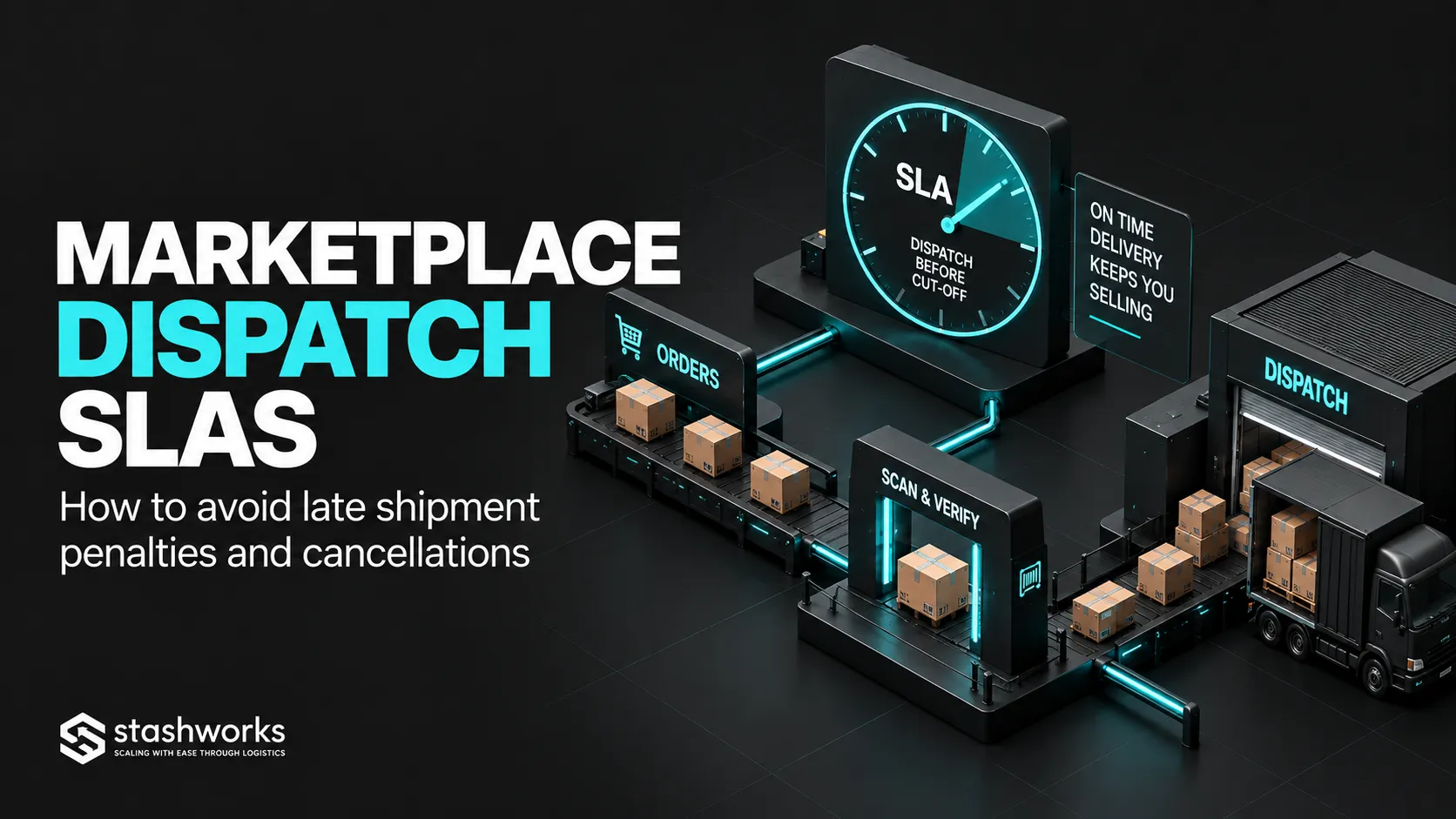
The article Marketplace Dispatch SLAs provides a deeper framework for turning marketplace deadlines into warehouse workflows.
Customer service should route issues to the system that can solve them
A marketplace inbox often receives questions that originate elsewhere: fulfilment status, delivery exceptions, damaged parcels, returns, product details or payment issues. The customer-service process needs clear escalation routes rather than one team trying to solve every problem from the seller centre.
Stashworks currently describes marketplace customer support as agreed customer enquiries, order-status support, inbox management and escalation of issues requiring further action. The exact channels and scope are defined during setup.
Use one issue taxonomy across channels
Different marketplaces may use different labels, but an internal issue taxonomy makes performance comparable. For example, the business can group tickets into listing, inventory, order, fulfilment, delivery, return, product and payment-related categories.
This allows a manager to see whether a rising support backlog is actually caused by catalogue quality, warehouse exceptions or delivery performance.
Access and permissions are part of operations
Marketplace management often requires external staff or partners to work inside seller accounts. Access should use platform-supported user, partner or role controls wherever available rather than shared owner credentials.
Shopify currently supports roles and collaborator permissions, while TikTok Business Center supports member and partner access at account and asset level. The principle is to grant the minimum access required for the task and review it when responsibilities change.
Manage the calendar, not only the queue
Daily operational work is reactive by nature, but marketplace management also needs a forward calendar. Product launches, price changes, campaign submissions, content refreshes, stock arrivals and major sale periods should be visible together.
This prevents the commercial team from creating demand the operations team has not prepared for. For major sales periods, use the planning framework in 9.9, 11.11 and 12.12 Fulfilment Planning Checklist.
Measure marketplace operations by controllable outcomes
Useful measures can include catalogue backlog, rejected-listing rate, time to resolve listing issues, campaign-readiness exceptions, customer-enquiry backlog, order-exception ageing and dispatch performance. The exact scorecard should match the activities the team actually manages.
Avoid combining all marketplace performance into sales alone. Revenue can rise while operational debt is accumulating underneath.
Where Stashworks fits
Stashworks positions Marketplace & Platform Management as part of Ecommerce Enablement, with listing operations, campaign support, customer support and a connection to its wider ecommerce and logistics operation. Its technology and fulfilment services provide the connection between marketplace activity, inventory and warehouse execution.
For a Singapore brand building a multichannel operating model, the useful next step is to map every recurring marketplace task, assign ownership, identify the system of record for each data type and document the escalation path into fulfilment and delivery.
When marketplace operations are part of expansion beyond the home market, Localising Marketplace Listings for Southeast Asia covers the country-specific catalogue layer, while Sell On Behalf as a Service explains the wider market-entry operating model.
Sources: Stashworks, Ecommerce Enablement; Lazada University Singapore; TikTok for Business, Seller Center setup; Amazon Singapore, Seller Central.