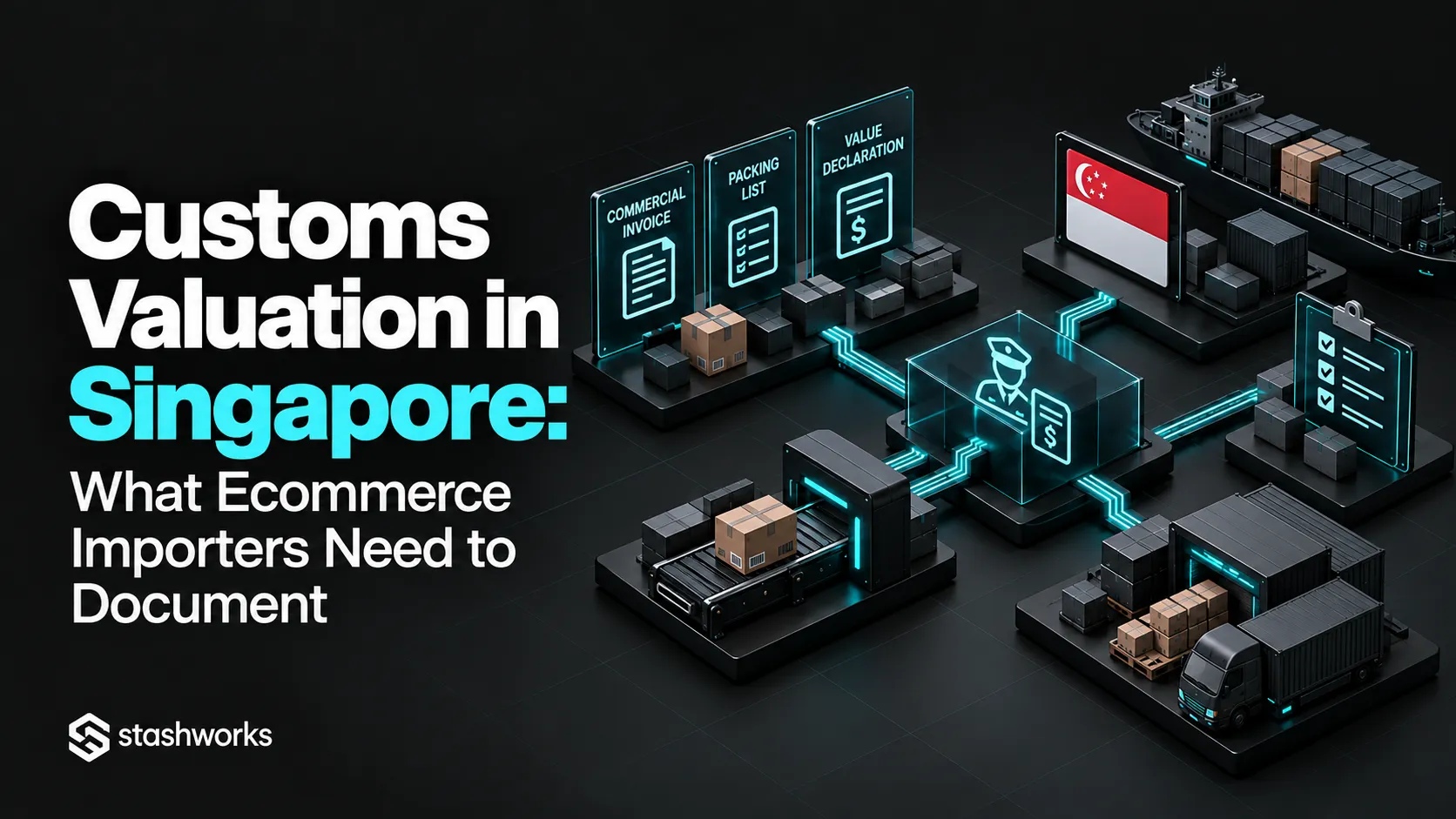
Customs valuation determines the value Singapore Customs uses to calculate import GST and, for dutiable goods, customs or excise duty. It is not always identical to the supplier invoice amount.
For ecommerce importers, the practical task is to keep enough commercial and freight documentation to explain how the declared customs value was built.
Singapore starts with the transaction value method
Singapore Customs states that the primary valuation method is based on the transaction value of the imported goods, subject to specified conditions and adjustments.
The customs value is expressed on a Cost, Insurance and Freight basis for import valuation.
Start with the price actually paid or payable
Use the commercial evidence of the sale: supplier invoice, sales contract, purchase order and payment records where relevant.
The transaction value method requires evidence of a genuine sale and can be affected by restrictions, conditions or related-party relationships that influence the price.
Add freight to Singapore where it is not already included
If the supplier invoice is EXW or FOB, the price may exclude all or part of the international transport. Singapore Customs requires relevant freight charges to be included in the CIF customs value.
If actual freight is unavailable under qualifying FOB transactions, Singapore Customs publishes flat-rate methods for specified circumstances.
Add insurance where applicable
Actual insurance charges form part of the CIF value when incurred. Singapore Customs also publishes flat-rate insurance methods for qualifying transactions where actual insurance cost is not known.
If no insurance cost was incurred, the official guidance allows zero insurance to be used in the relevant circumstances rather than inventing a charge.
Include costs incidental to sale and delivery
Singapore Customs lists adjustments that can include selling commissions, assists, packing costs, royalties or licence fees, proceeds of resale accruing to the seller, freight and insurance.
The exact treatment depends on the transaction, so do not assume every commercial charge is automatically included or excluded.
Incoterms® affect which additions are needed
With EXW, origin transport, export handling, main freight and insurance may need to be added. With FOB, international freight and insurance are typically outside the supplier's FOB price. With CIF, those elements are already included by definition.
The detailed responsibility split is explained in Incoterms for Ecommerce Importers.
Do not use “free shipping” as evidence that freight has zero value automatically
The correct customs treatment depends on how the sale and freight are actually structured. Singapore Customs' courier guidance states that where the seller genuinely provides free shipping, freight is not added separately, but the declared item value must match supporting documents.
Related-party pricing needs extra care
The transaction value method can still apply to related parties if the relationship has not influenced the price. If transfer pricing adjustments later change the import value, additional customs and GST considerations can arise.
Maintain the evidence explaining the pricing arrangement.
Use the correct exchange rate
Singapore Customs requires foreign-currency values to be converted using its prevailing weekly average MAS exchange rates for customs purposes according to the relevant approval or assessment date.
Do not substitute the accounting system's monthly rate without checking the Customs rule.
Keep commercial invoice data consistent
Product description, quantity, unit value, total value, currency, Incoterm, seller and buyer should match the supporting transaction. Avoid vague descriptions such as “samples” or “merchandise” where they do not explain the goods.
Keep transport and insurance evidence
Retain freight invoices, airway bills or bills of lading, forwarding statements and insurance documents used in the valuation. These records support the adjustments from product price to CIF value.
Keep packing and commission evidence where material
If the transaction includes separately invoiced packing, selling commission, tooling or other assists, document the amount and why it is or is not part of customs value.
Alternative methods apply if transaction value cannot be used
Singapore Customs lists sequential alternative approaches based on identical or similar goods, deductive value, computed value and residual valuation.
Do not choose a more convenient method simply because the supplier invoice is incomplete.
Consider an advance valuation ruling for complex arrangements
Singapore Customs currently allows importers to apply for a Customs ruling on valuation where they need clarity on how the rules apply to a specific arrangement.
This can be relevant for unusual related-party, royalty or bundled commercial structures.
Customs value is only one part of landed cost
The customs value helps determine tax and duty, but landed cost also includes destination handling, permit or brokerage fees, local transport, warehouse receiving and other costs.
Use How to Calculate Landed Cost for the broader cost model.
Build a valuation worksheet per shipment
Record invoice value, Incoterm, additions, deductions where permitted, freight, insurance, exchange rate, customs value, permit reference and supporting-document locations.
A standard worksheet makes repeated imports easier to review and reconcile.
Where Stashworks fits
Stashworks' Freight Forwarding service can support international movement and handover into warehousing. Customs valuation remains a declaration responsibility that should be confirmed with the importer and appointed declaring agent for the shipment.
General information only: Customs valuation is a regulatory matter. Confirm the treatment of complex transactions with Singapore Customs or qualified customs advisers.
Sources: Singapore Customs, Establishing Customs Value and Methods; Singapore Customs, Customs Exchange Rates; Singapore Customs, Valuation Rulings.