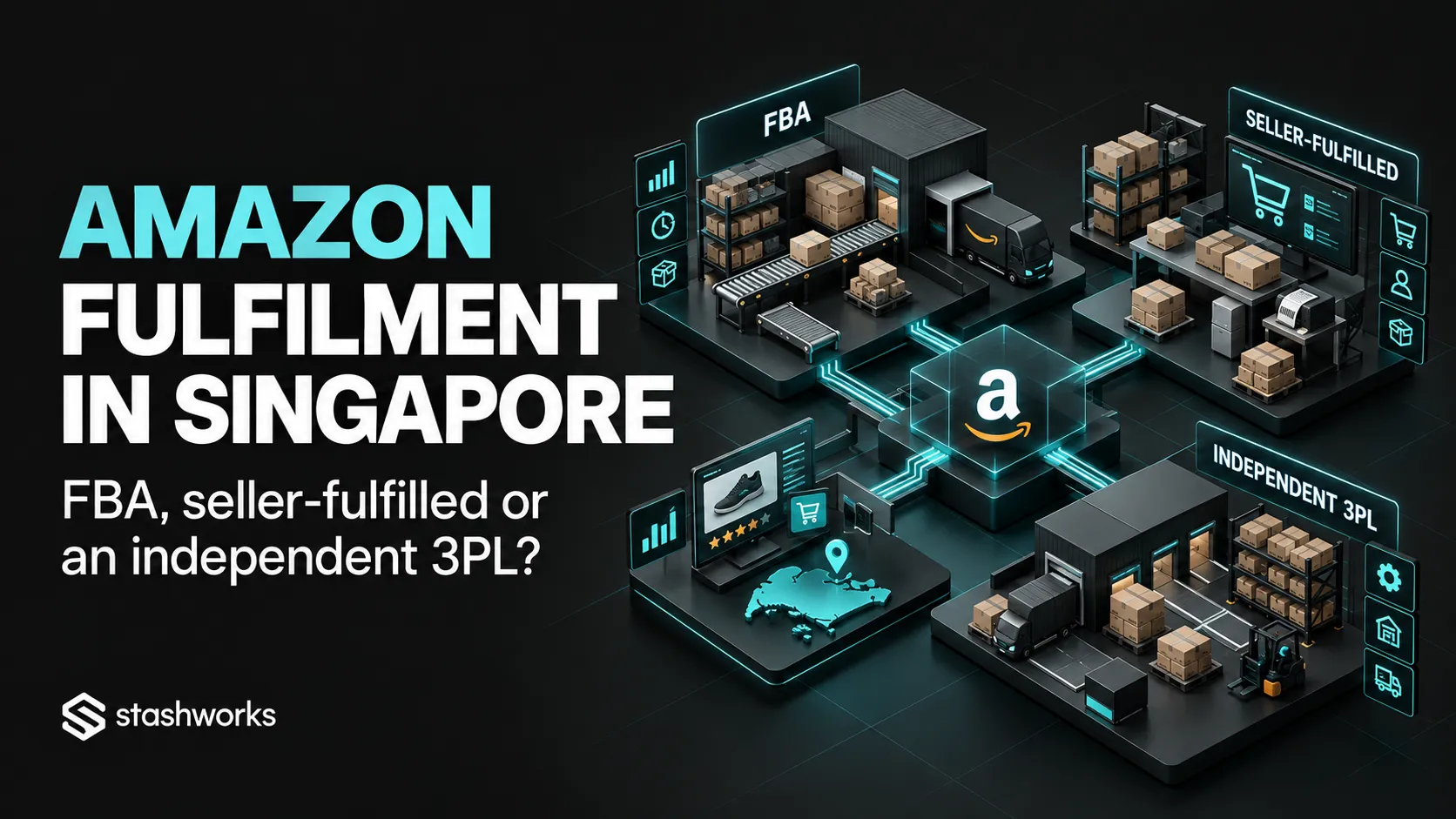
Amazon sellers in Singapore do not have to use one fulfilment model for every product. The practical choice is between sending eligible inventory into Fulfilment by Amazon (FBA), fulfilling orders through a merchant-controlled operation, or using an independent 3PL to perform that merchant-fulfilled work. A hybrid model can also make sense.
The right choice depends on where inventory should sit, how much control the brand wants, whether stock serves other channels, and which Amazon programme is available for the specific seller and product.
What FBA changes
With FBA, eligible inventory is sent into Amazon's fulfilment network. Amazon's current Singapore seller guidance describes FBA as the model where Amazon stores eligible products and handles picking, packing, shipping, customer service and returns for those FBA items.
FBA can simplify the Amazon order workflow because the inventory is already inside Amazon's fulfilment operation. It also changes the seller's inventory-planning responsibility: the brand must decide what stock to send into FBA and when to replenish it.
What merchant-fulfilled means
Amazon's Seller Central guidance describes merchant fulfilment, also referred to as FBM or MFN, as the model where the seller fulfils customer orders itself. The seller controls the inventory location and is responsible for configuring shipping and return settings and managing the fulfilment process.
“Seller fulfilled” does not necessarily mean the brand's own employees must pack every parcel. A merchant can use an independent 3PL as the operating warehouse while the Amazon order remains merchant fulfilled.
An independent 3PL sits behind the merchant-fulfilled model
In this setup, Amazon orders flow to a warehouse outside Amazon's FBA network. The 3PL stores inventory, processes the order and prepares it for delivery according to the agreed workflow.
This can suit brands that want one inventory operation serving Amazon alongside Shopify or other marketplaces. Stashworks' current Technology page lists Amazon among its supported ecommerce integrations, while its Ecommerce Fulfilment service covers multichannel order processing, picking, packing and dispatch.
Amazon Easy Ship is another seller-fulfilled delivery option in Singapore
Amazon Easy Ship is currently available to eligible Singapore sellers for products that are not registered with FBA. Amazon describes the service as pickup from the seller's eligible location and trackable delivery to the buyer, while the seller prepares the parcel for collection.
Easy Ship therefore changes the delivery leg, not the fact that inventory and order preparation remain outside FBA. Eligibility, postcode coverage, fees and operational requirements should be checked in the seller's current Amazon account.
Compare where inventory is held
Inventory location is one of the biggest structural differences. FBA stock is sent to Amazon's fulfilment network. In a merchant-fulfilled model, stock remains in the seller's own operation or an independent 3PL.
For a multichannel brand, this raises an inventory-allocation question: should Amazon have dedicated stock, or should the same physical pool serve Amazon and other channels?
The article Multichannel Order Fulfilment: One Inventory Pool Across Every Sales Channel explains the operational trade-offs of shared inventory.
Compare operational control
FBA transfers more of the physical Amazon order workflow into Amazon's network. Merchant fulfilment gives the seller more control over packaging, warehouse processes and how inventory is coordinated with other sales channels.
More control also means more responsibility. The seller or its 3PL must maintain the operational process needed to meet Amazon's current order, shipping and customer-experience requirements.
Compare multichannel flexibility
A brand selling mostly on Amazon may value the simplicity of keeping eligible Amazon stock inside FBA. A brand selling across its own store and several marketplaces may value an independent 3PL because one warehouse can support multiple channels under one operating model.
Neither model is universally better. The decision depends on how much inventory duplication, channel-specific stock and operational complexity the business is willing to manage.
Compare returns and customer-service ownership
Amazon's current FBA guidance states that Amazon handles customer service and returns for FBA items. With merchant fulfilment, the seller remains responsible for the applicable customer-service and return workflows, even if a 3PL handles the physical warehouse steps.
Define who receives returned stock, who inspects it and how inventory status is updated before choosing the operating model.
Compare cost using the complete workflow
Do not compare one fulfilment fee in isolation. For FBA, consider the applicable programme fees, inbound movement to Amazon, storage and any other relevant charges shown in the current seller account. For merchant fulfilment, include warehouse receiving, storage, pick and pack, packaging, delivery, returns and account-specific minimums or project work where applicable.
Use current Amazon tools and actual 3PL quotations because programme fees and commercial terms can change. Stashworks does not publish a universal public rate card on its current site.
Use different models for different products if the economics support it
Amazon's own seller guidance notes that sellers can choose the fulfilment method that is right for each product. Fast-moving Amazon-focused SKUs may fit one model, while long-tail or multichannel stock fits another.
A hybrid setup still needs careful inventory mapping so the same product is not accidentally promised from two locations without clear availability rules.
A practical decision framework
The table below summarises the operating differences at a high level. Programme eligibility and exact commercial terms should always be checked against current Amazon documentation and the seller's account.
Where Stashworks fits
Stashworks can support merchant-fulfilled Amazon orders through its multichannel ecommerce fulfilment operation, subject to the agreed integration, order workflow, delivery method and account requirements. It should not be described as a substitute for Amazon's own FBA programme; it is an independent 3PL option for brands that want inventory and fulfilment outside the FBA network.
Before choosing, compare the real SKU mix, Amazon share of sales, other sales channels, inventory strategy, return workflow and complete cost of each model.
Sources: Amazon Singapore, Seller Central fulfilment options; Amazon Singapore, Beginner's Guide; Amazon Singapore, FBA Guide; Amazon Singapore, Easy Ship; Stashworks, Ecommerce Fulfilment; Stashworks, Technology.