Inventory management becomes difficult before a business considers itself “large”. The first warning is usually not the number of units in the warehouse. It is that different teams begin working from different versions of the truth: purchasing has a supplier spreadsheet, ecommerce has channel availability, the warehouse has physical stock, and finance has inventory value.
Growth turns that mismatch into an operating problem. A campaign can oversell a product that physically exists but is already reserved. A return can sit in the warehouse while the storefront still shows the unit as unavailable. A supplier delivery can be counted incorrectly and every later replenishment decision inherits the error.
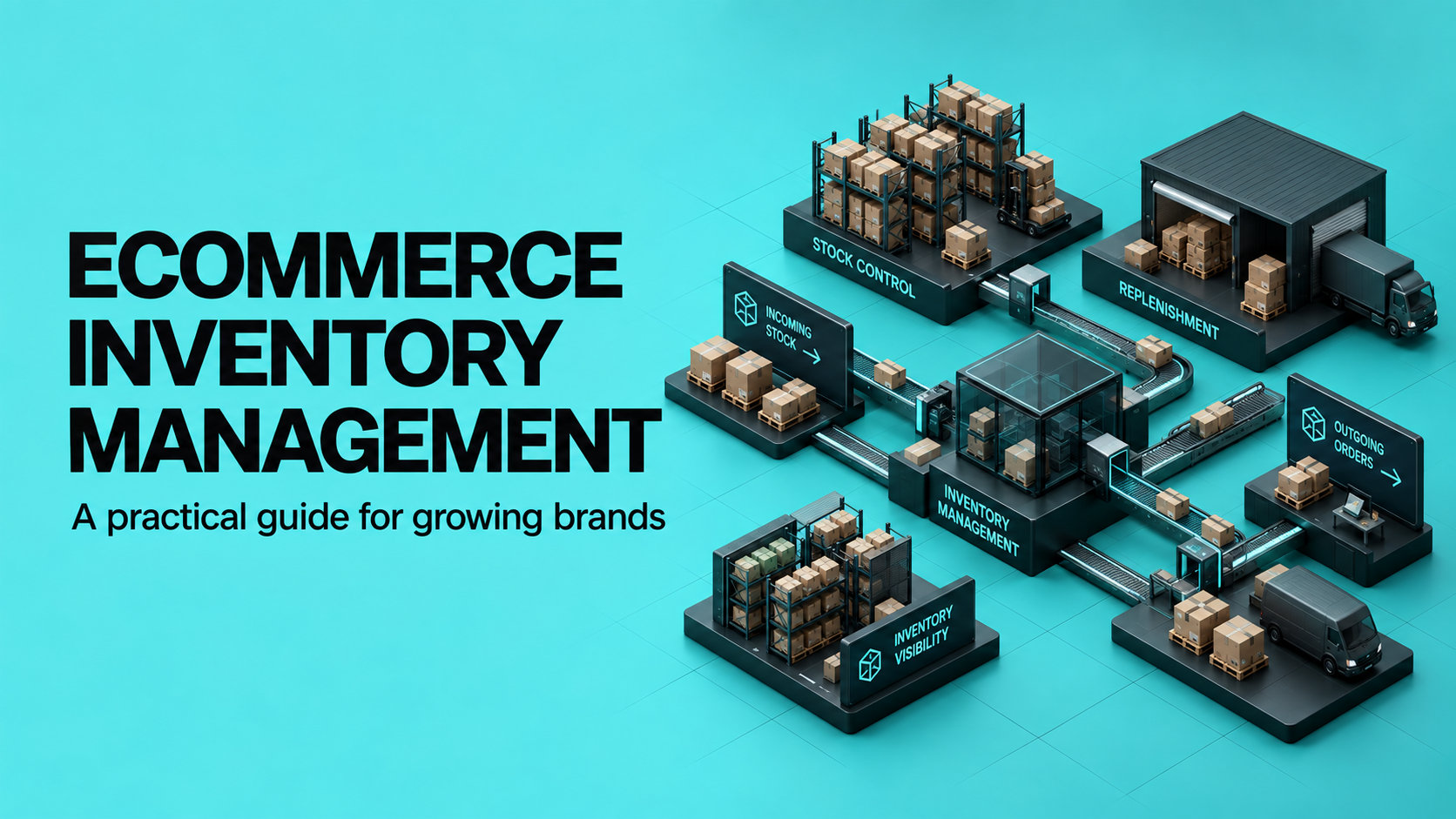
The practical objective of ecommerce inventory management is therefore not to maximise stock. It is to maintain a trustworthy model of what inventory exists, where it is, what state it is in and what can actually be promised to customers.
Start with one product master
Every inventory process depends on product identity. Each sellable variant needs one stable SKU, a clear name and a unique barcode where scanning is used. Dimensions, weight, unit of measure, bundle components, expiry or batch requirements and handling notes should be defined before stock reaches the warehouse.
Duplicate or reused SKUs create problems far beyond reporting. They can cause channel mappings to collide, receiving to post against the wrong product and warehouse staff to scan a valid code that represents the wrong variant.
Shopify’s current SKU guidance recommends unique, consistent identifiers for each product variant and warns that duplicate SKUs can create issues with third-party integrations and inventory tracking.
Inventory needs states, not one “stock on hand” number
Physical ownership and customer availability are different concepts. A business may own 100 units while only 82 are available to sell because some are reserved for open orders, damaged, quarantined or awaiting return inspection.
Define the states the operation actually uses. Typical examples include incoming, received, available, reserved, picked, damaged, quarantined, returned and awaiting disposition. The exact labels can vary; the important point is that the warehouse and commercial systems interpret them consistently.
Locations should describe where stock can actually be found
Inventory records need a physical dimension. At a minimum, the system should distinguish warehouses or fulfilment locations. Inside a warehouse, a WMS can go further into zones, racks, shelves, bins or pallet locations.
That location discipline reduces dependence on memory. It also makes transfers visible. Moving 20 units from a reserve pallet into a picking bin is an inventory event even though the total quantity owned by the business has not changed.
Receiving is where inventory accuracy begins
A purchase order says what should arrive. The warehouse record must show what actually arrived.
At receiving, compare supplier information with the physical delivery, record shortages or overages, separate damaged units and update the correct location and status. Shopify’s 2026 receiving guidance makes the same distinction: receiving verifies quantities and condition before putaway, and inaccurate receiving creates downstream stock errors.
Do not mark inventory available merely because a truck reached the dock. Define when the receiving check is complete and when the stock becomes usable for customer orders.
Sales channels need controlled access to inventory
When a brand sells through its own store, marketplaces and social channels, the physical units may be shared while each channel has its own order and availability logic.
A central inventory model should determine how sales, cancellations, reservations and returns affect available stock. This is the deeper inventory layer behind multichannel order fulfilment: multiple channels can use one operational inventory only when product identity and stock events reconcile reliably.
Replenishment should begin with demand and lead time
Knowing the current quantity is not enough. Inventory management also decides when more stock should enter the system and how much is appropriate.
Use sales velocity, supplier lead time, expected campaigns, minimum order quantities and existing inbound stock to plan replenishment. Safety stock can protect against uncertainty, but it should not be used to hide inaccurate records. If the system cannot explain where existing units are, adding more buffer increases working capital without fixing the underlying control problem.
Returns must re-enter inventory through a decision
A returned parcel is not automatically saleable. It may be unused and ready for stock, damaged, incomplete, expired, opened or in need of repacking.
The returns process should identify the original order, inspect the item and assign a disposition. Only approved saleable units should return to available stock. The detailed physical workflow is covered in Ecommerce Returns: A Practical Reverse-Logistics Workflow.
Count inventory to test the system, not to replace it
A full stocktake or cycle count compares the physical warehouse with the recorded balance. The count is valuable because it reveals where the model has drifted.
Repeatedly correcting the number without investigating the cause is not inventory control. Classify variances by receiving, putaway, picking, returns, damage, transfers, bundle logic or unauthorised adjustment. The objective is to make future counts less surprising.
Inventory age deserves as much attention as inventory quantity
Two warehouses can hold the same number of units and have very different inventory health. One may contain fast-moving replenishment stock; the other may be full of products that have not sold for months.
Review velocity, sell-through, days on hand and inventory age by SKU. Shopify’s 2026 inventory guidance emphasises that slow-moving products tie up cash and warehouse capacity even when the stock record itself is accurate.
When aged stock is growing, the problem may belong to forecasting, purchasing, merchandising or product strategy rather than the warehouse. Inventory management should make that visible early enough to act.
Choose one operational source of truth
Modern ecommerce businesses often use several systems: storefronts, marketplaces, ERP or accounting software, an inventory platform and a WMS. They do not all need to store every field, but ownership needs to be explicit.
Define which system owns product identity, which owns physical warehouse movements, which quantity is exposed to sales channels and how differences are reconciled. Shopify’s current centralized-inventory guidance makes a similar distinction between centralised storage and centralised inventory data: stock can exist in several places while still being managed through one coherent record.
Measure inventory quality before adding more automation
Useful measures include inventory accuracy, stockouts by SKU, inventory adjustments by reason, days on hand, sell-through, return disposition age and receiving discrepancies.
Do not build a large KPI dashboard before the team can act on the measures. Start with the few signals that change purchasing, warehouse work or customer availability.
A practical improvement sequence for a growing brand
Begin by cleaning the product catalogue and removing duplicate identifiers. Map every inventory location and state. Reconcile the physical balance. Standardise receiving and returns. Define the source of truth and channel update rules. Then add reorder logic, alerts and automation.
This order matters. Automation makes a good process faster, but it can also distribute bad inventory data across every channel more efficiently.
Inventory management connects the commercial and physical business
Purchasing decides what should arrive. Warehousing controls what physically exists. Ecommerce decides what can be sold. Customer service deals with the exceptions. Inventory management is the system that keeps those decisions coherent.
Stashworks connects managed warehousing, ecommerce fulfilment and inventory and order technology. When evaluating that operating model, test the difficult inventory events—not just the dashboard view: partial receiving, damaged stock, cancellations, returns, bundles and stock adjustments.
Sources: Shopify, Ecommerce Inventory Management; Shopify, Centralized Inventory Management; Shopify, Inventory Tracking.