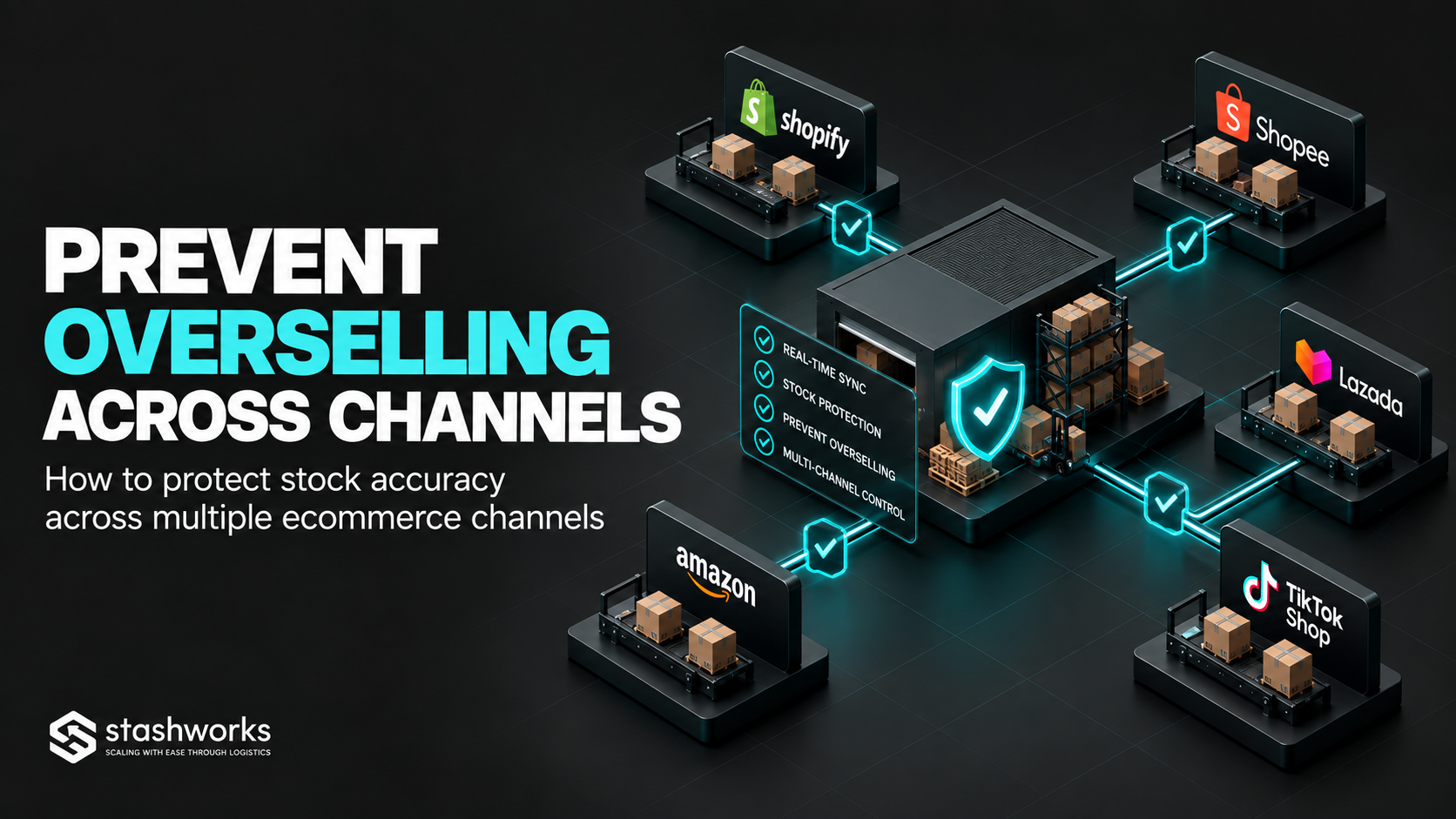
Overselling usually looks like a sales-channel problem because that is where the customer discovers it. The deeper cause often sits between the channels and the warehouse.
Two marketplaces can show the same final unit as available. A cancellation can release stock in one system but not another. A bundle can consume components without reducing their individual listings. A return can be counted before it is actually saleable.
Preventing overselling therefore requires more than faster stock updates. It requires one explainable model of what can be sold and disciplined rules for every event that changes that number.
Start by separating on-hand stock from sellable stock
A warehouse may physically hold 100 units while fewer than 100 should be offered to customers. Some units can already be reserved, picked, damaged, quarantined, returned but not inspected, or committed to another location.
Define which states contribute to available-to-sell inventory. Do not let each channel invent its own interpretation of physical on-hand quantity.
Map every channel listing to one internal SKU
Shopify, Shopee, Lazada and TikTok Shop can describe the same product differently. The warehouse needs one stable identity underneath those channel listings.
Maintain a mapping from each listing or variant identifier to the internal SKU. Check for duplicate and reused SKUs before troubleshooting synchronisation; the fastest inventory integration cannot reconcile two identifiers that the business itself has defined incorrectly.
The catalogue discipline is covered in SKU Management.
Choose one operational source of truth
Decide which system owns the warehouse quantity used to calculate availability. That may be a WMS, OMS or central inventory platform depending on the architecture.
Other channels can display quantities and accept orders, but they should receive availability from the controlled operational record rather than becoming independent sources of inventory truth.
The broader multichannel design is covered in How to Manage Inventory Across Shopify, Shopee, Lazada and TikTok Shop.
Reserve inventory when the business commits to the order
One of the most important protections against overselling is to reduce available inventory before the physical item is picked.
When an eligible order is accepted, reserve or allocate the unit according to the system's logic. That reservation stops other channels from treating the same physical unit as freely available.
If the order is cancelled before fulfilment, release the reservation through a controlled event. If the parcel has already shipped, do not simply add the unit back because the storefront status changed.
Understand how multiple fulfilment locations change availability
Shopify tracks inventory separately by location and can route orders based on available stock and fulfilment rules. Its fulfilable-inventory model also connects customer availability to locations capable of shipping to the customer's zone.
That means “the company owns five units” does not necessarily mean all five should be shown to every customer. Location, market and fulfilment eligibility can all affect what is genuinely promiseable.
Use location-aware availability instead of summing inventory without considering whether the stock can actually support the order.
Use safety buffers for real synchronisation risk
Even a well-connected stack can experience short delays. A channel may receive a stock update seconds or minutes after the warehouse event that caused it.
For very fast-moving products, a controlled safety buffer can reduce exposure near stockout. The buffer should be based on sales velocity and observed synchronisation behaviour, not a permanent percentage copied across the catalogue.
If a large buffer is always necessary, investigate the integration or process. Buffer stock is protection against uncertainty, not a substitute for reliable data.
Bundles need component-level availability
A bundle can oversell its components even when the bundle listing itself looks accurate. If Bundle X requires one Product A and one Product B, the available number of bundles is limited by the scarcer component.
A sale of the bundle should reduce component availability in the central inventory model. If those components are also sold separately on other channels, every listing needs to see the resulting change.
The fulfilment options are covered in Kitting and Product Bundling.
Returns should not increase availability at the first scan
A returned item may be physically present but damaged, incomplete or unsuitable for resale. Put it into a return or quarantine state until inspection is complete.
Only an approved restock event should increase sellable inventory. Otherwise the system can promise a unit that is still on the returns bench.
Manual adjustments need reasons and permissions
Overselling risk increases when several people can edit channel quantities independently. A well-intentioned team member can “correct” one marketplace to match an outdated spreadsheet and undo the protection provided by the central inventory model.
Restrict manual adjustments to defined roles, require reason codes where the system supports them and review repeated changes. Frequent manual correction is evidence that another part of the process is unreliable.
Integration failures must become visible exceptions
Every API or connector can fail. The critical design question is what the operation sees when it happens.
Failed inventory updates should be retried and surfaced. Record the affected SKU, destination channel, last successful quantity and event time. If the connection is down during a fast-moving campaign, the team may need a temporary channel buffer or controlled selling restriction until synchronisation recovers.
Reconcile even when everything appears live
Real-time updates reduce drift but do not prove that historical quantities are correct. Schedule reconciliation between the warehouse source of truth and each channel, with more frequent checks for high-velocity or low-stock SKUs.
Investigate the cause of differences rather than merely overwriting one number. Receiving, cancellations, returns, bundle logic and catalogue mapping are common places to look.
Peak campaigns need tighter stock controls
During 9.9, 11.11, 12.12, livestream events or product launches, the rate at which the final units can be sold may exceed the normal synchronisation and review rhythm.
Confirm physical stock before the event, freeze unnecessary catalogue changes, monitor campaign SKUs more frequently and define who can change channel allocations or buffers. The wider plan is in the peak-season fulfilment checklist.
Create an oversell response playbook
Prevention will reduce risk, but the business should still know what to do if an order arrives without genuinely available inventory.
Identify the order immediately, stop further sales of the affected SKU where necessary, reconcile the physical and system quantity, investigate open reservations and inbound stock, and route the customer decision to the appropriate commercial team. Do not silently create fake inventory simply to keep the order in the queue.
The goal is one promiseable inventory model
A multichannel business does not need every channel to display the same number at every moment. It may deliberately use allocations, buffers or location rules. What it needs is for those differences to be controlled and traceable to one physical inventory model.
Stashworks' technology layer connects inventory and order information with its warehouse operation, and the company currently lists Shopify, Shopee, Lazada and TikTok among supported integrations. When scoping a multichannel setup, test the difficult events: simultaneous orders, cancellations, bundles, returns, stock adjustments and temporary integration failure.
Sources: Shopify Help Center, Multiple Locations and Apps; Shopify Help Center, Order Routing; Shopify Help Center, Location Fulfilment; Stashworks, Technology.