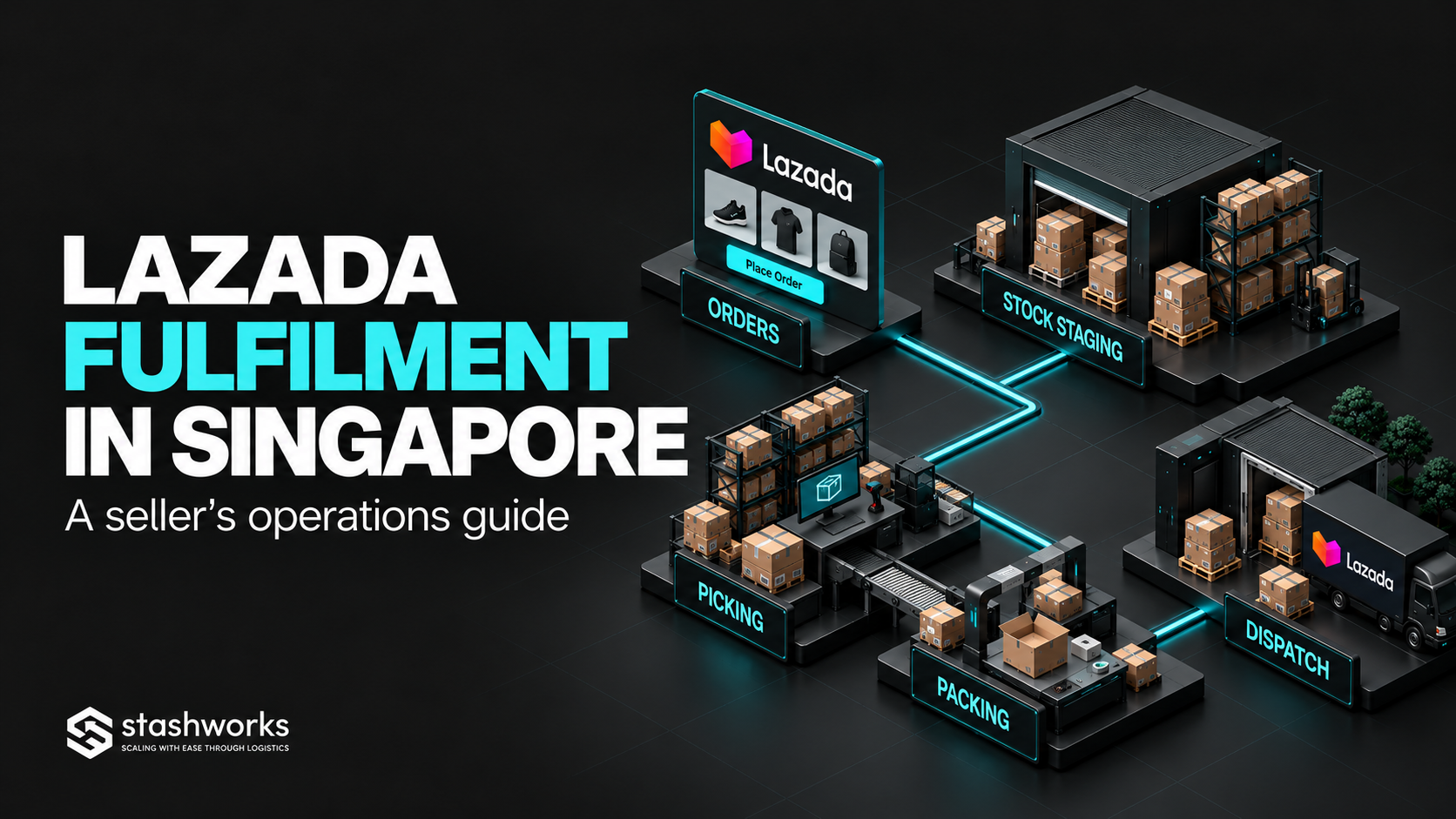
Selling on Lazada creates a digital storefront, but fulfilment still depends on a physical operating system behind it. Product data has to match warehouse stock. Orders have to reach the right team. Parcels need to be packed, labelled and handed over correctly. Returns need to find their way back into the inventory record.
The best time to define those rules is before campaign volume makes every exception urgent. This guide focuses on the operational layer a Singapore seller should have in place around Lazada.
Build the product master before the first live order
Every sellable variant should map to one stable internal SKU. Store the product name, barcode or other scan identifier, dimensions, weight, unit of measure and any handling requirements the warehouse needs.
Lazada listing IDs and variant names are channel-facing identifiers. The warehouse should map them to a consistent internal product identity so the same physical SKU is not accidentally created twice.
Keep pickup and return warehouse information accurate
Lazada's current Singapore seller onboarding guidance asks sellers to provide accurate pickup and return warehouse addresses in Seller Center. Those addresses are not administrative decoration; they determine where operational handoffs and reverse-logistics movements are expected to occur.
If the business changes warehouse or moves fulfilment to a 3PL, update the relevant Seller Center configuration as part of the cutover plan rather than after parcels have already been routed incorrectly.
Choose one source of truth for inventory
If the same stock is also sold through Shopify, Shopee or TikTok Shop, Lazada should not become a separate manually maintained inventory universe. Define which operational system owns available stock and how Lazada receives updates from it.
That source should reflect receiving, reservations, picks, damage, returns and adjustments. The broader architecture is covered in How to Manage Inventory Across Shopify, Shopee, Lazada and TikTok Shop.
Map the order states that create warehouse work
Not every order state should trigger the same action. Define which Lazada order statuses are eligible for fulfilment, when stock becomes reserved, when the warehouse is allowed to pick, and what happens if an order changes or is cancelled.
The warehouse should process an explicit queue rather than relying on someone to notice new orders in a dashboard.
Treat current ship-by requirements as live operating data
Marketplace shipping rules can change by programme, order type or policy update. Instead of embedding one permanent number of hours or days into the SOP, use the current order deadline shown in the seller workflow and keep the team responsible for fulfilment aware of policy changes.
The internal warehouse cut-off should be earlier than the marketplace deadline, leaving enough margin for packing, label creation, staging and the actual logistics handover.
Packaging needs to satisfy both the product and the channel workflow
Choose packaging based on product protection, parcel size and the shipping process rather than branding alone. The warehouse should know which materials, inserts and sealing rules apply to each order type.
Before scale, test whether labels remain readable, whether similar variants are easy to verify at packing, and whether the parcel can move through the assigned logistics process without manual relabelling.
Carrier handover needs evidence
A parcel can be packed on time and still become a late operational event if the handover is not completed or recorded correctly. Define the moment at which an order moves from warehouse responsibility into the delivery network.
Keep the relevant scan, manifest or tracking evidence so the team can investigate an order that appears stuck between “packed” and “shipped”.
Returns should preserve the original order context
When a returned Lazada parcel reaches the warehouse, identify the original order and SKU before deciding whether the product can re-enter saleable inventory.
A return can be unopened and saleable, damaged, incomplete, used, or in need of repacking. Only the correct disposition should update available stock. This protects every other sales channel using the same inventory pool.
Campaigns should change the preparation schedule before they change the order queue
Lazada is known for large marketplace campaigns and also provides tools such as LazLive for sellers. Regardless of the specific promotional format, the warehouse problem is similar: a short demand window can create a concentrated wave of orders.
Prepare inventory, bundle configuration, packaging, labour and carrier capacity before the campaign starts. Avoid unnecessary SKU changes during the event and monitor the fast-moving products more frequently than in an ordinary week.
The full preparation framework is in the peak-season fulfilment checklist.
Reconcile marketplace and warehouse data after high-volume periods
After a campaign, compare the warehouse record with Lazada orders and inventory updates. Investigate unmatched orders, failed stock updates, cancellations after release, returns and manual adjustments.
A clean reconciliation prevents a temporary campaign exception from becoming the starting inventory error for the next month.
Outsourcing does not remove the need to define the workflow
A 3PL can perform the physical work, but the seller still needs to define commercial rules: which products are active, what counts as saleable, which packaging applies, which orders can be released and how exceptions should be escalated.
Stashworks currently lists Lazada among its supported integrations. Its ecommerce fulfilment operation connects inventory, order processing, pick and pack, dispatch and returns, while the technology layer is designed to connect channel orders with warehouse activity.
Before onboarding, confirm the exact Lazada integration method for the account and test the complete event flow, including a normal order, cancellation, inventory update, shipment confirmation and return.
A reliable Lazada operation is an end-to-end process
The seller experience may begin with product uploads and Seller Center, but fulfilment quality is determined by the chain behind it: correct product identity, trustworthy inventory, clear order release, accurate picking, controlled packing, documented handover and disciplined returns.
Build those controls before order volume makes them difficult to change.
Sources: Lazada Singapore, Seller FAQ; Lazada Singapore, Seller Sign-Up; Lazada Singapore, Be a Seller; Stashworks, Ecommerce Fulfilment.