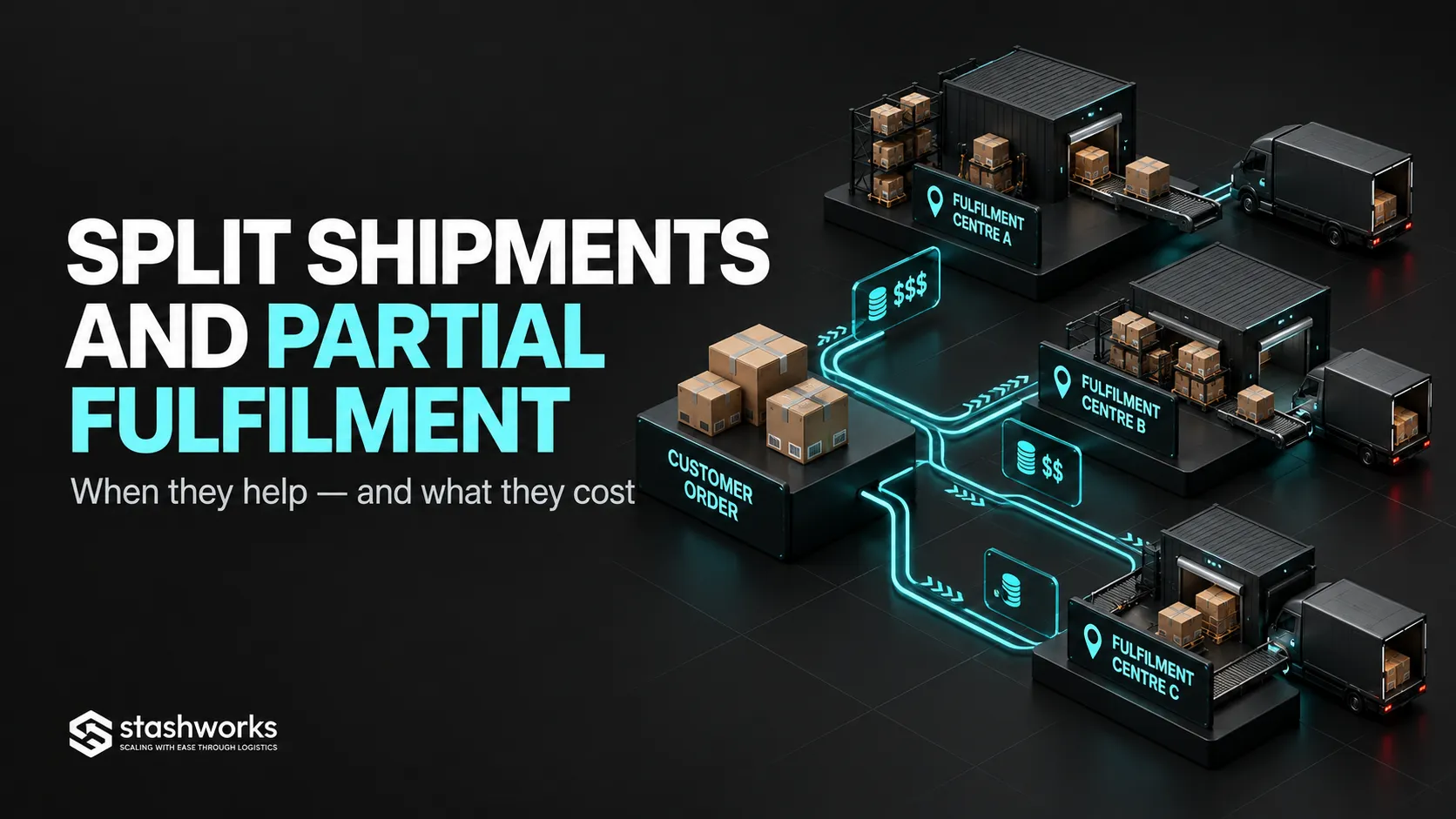
Split shipments can improve customer speed when one order cannot be fulfilled as a single parcel. They can also increase packaging, carrier, tracking and customer-service complexity.
The right policy is not “always split” or “never split”. It is to decide when the customer benefit justifies the extra operational cost.
Understand why orders split
An order can split because inventory sits in different locations, one item is out of stock, a pre-order is mixed with available stock, products require different shipping profiles, or part of the order uses pickup while another part ships.
Shopify's current fulfilment model explicitly supports separate fulfilments in several of these cases.
Separate system split from deliberate partial fulfilment
Sometimes the platform creates multiple fulfilments automatically because items cannot ship together. In other cases, the operations team chooses to fulfil available lines and leave the rest unfulfilled.
These are operationally different even if the customer ultimately receives more than one parcel.
Customer speed is the main benefit
If four items are available and one is delayed, shipping the four can reduce waiting time and prevent one shortage from holding the entire order.
This is especially valuable when the delayed line has an uncertain replenishment date.
Each additional parcel adds cost
A second shipment can mean another pick, pack, label, carton or mailer, carrier charge, tracking event and delivery attempt.
Calculate the marginal cost rather than comparing only the headline courier rate.
Packaging use can increase disproportionately
Two small parcels can consume more packaging material than one combined order. Custom inserts or branded presentation may also need to be duplicated.
Tracking becomes a communication problem
Customers need to understand that the order is arriving in parts and which products belong to each tracking number.
The ecommerce platform, warehouse and customer-service system should all preserve that relationship.
Returns can become more complicated
One order may generate several delivery dates and several potential return parcels. Support teams should be able to see which fulfilment contained the returned item.
Use routing rules to reduce unnecessary splits
For multi-location operations, order routing can prioritise a location that holds the complete order rather than choosing the closest location for each item.
Shopify's current default routing strategy includes “Minimize split fulfillments” before geographic rules, demonstrating the cost-service trade-off directly.
Do not avoid splits if it creates a worse delay
Holding an entire order for one uncertain line can create customer dissatisfaction and increase cancellation risk. The business should define how long it is willing to hold complete orders.
Use value thresholds
A low-value delayed item may not justify a second shipment, while a high-value order or premium customer promise might.
Define thresholds by order economics and customer experience rather than leaving the decision to individual warehouse staff.
Use product compatibility rules
Some items should not ship together because of size, fragility, temperature, dangerous-goods restrictions or packaging risk. Those splits are operational requirements rather than inventory failures.
Pre-orders need an explicit policy
When an order mixes ordinary stock and a future-release product, state at checkout whether items may ship separately.
The workflow in Pre-Orders and Backorders explains how to protect the promise before warehouse release.
Test the integration before enabling partial fulfilment
Verify that each shipment sends the correct line items, quantity, carrier and tracking information back to the sales channel. The remaining unfulfilled items should stay visible.
Use the Platform-to-Warehouse Integration Checklist for acceptance testing.
Measure split rate and reason
Track the percentage of orders split and classify the cause: multi-location stock, out-of-stock item, preorder, product compatibility or manual choice.
A rising split rate can reveal poor inventory placement or replenishment decisions.
Measure cost per complete customer order
Instead of evaluating each parcel independently, calculate total fulfilment and delivery cost required to complete the customer's original order.
This makes the economic impact visible.
Use slotting and allocation to reduce preventable splits
For multi-location networks, inventory allocation determines whether commonly co-purchased items are available together. Split rate can therefore be an inventory-planning issue rather than a fulfilment issue.
Where Stashworks fits
Stashworks' Ecommerce Fulfilment service supports connected order processing, pick and pack, dispatch and tracking. Whether split or partial fulfilment is supported for a specific channel and account should be confirmed during integration and workflow design.
Sources: Shopify Help Center, Partial and Split Fulfilment; Shopify Help Center, Order Routing; Stashworks, Ecommerce Fulfilment.