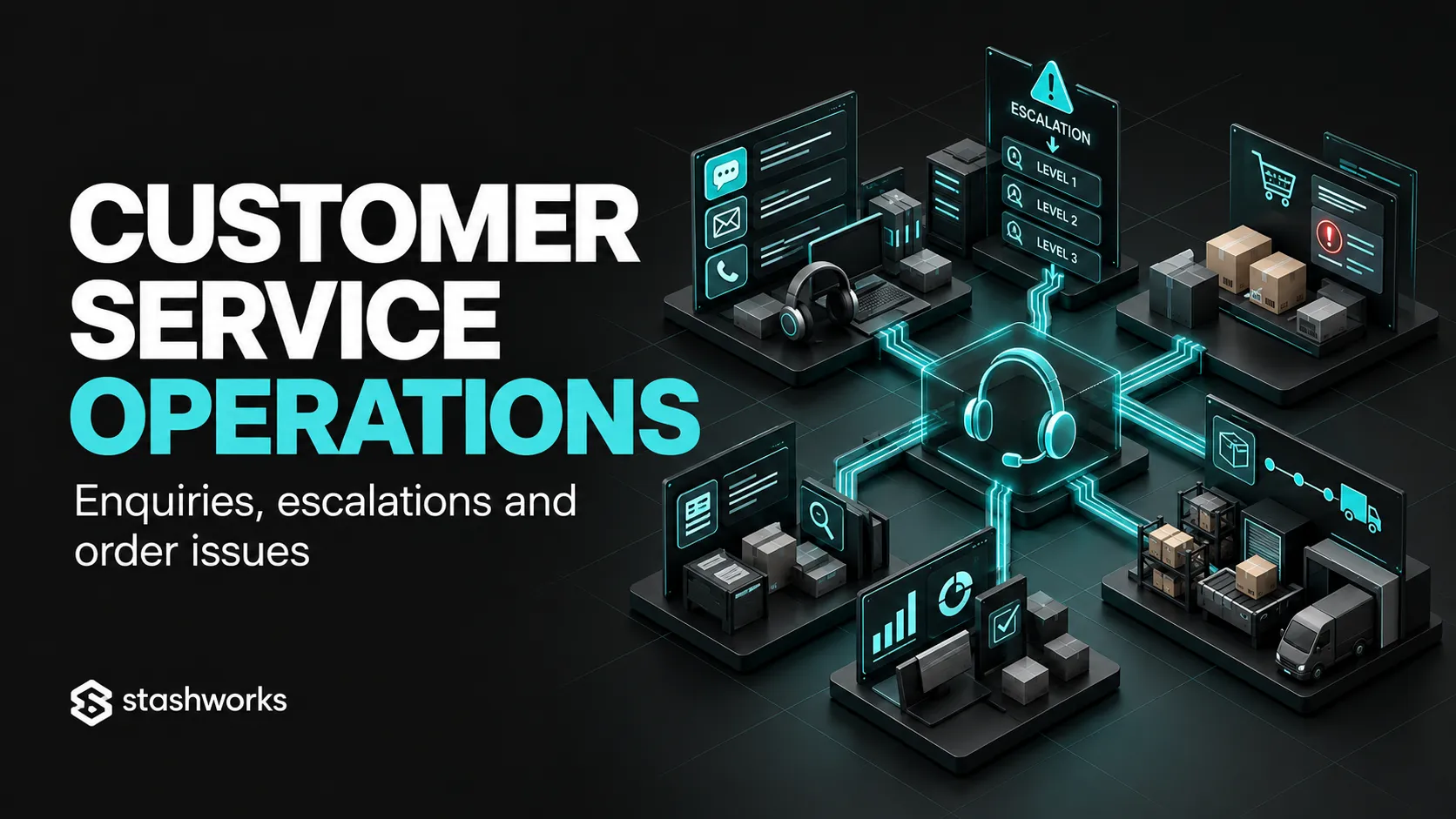
Marketplace customer service is an operations function as much as a communications function. A customer may ask a simple product question, but many enquiries are symptoms of something happening elsewhere: an order has not entered fulfilment, a carrier event is delayed, a return needs approval or a listing contains the wrong information.
The most reliable support model therefore connects marketplace messages to the teams and systems that can resolve the underlying issue.
Separate enquiries by the action they require
One inbox can contain very different work. Classifying messages makes ownership clearer and helps the team avoid treating every case as a generic support ticket.
Useful operational categories include product information, listing issue, order change, fulfilment status, delivery exception, cancellation, return, refund, damaged item and marketplace-policy issue.
Answer product questions from an approved source
Customer-service staff should not invent product facts from memory. Use the governed product record or approved marketplace content for dimensions, pack quantity, compatibility, ingredients, warranty wording or other product information.
If the answer has regulatory or safety implications, route it to the brand owner or qualified team rather than allowing an external operator to improvise.
Order-status enquiries need fulfilment visibility
A seller-centre order status may not explain every warehouse event. Support staff should know whether the order has been released, picked, packed, handed to a carrier or placed in an exception queue where that information is available.
Stashworks' Ecommerce Enablement service describes customer support around agreed enquiries, order-status support, inbox management and escalation. Its technology and fulfilment services provide the operational context behind those enquiries.
Create escalation routes by issue type
A useful escalation matrix identifies the team that can actually fix the problem. Listing errors go to catalogue operations; missing stock goes to inventory or fulfilment; missed handover goes to warehouse operations; delivery exceptions go to the carrier-management process; product claims go back to the brand.
The support team should not be responsible for solving issues it cannot control, but it should own the handoff and keep the customer-facing case moving.
Define what the external operator can decide
Outsourced support becomes risky when decision rights are unclear. Specify which replies can be sent without approval, which cases need brand approval and which financial or policy decisions remain entirely in-house.
For example, an operator might be authorised to provide a verified order update but not to create an unapproved refund policy or make a product claim that has not been signed off by the brand.
Use templates as guardrails, not scripts for every case
Templates help maintain tone and reduce repeated typing, but they should include variables and clear escalation triggers. A customer whose parcel is genuinely lost should not receive the same generic wording as a customer whose order is still within the normal process.
Review high-volume templates regularly because marketplace policies and operational processes change.
Respect platform communication rules
Marketplace messaging is governed by platform-specific policies. TikTok Shop's Singapore Customer Communication Policy, updated in July 2026, applies to seller communication across in-app messaging and other TikTok Shop communication channels and prohibits deceptive, manipulative or off-platform steering behaviour.
The operational lesson is broader than one platform: customer-service teams need current marketplace policy guidance, and outsourced staff should not be allowed to create their own communication practices without oversight.
Control access to customer information
Customer-service work can expose names, addresses, order details and communication history. Staff and partners should receive only the access needed for their responsibilities, using platform-supported user or partner permissions wherever available.
Do not move customer data into personal messaging apps or uncontrolled spreadsheets simply because it is convenient. The brand should define where case information may be stored and who may access it.
Connect delivery exceptions to the support queue
Many customer contacts can be prevented or resolved faster when delivery exceptions are visible early. Address problems, failed attempts, return-to-sender events and stalled tracking should enter a workflow before the customer has to explain the problem from scratch.
The article Failed Deliveries and Address Errors explains how better last-mile exception handling reduces avoidable support work.
Measure backlog and resolution quality together
Response speed matters, but closing tickets quickly is not useful if cases reopen or customers receive incorrect answers. Track backlog, ageing, first-response time where the platform exposes it, escalation rate, repeat contact and the root causes generating the enquiries.
Segmenting by issue type helps reveal whether the real problem is catalogue quality, fulfilment accuracy, delivery performance or support execution.
Run a weekly root-cause review
Customer service is one of the best sources of operational feedback. Repeated questions about the same product can indicate weak listing content; repeated order-status enquiries can expose poor tracking communication; repeated delivery complaints can identify carrier or address problems.
Feed those patterns back to the team that owns the process instead of treating support as a closed loop.
Where Stashworks fits
Stashworks includes Customer Support within its Ecommerce Enablement service, with exact channels, hours and scope defined during setup rather than assumed. Brands considering outsourced marketplace support should document enquiry types, decision rights, escalation owners and the operational information the support team will need.
That creates a service model that can resolve issues rather than merely answer messages.
Sources: Stashworks, Ecommerce Enablement; TikTok Shop Singapore, Customer Communication Policy, 1 July 2026; TikTok Shop Singapore, Customer Service Guidelines.