Inventory strategy is one of the biggest market-entry commitments because it determines where cash is tied up, how quickly orders can reach customers and how much customs, warehouse and return complexity the business must manage.
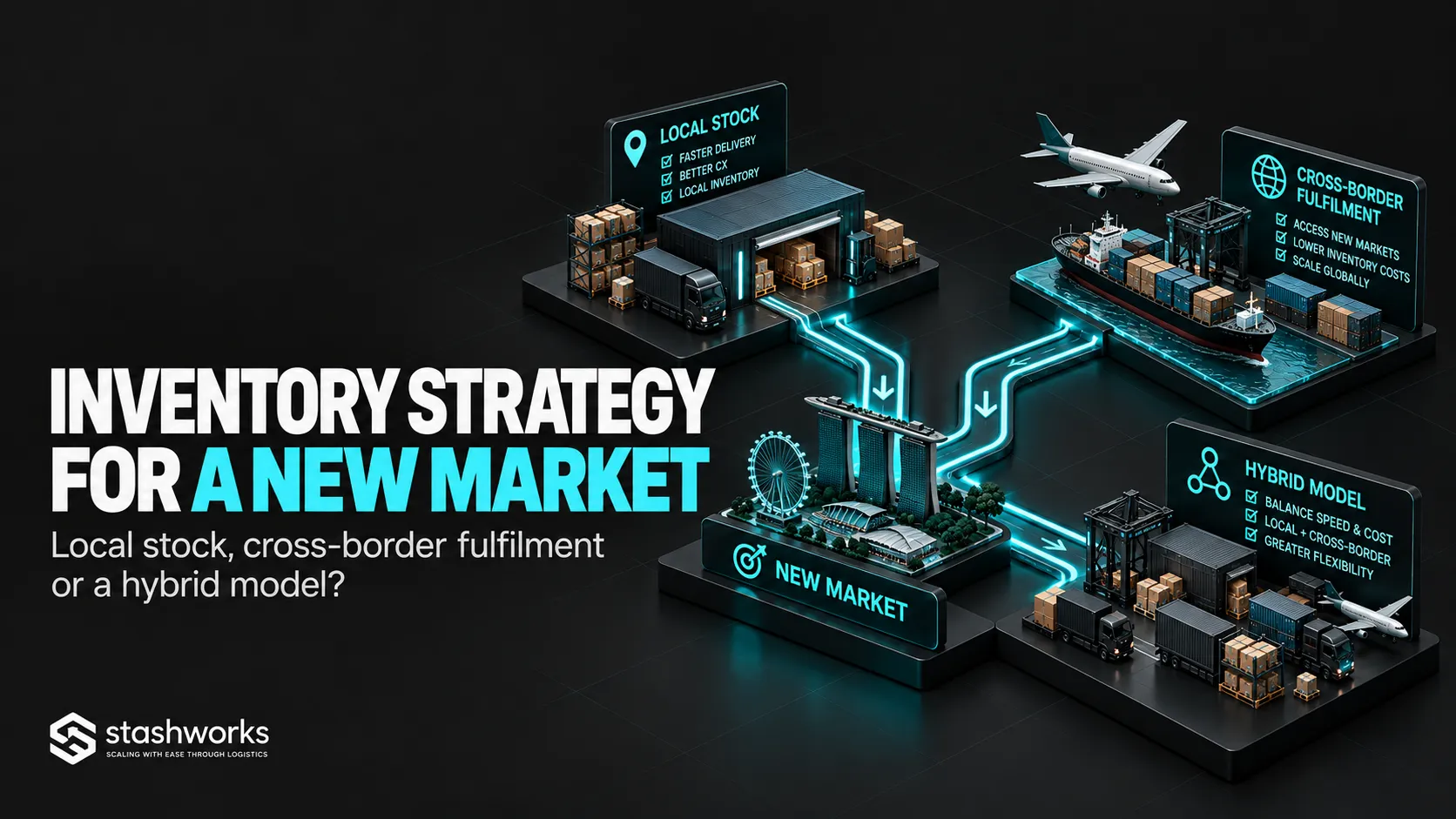
The three common models are local stock, cross-border fulfilment and a hybrid approach. None is universally best.
Local stock puts inventory close to demand
In a local-stock model, commercial inventory is imported into the target country before customer orders arrive. Orders are then fulfilled from a local warehouse or 3PL.
This can shorten the physical delivery route and simplify local returns, but the brand commits inventory before demand is fully known.
Cross-border fulfilment delays the inventory commitment
With cross-border fulfilment, stock remains in the origin or regional hub and moves to the target country after the customer orders, subject to platform, product and customs feasibility.
This reduces the amount of inventory stranded in a new market but can create longer delivery times, per-parcel customs complexity, higher transport cost and a more difficult returns flow.
A hybrid model splits the catalogue by confidence
Hybrid inventory places proven or high-velocity products locally while fulfilling long-tail or uncertain demand cross-border where feasible. This can protect service levels for key SKUs without committing the entire catalogue.
The model is useful only when inventory and channel systems clearly know which location should fulfil each order.
Start with customer promise
If the channel or customer expects a short delivery window, local stock may be necessary to compete. If customers will accept a longer lead time for a specialised product, cross-border fulfilment can remain viable longer.
Measure competitor delivery promises and actual carrier options rather than assuming every category competes on maximum speed.
Compare landed economics, not freight alone
Local stock concentrates freight into inbound shipments but adds receiving, storage and inventory carrying cost. Cross-border fulfilment can reduce storage in the target market while increasing per-order transport and customs handling.
Build both models to the delivered-order level, including failed deliveries and returns.
Import requirements can decide the model
Some products are more practical to import in commercial bulk through a licensed or registered importer than to move individually cross-border. Others may be suitable for direct cross-border programmes subject to shipment value and category rules.
In Singapore, commercial imports require the applicable Customs permit process, and regulated categories can add product- or importer-specific requirements.
Local stock improves control over delivery exceptions
A local warehouse can often react faster to address corrections, replacement orders and return inspection because inventory and support teams operate in the same market.
Cross-border exceptions can take longer and may make low-value returns uneconomic.
Cross-border inventory can protect against demand uncertainty
At market-entry stage, demand forecasts are weak. Keeping stock in an existing hub allows the same inventory to support other markets rather than being committed entirely to a new country.
This flexibility is valuable for long-tail SKUs and products with uncertain launch demand.
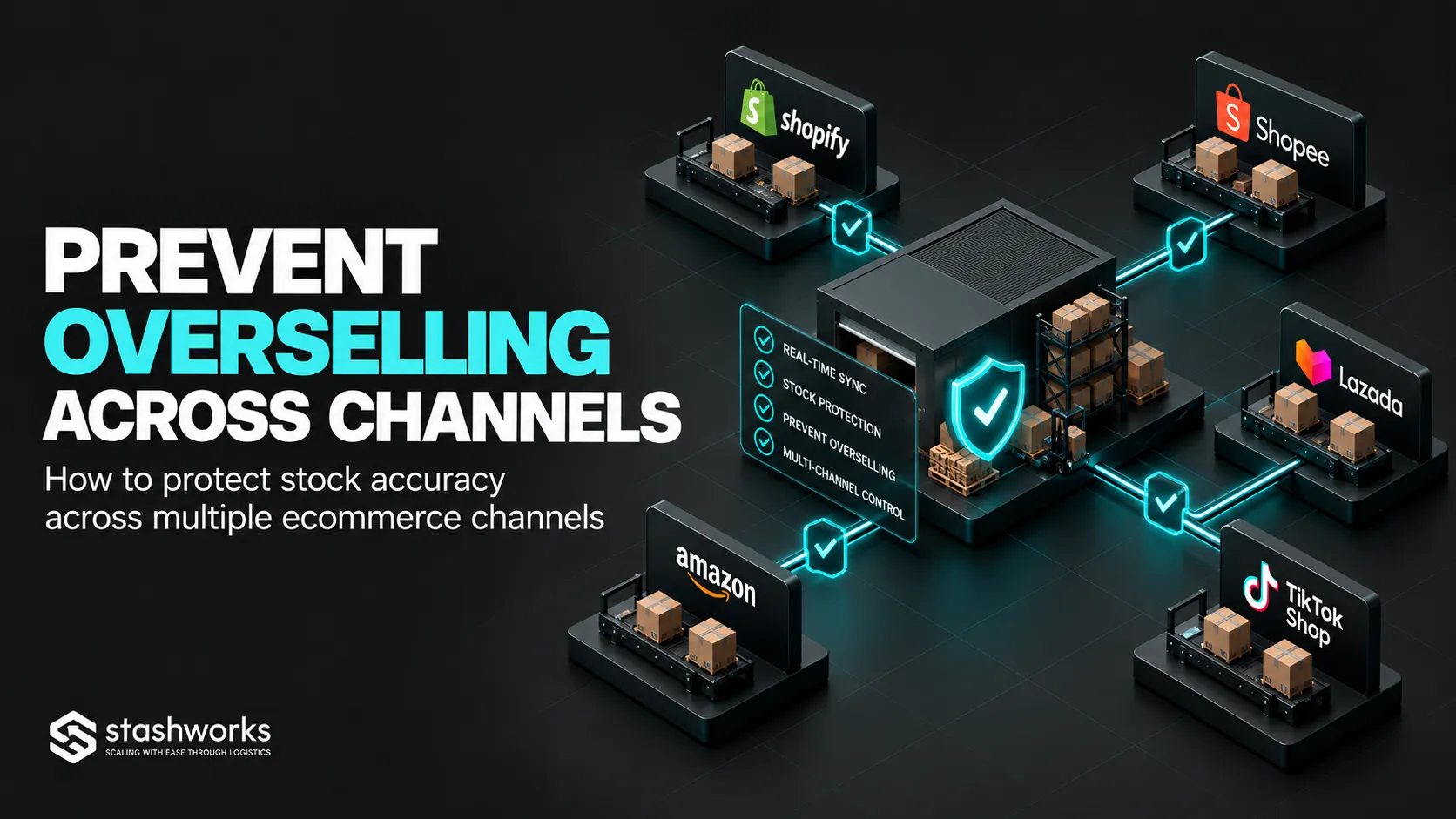
Local stock can reduce overselling risk only if systems are accurate
Putting inventory in-country does not automatically improve inventory control. The brand still needs one source of truth, clear reservations and reconciliation between marketplaces and the warehouse.
Use the framework in How to Manage Inventory Across Shopify, Shopee, Lazada and TikTok Shop.
Safety stock should reflect replenishment lead time
A local operation replenished by sea freight may need a different buffer from one replenished frequently by air. Use demand variability and actual replenishment lead time rather than a fixed percentage.
See Safety Stock and Reorder Points for the calculation logic.
Returns can reverse the apparent cost advantage
Cross-border shipping may look economical until returns are included. Decide whether returned units come back to the origin, stay with a local partner, are disposed of, or enter another recovery process.
Local stock usually creates a clearer path for inspection and restocking, although that still has handling cost.
Inventory ownership must be explicit
When using a distributor, sell-on-behalf provider or other local partner, document who owns stock before import, after customs clearance, while stored and after a customer return.
This matters for insurance, damage, write-offs, tax and exit planning.
Use SKU segmentation instead of one policy for everything
Classify products by sales velocity, margin, size, regulatory complexity, replenishment lead time and demand confidence. A-market or hero SKUs may justify local stock while C-class long-tail products remain regional or cross-border.
Use Singapore as a regional hub only where the network supports it
Singapore can function as a regional inventory and logistics base for some businesses, but the economics depend on destination-country customs, delivery cost and product rules. The existing guide Using Singapore as an Ecommerce Fulfilment Hub for Southeast Asia covers that model in more detail.
How SOBAAS fits
Stashworks' SOBAAS model can include local inventory and fulfilment in supported markets as part of the agreed setup. Stashworks currently lists Singapore, Malaysia and Thailand as available SOBAAS markets.
The exact inventory position, import arrangement and fulfilment route should be confirmed for the target country and product before stock moves.
Use a staged inventory decision
Start with the minimum inventory model that can test the customer proposition fairly. Increase local stock only as demand, replenishment and unit economics become more predictable.
A successful market does not require every SKU to use the same fulfilment route.
General information only: Customs, tax and product rules affect whether local, cross-border or hybrid fulfilment is feasible. Verify the proposed model for the specific country and product.
Sources: Singapore Customs, Import Procedures Overview; ASEAN Trade Repository, Procedures and Documentary Requirements; Stashworks, SOBAAS.