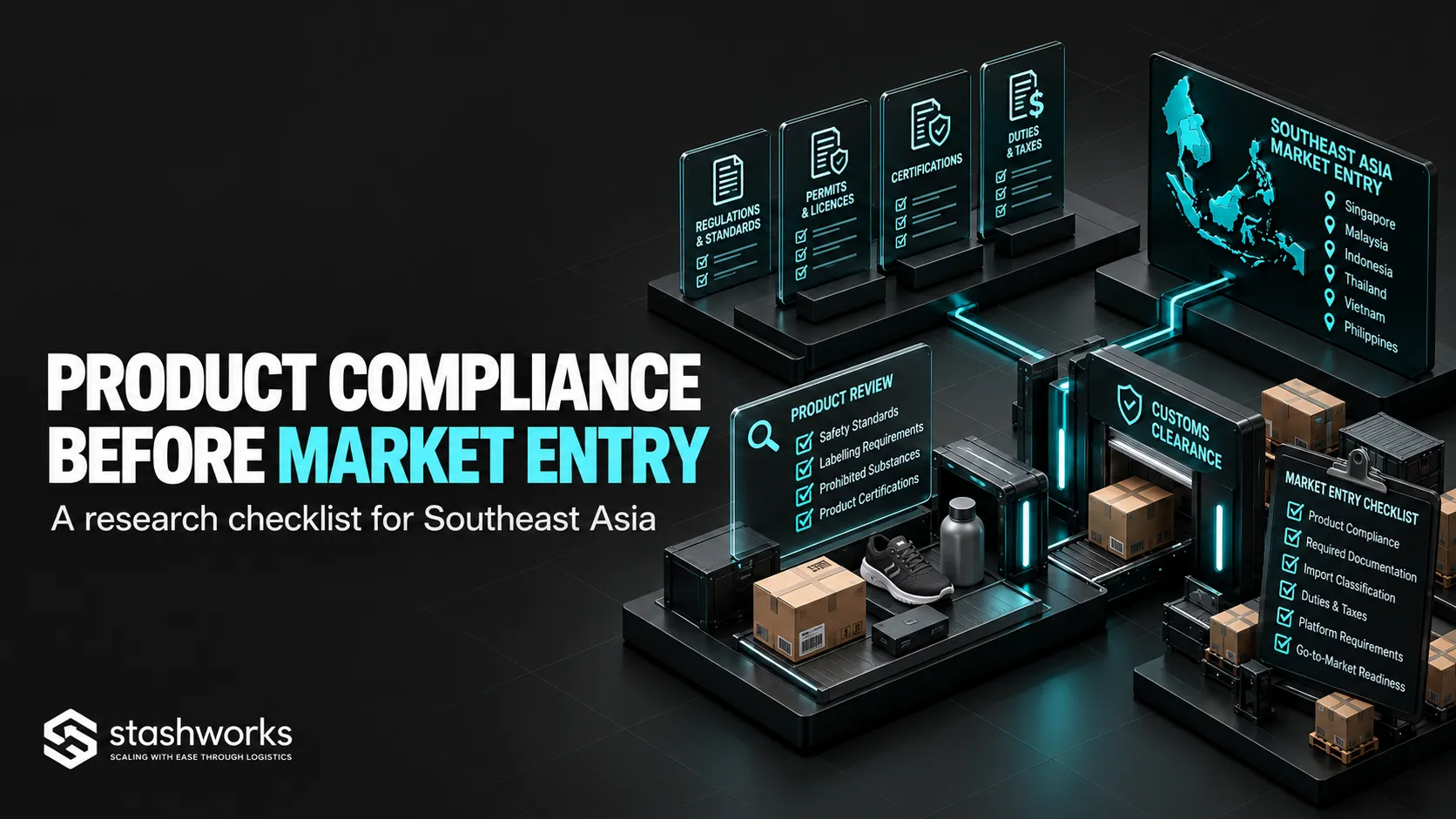
Product compliance should be investigated before marketplace setup, inventory purchasing and campaign production. The question is not simply “Can this product be shipped into the country?” It is whether the product can be imported, supplied, advertised and supported under the rules that apply to its exact category and claims.
This checklist provides a research process for Southeast Asian ecommerce expansion. It is not legal or regulatory advice.
1. Define the exact product, not only the retail category
Capture the product name, intended use, ingredients or materials, technical characteristics, power specifications where relevant, age group, claims, packaging format, country of manufacture and every sellable variant.
Small differences can change classification. A cosmetic and a therapeutic product may appear similar commercially but fall under different regulatory regimes.
2. Identify the national regulator
Each country has its own authorities and legislation. Use the national regulator's current website as the primary source for product-specific obligations.
The ASEAN Trade Repository can help identify non-tariff measures and documentary requirements across ASEAN member states, but the underlying national rule should still be checked directly before launch.
3. Check import restrictions and licensing
Determine whether the product is prohibited, controlled, subject to an import licence, restricted to approved sources or requires specific permits for each shipment.
Keep import eligibility separate from product-sale approval. Both may apply.
4. Confirm who is allowed to act as importer
Some categories require a locally registered or licensed importer. Determine whether the brand, distributor, sell-on-behalf partner or another appointed party can legally perform that role.
In Singapore, for example, commercial food importers generally need the appropriate SFA licence or registration, a valid UEN and an activated Customs account.
5. Check whether product registration or notification is required
Some categories require a product-level submission before sale. Singapore's HSA states that manufacturers and importers generally need to notify cosmetic products before supplying them, subject to specific exceptions and continuing obligations.
Do not assume an approval or notification in one ASEAN country transfers automatically to another.
6. Identify applicable technical standards
Electrical, electronic, mechanical, children's or other safety-sensitive products may be subject to technical standards, conformity assessment or testing.
Singapore's Consumer Product Safety Office currently lists 33 categories of Controlled Goods under the Consumer Protection (Safety Requirements) Regulations, with different conformity-assessment approaches according to risk tier.
7. Verify laboratory and certification requirements
Determine whether testing must be completed by a recognised laboratory, whether an existing overseas report is accepted, and whether certification expires or needs local registration.
Ask the regulator or designated conformity body rather than assuming a supplier certificate is sufficient.
8. Review ingredients and restricted substances
Food, cosmetics, supplements, chemicals and other regulated categories can have ingredient limits, prohibited substances or permitted-use conditions.
Compare the formula or bill of materials against the target country's current rules before creating local packaging or shipping commercial stock.
9. Review labels line by line
Check mandatory product name, quantity, ingredients, warnings, manufacturer, importer or responsible-party information, country of origin, batch or date information and language requirements where applicable.
Do not rely on a packaging design approved for another market without comparison against the local rule.
10. Audit every marketing claim
Claims can affect classification and enforcement risk. Words such as “treats”, “prevents”, “medical”, “clinically proven”, “safe for children” or performance claims can trigger specific substantiation or category rules.
Keep an approved-claims library and prevent marketplace operators from inventing claims to improve conversion.
11. Check marketplace category requirements
Marketplaces can impose their own seller documentation and restricted-product rules in addition to national law. A product that is lawful to sell may still require extra marketplace approval or may be prohibited by a particular platform.
Use current Seller Center guidance for the exact country and category.
12. Confirm barcode and product-identifier requirements
Determine whether GTIN, barcode, serial, batch or other identifiers are required by regulation, platform or warehouse workflow. Keep the regulatory identifier separate from internal SKU logic.
The existing SKU Management guide explains the warehouse side of product identity.
13. Decide who maintains compliance records
Identify the party responsible for certificates, test reports, product notifications, supplier declarations, invoices, permits and renewal dates. Store records where they remain available if the operating partner changes.
14. Build renewal dates into operations
Some registrations or notifications expire or need periodic renewal. HSA, for example, states that Singapore cosmetic product notifications are valid for one year and require re-notification if the product continues to be marketed.
A renewal calendar prevents a live listing from remaining active after the underlying documentation lapses.
15. Define the change-control process
A reformulation, supplier change, new factory, packaging change, new claim or variant can affect existing compliance work. Require regulatory review before material product changes are pushed to marketplaces.
16. Plan adverse-event, complaint and recall handling where relevant
Regulated product categories can carry post-market responsibilities. Decide who monitors serious complaints, who contacts the regulator, who blocks affected inventory and how customers or marketplaces are notified if action is required.
17. Recheck requirements before every new country
ASEAN cooperation can improve regional trade, but national product rules and enforcement remain country-specific. Treat Malaysia, Thailand, Singapore and other member states as separate compliance projects unless an official harmonised framework explicitly applies to the product.
18. Give the logistics partner only approved products
A warehouse should not be expected to determine whether a product is legally marketable from the carton alone. Provide approved SKU lists, handling requirements and any restrictions that affect storage, fulfilment or returns.
Stashworks' SOBAAS onboarding includes product-readiness review and confirmation of market, product and operating requirements. That does not replace the brand's need to verify legal and regulatory obligations.
Create a compliance evidence pack
For each SKU, maintain the product classification, regulator, required licence or notification, certificates, approved label, approved claims, importer or responsible party, renewal dates and source links to current official guidance.
This evidence pack becomes part of the market-entry handoff to marketplace, logistics and customer-support teams.
General information only: This checklist is not legal, product-safety or regulatory advice. Requirements vary by product and country and can change.
Sources: ASEAN Trade Repository, Non-Tariff Measures; ASEAN Trade Repository, Product Registration Requirements; HSA, Cosmetic Regulatory Overview; SFA, Food Import Requirements; Consumer Product Safety Office, Controlled Goods.